Ever stared at a hard chess puzzle and felt your brain just freeze? Don't worry, everyone feels that way. When a puzzle looks impossible, it’s not a sign you're bad at chess. It just means your brain is getting a really good workout. And that's how you get better!
Why Hard Chess Puzzles Feel So Tough
It's normal to feel a little lost when you see a tough puzzle. Easy puzzles have obvious answers, like a checkmate in one move. But hard puzzles hide their secrets. You have to look a lot closer.
The real challenge isn't just finding the right move. It's understanding why that move is so good. This makes you think harder, guess your opponent's next moves, and see cool tricks that aren't easy to spot. It's like a workout for your brain's thinking muscles.
Changing How You Think
To beat these puzzles, you have to change how you look at them. Instead of trying to find a quick answer, you need to be okay with not knowing right away. The goal is to enjoy the process of thinking hard and exploring all the different moves you could make.
Think of it like this:
- Easy puzzles are like simple math problems to keep your brain sharp.
- Hard puzzles are like tricky riddles that make you think in new ways.
This kind of thinking makes you more patient and helps you focus for longer. Every hard puzzle you try, even if you don't solve it, teaches you a new idea or pattern.
It's a Sign You're Getting Better
Feeling stuck is actually a good thing! It means you're moving past the easy stuff and pushing your brain to grow. The struggle itself makes you tougher, which is a super important skill for staying calm and finding good moves in a real chess game.
The best part about solving hard puzzles isn't just getting a higher rating. It's the confidence you get. You start to believe you can handle tricky situations and find creative solutions when it counts.
This mental toughness is what makes a player great. The more you practice with hard puzzles, the less scary they'll seem in your games. This is a popular way to train everywhere, even in India, where lots of people love chess puzzles. In fact, 60% of players there use hard puzzles to practice. Some coaches have seen their students get 200 rating points higher in six months just by practicing this way.
You can learn more about how composed puzzles lead to improvement on Chess.com.
How Your Thinking Changes with Harder Puzzles
Check out how hard puzzles make you develop better skills than easy ones.
| Thinking Style | With Easy Puzzles | With Hard Puzzles |
|---|---|---|
| Goal | Find the one winning move. | Understand the whole winning plan. |
| Thinking Ahead | 1-3 moves. | 5+ moves. |
| Moves to Look For | Obvious checks and captures. | Quiet moves and clever ideas. |
| Mindset | Quick pattern spotting. | Patient thinking and problem-solving. |
| Opponent | Expect them to make the easy move. | Guess their smartest defense. |
Working on hard puzzles doesn't just make you better at puzzles—it makes you a smarter and tougher chess player.
Your Method for Solving Any Hard Puzzle
Looking at a tough puzzle can feel like trying to solve a math problem you've never seen before. But just like in math, there's a method you can use every time to figure it out.
Having a plan helps you stay organized and not feel so overwhelmed by all the possible moves. Let's create a simple thinking routine you can use for any hard puzzle. It's not about magic; it's about training your brain to look at the board in a smart way.
With a little practice, this method will feel natural, and you'll be able to solve even the trickiest puzzles with more confidence.
First Look: What to See
Before you start thinking about moves, just stop and look at the board. Do a quick scan to get a feel for what's happening. Don't rush this part! A quick check can save you a lot of time and stop you from going down the wrong path.
Ask yourself these simple questions:
- Who has more pieces? Is someone up a pawn or a piece? This usually tells you who should be attacking and who needs to defend.
- Are there any dangers? Is your king in trouble? Are any of your pieces about to be captured? Finding threats against you is just as important as finding your own.
- Which pieces are the most powerful? Look for pieces that are controlling important squares, putting pressure on the other player, or are ready to jump into action.
This first look gives you the basic story of the position. It's like reading the first paragraph of a book—it sets the scene before you get into the details.
The path to solving a hard puzzle is often the same: first you feel confused, then you struggle a bit, and that's where you really start to get better.
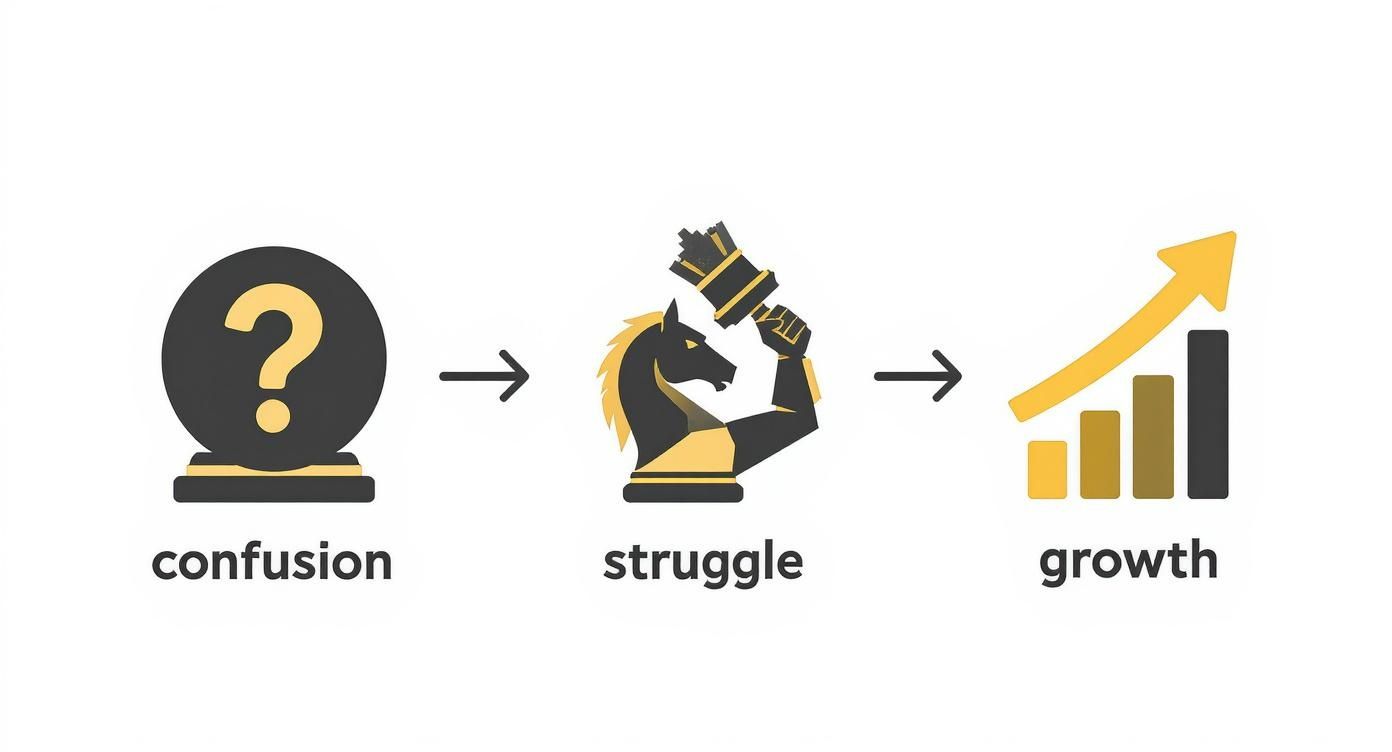
This shows that feeling stuck isn't the end. It's a key part of becoming a stronger chess player.
Finding Your Best Moves
Okay, you have a good idea of what's going on. Now it's time to look for possible moves. But you can't check every single one—that would take forever! Instead, we focus on candidate moves: the moves that are most likely to be the right answer.
Here are the most important ones to look for:
- Checks: Forcing moves are the best! A check makes your opponent's choices very limited, which makes your job easier. Always look for every possible check, even if it seems like a weird one.
- Captures: Taking one of your opponent's pieces is another great move. Look for all the captures you can make, starting with the most valuable pieces (like taking a queen or a rook).
- Threats: What if you can't check or capture anything? Then you look for big threats. This could be a move that attacks a major piece, sets up a checkmate, or creates a fork.
By focusing only on checks, captures, and big threats, you ignore all the boring moves. This simple system helps you use your brainpower on the moves that are most likely to be the right answer in a hard puzzle.
Thinking One Move at a Time
Now that you have a short list of moves, it's time to think them through. This is where a lot of players get confused. The secret is to be calm and organized. Pick one move from your list and think about it completely before moving to the next one.
Let's say your first move is a rook check. Imagine that move in your head. Now, ask yourself, "What is my opponent's best move?" Look at all the ways they can get out of check. For each of their replies, figure out what your next best move would be.
This creates a little "tree" of possibilities in your mind. It might look like this:
- I check with my rook.
- My opponent can move their king to square A. If they do, I can checkmate with my queen.
- Or, they can block with their bishop on square B. If they do that, I can just take the bishop.
You have to do this for each of your candidate moves. This organized way of thinking is what separates guessing from really analyzing. If you want to get better at this, I've shared more tips on how to improve your chess calculation in this detailed guide.
This careful, step-by-step method stops you from jumping between ideas and getting mixed up. If one move doesn't lead to a clear win, put it aside in your mind and move on to the next one on your list. Sooner or later, you'll find the one that works! This is the most important skill for solving any hard puzzle.
Learning to See Winning Patterns
Great chess players seem to have a special power. They don't just calculate moves like a computer; they see ideas almost right away. They get this skill from recognizing winning patterns, and the best way to practice that is by solving lots of chess puzzles hard enough to make you think.
This isn't about memorizing thousands of positions. It's about building a collection of cool tricks in your mind—like a toolbox you can use in your own games. Once you've seen a pattern enough times in puzzles, you'll start to spot it easily in a real game.
Let's look at some of the most common—and awesome—patterns you'll find. More importantly, we'll look at the clues that tell you a certain trick might be hiding in the position.
The Classic Smothered Mate
The smothered mate is one of the coolest checkmates in chess. It's when a knight delivers the final check to a king that is completely blocked in by its own pieces. It’s a classic pattern that shows up a lot in puzzles.
What are the signs to look for?
- A Trapped King: The enemy king is stuck, usually in a corner, surrounded by its own pawns and pieces with nowhere to go.
- An Attacking Knight: You have a knight that is close enough to give the final check.
- A Queen Sacrifice: Often, you have to sacrifice your queen to force the king into the corner and make a path for your knight.
For example, imagine your opponent's king is on h8, with its own pawns on h7 and g7. You might be able to sacrifice your queen on g8. Their rook has to take it, the king is now trapped, and your knight jumps to f7 for an amazing checkmate!
Removing the Defender
This is a really powerful and common idea. The logic is simple: if one of your opponent’s pieces is defending something important, you just get rid of it. That "something important" could be a key square, another piece, or the king.
When you solve puzzles, always look for pieces that are doing two jobs at once. A bishop might be protecting a rook and also stopping your knight from jumping to a great square. If you can trade for that busy bishop, their whole defense could fall apart.
A key defender is like the one leg holding up a wobbly table. Kick that leg out, and everything crashes. This is the simple but powerful idea behind removing the defender.
Solving puzzles with this theme teaches you to see the secret connections between your opponent's pieces. You start to see not just where the pieces are, but what jobs they are doing. This skill has a long history. In fact, chess puzzles in India go back to at least 1845 with the 'Indian Problem,' a hard puzzle that made players think many moves ahead—just like you need to do to spot ideas like removing the defender. You can learn more about this neat piece of chess history and the Indian Problem.
The Surprising Quiet Move
Not every winning move is a check or a capture. Sometimes, the strongest move is a quiet one—a small move that doesn't capture or check but gets ready for a huge threat. These are often the hardest moves to find, and they're what makes many chess puzzles hard.
A great quiet move often creates zugzwang, a situation where any move your opponent makes just makes things worse for them. Imagine slowly pushing a pawn forward. It looks harmless, but you know that in two moves it will create a checkmate threat they can't stop.
How can you spot these sneaky moves?
- The position feels tense: All the obvious checks and captures don't seem to work.
- Your opponent has few moves: Their pieces are all tangled up and they're running out of good options.
- You can create a new threat: Look for a move that sets up a new attack that they won't be able to stop on their next turn.
Building Your Mental Library
The real reason to solve puzzles isn't just to get them right. It's to learn the pattern so well that it becomes automatic—part of your chess gut feeling.
Here’s a simple way to make that happen:
- Solve the Puzzle: Try your best to find the answer.
- Check the Answer: Whether you were right or wrong, always play through the correct moves to understand the idea.
- Name the Pattern: Give the trick a name, like "smothered mate" or "deflection." Naming it helps you remember it.
- Save the Puzzle: Most puzzle websites let you save puzzles. Make folders for different patterns.
By looking at the puzzles you've solved again and again, you are building your own library of patterns. This is what turns slow thinking into seeing the answer right away, making you a faster and more confident player.
How to Create a Simple Weekly Training Plan
Just doing puzzles whenever you feel like it is fun, but it won't make you a lot better. If you really want to improve, you need a simple, organized plan.
Think of it like a workout schedule for the gym—some days you lift heavy weights, other days you do cardio. It’s the same with chess. Mixing different types of hard puzzles keeps things interesting and makes sure you're training all your brain muscles.
A good plan practices all the important puzzle skills. One day you might spend time thinking really hard about a few super tough puzzles. The next, you could be racing the clock to practice thinking fast. This mix is the secret to getting better in a balanced way.
You don't need to practice for hours every day. Even just 20-30 minutes of focused puzzle training can make a huge difference over a few months. A good routine keeps you on track and lets you see your progress.
Building Your Weekly Schedule
Making a schedule doesn't have to be a huge deal. The main idea is to give each practice day a theme. This tells your brain what to focus on, whether it's thinking deep, spotting patterns, or just being fast.
Here’s a simple plan you can change to fit your own life and goals:
- Monday & Thursday (Deep Thinking Days): These are your days for slow, careful thinking. Pick just 3-5 really tough puzzles. Take your time, don't use hints, and think through every move until you're sure you have the answer. The goal here is to be 100% correct, not fast.
- Tuesday & Friday (Speed Days): On these days, it's all about timed practice. Go on a site with a puzzle rush or puzzle storm feature. The goal is simple: solve as many puzzles as you can in a set time, like 5 or 10 minutes. This sharpens your gut feelings for tactics and helps you spot easy patterns quickly.
- Wednesday (Review and Rest): Time to learn from your mistakes. Go back to the puzzles you got wrong on Monday. Try to figure out exactly where you messed up. Did you miss a key move? Did you stop thinking too soon? Looking at your mistakes is super important for learning. Or, you can just take a break and let your mind rest.
This is just an example, of course. You can move the days around however you want. The only thing that really matters is that you stick with it.
A Sample Weekly Puzzle Plan
Here's a balanced schedule to work on different puzzle skills all week.
| Day | Main Goal | Time |
|---|---|---|
| Monday | Deep Thinking | 20-30 minutes |
| Tuesday | Timed Practice | 15-20 minutes |
| Wednesday | Review Mistakes / Rest | 15 minutes or 0 |
| Thursday | Deep Thinking | 20-30 minutes |
| Friday | Timed Practice | 15-20 minutes |
| Saturday | Play Real Games | 1-2 hours |
| Sunday | Rest and Relax | 0 minutes |
This schedule makes sure you're not just doing one type of puzzle but are building a good all-around tactical eye.
Being consistent is better than being intense. Solving a few puzzles every day is way better than trying to do them all for five hours once a week. It’s the daily habit that builds the brainpower you need to solve hard chess puzzles.
Finding Good Puzzles and Tracking Your Progress
So, where do you find all these puzzles? Luckily, we have lots of choices. Websites like Lichess and Chess.com have huge collections of puzzles for every skill level. They even let you search for puzzles by theme, which is great for practicing things you're not good at, like forks or pins.
To make sure your plan is working, you need to track your progress. The easiest way is to watch your puzzle rating on whatever site you use. If it's going up over time, you're doing great!
Another good idea is to keep a simple journal. Write down the puzzles that were really hard for you. Over time, you’ll start to see patterns in your mistakes, which tells you exactly what you need to work on. For a more detailed plan, check out this guide on building a complete chess training plan for rapid improvement. And for more ideas on how to structure your learning, this article on creating an effective training program is also really helpful.
Remember, any plan is just a guide. If you’re feeling tired, take a day off. If you’re feeling extra smart, maybe do a few more puzzles. The best plan is always the one you can actually stick to.
Using Your Puzzle Skills to Win Real Games
Solving a tough puzzle feels awesome, but let's be real—the best part is using those skills to win an actual game. All that hard work you're putting into solving chess puzzles hard enough to challenge you is supposed to help you when you play. It's all about taking that focused "puzzle mode" and using it in your real games.
The skills you're building, like thinking a few moves ahead and spotting hidden patterns, are exactly what you need when the clock is ticking. Think of it this way: every chess game is just a bunch of puzzles waiting to be solved. Your opponent creates a problem, and you have to find the best answer.
The trick is learning how to turn on that puzzle-solving part of your brain when a real person is sitting across from you. Let’s talk about how to do that.
Spotting Tricks in a Real Game
In a puzzle, you know there's a great move hiding somewhere. This makes you look for it. The biggest challenge in a real game is noticing when a chance for a cool trick suddenly appears.
Your opponent might make a small mistake, a move that looks fine but actually creates a secret weakness. Because you've trained your brain with tough puzzles, you'll be much better at sensing these moments.
To get better at this, try to think like a puzzle-solver during your games. After every single move your opponent makes, ask yourself a simple question: "What did that move change, and are there any checks, captures, or threats now?"
This simple habit makes you always look for the same kinds of chances you look for in puzzles. It's like putting on your special tactic-spotting glasses before you make your own move.
From Puzzle Mode to Game Mode
It’s easy to think hard about a puzzle when there's no time limit. In a real game, that ticking clock adds a lot of stress. You can't spend twenty minutes on one move, so you have to be smart about when to go into "puzzle mode."
Here are a few signs that a position might be worth looking at more closely:
- Loose Pieces: When your opponent has pieces that aren't defended, tricks are often nearby.
- King Safety Problems: If your opponent's king looks unsafe, it's a huge sign that a cool combination might be possible.
- A Fight in the Center: When both players are fighting for control of the middle of the board, there are often chances for clever moves.
When you see one of these things, that’s your signal to slow down and start thinking just like you would with a hard puzzle.
Being able to see the moment a game changes from a quiet, strategic game into a sharp, tactical puzzle is what makes a player great. This is the skill you are building with every hard puzzle you solve.
Managing Your Clock Like a Pro
One of the best things about puzzle training is that you get much faster at thinking ahead. Still, you need to manage your time well. In a game, you have to decide how much time a position is really worth.
A good rule is to spend more time on critical moments. A critical moment is a point in the game where your decision will have a huge effect on the result. This is often when the game becomes sharp and full of tactics.
When you think a critical moment has arrived, it's okay to use a good chunk of your time. Don't be afraid to spend five or even ten minutes to make sure you get it right. Your puzzle practice has prepared you for this. You've trained your brain to handle tricky situations, so trust your skills and give yourself the time you need.
The Confidence to Find Winning Moves
In the end, solving hard chess puzzles builds confidence. You prove to yourself over and over that you can figure out complicated positions and find the right move. This confidence is a powerful weapon in a real game.
When you're in a tough spot, you won't panic. Instead, you'll remember all the puzzles you've solved and trust that there is probably a good move to be found. You’ll be more likely to see your opponent’s mistakes and jump on the winning move they missed.
This mental strength is what connects your puzzle skills to your results in real games. Your hard work pays off not just in a higher puzzle rating, but in more checkmates, more wins, and the awesome feeling of playing a great game.
Answering Your Questions About Hard Chess Puzzles
Once you start trying to solve really tough chess puzzles, you're going to have some questions. It's totally normal to feel a little unsure or wonder if you're doing things right. Let's go over some of the most common questions players have.
Getting these answers will help you stay motivated and make sure you're using your practice time well.
How Many Hard Puzzles Should I Solve Daily?
This is a big one, and the answer is probably less than you think. When it comes to hard puzzles, quality is much better than quantity. The goal isn't to fly through dozens of them.
A good place to start is to aim for just 3 to 5 hard puzzles a day. The trick is to give each one your full attention. You’ll learn a lot more by spending time thinking hard and understanding the ideas in a few puzzles than by rushing through twenty just to see the green checkmark.
What if I Get a Puzzle Wrong?
Getting a puzzle wrong isn't a failure—it's a huge chance to learn something. The worst thing you can do is get frustrated and click "next puzzle." Instead, take a minute to figure out what really happened.
When you miss one, here's what to do:
- Look at the Whole Answer: Don't just look at the first right move. Play through the entire winning combination to see how it works.
- Compare It to Your Move: Why didn't your idea work? Did your opponent have a sneaky defensive move that you missed? Finding your mistake is how you really learn.
- Name the Pattern: Try to give a name to the trick you missed. Was it a deflection? A quiet move? A zwischenzug (an in-between move)? Naming it helps you remember it for your next game.
Think of every wrong puzzle as a chance to add a new trick to your toolbox.
How Do I Know If a Puzzle Is Just Too Hard for Me?
It’s important to challenge yourself, but you also don't want to spend an hour on one puzzle and feel totally defeated. A good idea is to set a rough time limit, maybe around 10-15 minutes for one really tough puzzle.
If you’ve tried your best in that time and are still completely stuck, it’s okay to look at the answer. The puzzle might use a pattern or an idea you’ve just never seen before. Just make sure you study the answer so you can learn the lesson.
There's no shame in not solving a puzzle. The real goal is to understand the answer so well that if a similar position ever shows up in a game, you'll know exactly what to do.
How Fast Should I Be Solving These?
With hard puzzles, speed isn’t the main goal. Being right and understanding the idea is what matters. That said, how fast you solve them shows how quickly you can spot patterns, a skill that only gets better with regular practice.
Some players can get incredibly fast. For example, a young chess player from India named Devansh Nara set a world record by solving 175 checkmate puzzles in just 1 minute and 43 seconds. Things like that show the kind of quick thinking that comes from thousands of hours of practice.
You can watch his amazing puzzle-solving achievement on YouTube. While you don’t need to try for a world record, it’s a cool example of how practice builds speed.
So, don't worry about the clock when you're starting. Focus on finding the right moves and understanding why they work. You'll naturally get faster as your brain learns more patterns.