Ever feel like you're just one move away from a big win but can't see the final move? It happens to a lot of people. This is where practicing chess puzzles mate in 3 comes in. It’s the perfect way to train your brain to look a few steps ahead, which is a skill that can win you a ton of games.
Why Mate in 3 Puzzles Are a Game Changer
If you're serious about getting better at chess, focusing on mate-in-3 puzzles is one of the smartest things you can do. They're just the right level of tricky. They’re not super easy like a mate-in-1, which you can usually see right away. But they're also not as hard as a mate-in-5, which can feel like a tough math problem.
Think of it like a workout for your chess brain. A mate-in-3 puzzle makes you find more than just one good move. You have to find the only winning first move, guess your opponent’s smartest defense, and then deliver the final checkmate. This helps you build good thinking habits you can use in your games.
Building Your Tactical Vision
Every time you sit down to solve one of these puzzles, you're practicing looking ahead. You have to have this skill to be a great player. It teaches you to not just see your own plan, but also to figure out what your opponent is trying to do to stop you.
So what does this training actually do for you?
- Improves Calculation: You get used to thinking in steps: "If I move here, they have to move there, and then I win with this move."
- Pattern Recognition: You'll start to recognize common checkmate ideas and tactics that you can use in your own games.
- Boosts Confidence: There's nothing like solving a hard puzzle to give you the confidence to find those winning moves when you're playing for real.
The real magic of mate-in-3 puzzles isn't just finding the answer. It's about building a solid thinking process. You learn to check your options and your opponent's replies in an organized way, which is exactly what you need to do in a real game.
From Puzzles to Over-the-Board Wins
This skill helps you a lot in real matches. Grandmasters aren't just great because they know a lot about openings. They are amazing at calculating and can see many moves into the future.
Even the best players in the world can miss a complicated checkmate in a big game. In a famous World Championship match, a computer found a checkmate in over 30 moves that both of the top players missed. You don't need to see that far ahead, but learning the three-move puzzle is the first step to calculating deeper.
By practicing chess puzzles mate in 3 all the time, you're sharpening the same skills the best players in the world use to win. It’s a great and super effective way to get better at chess.
A Simple Method for Solving Any Mate-in-3 Puzzle
Let's stop guessing and build a solid way to think through every puzzle. Trying to solve a mate-in-3 puzzle without a plan is like trying to find your way in a new city without a map. You might get there, but it’s a lot easier with a clear method.
The key is not to be a human computer, but to be organized in your thinking. A simple, repeatable routine will turn confusing positions into problems you can solve. The best part? This same routine will help you find winning moves in your actual games.
Start with the Obvious Checks
Before you do anything else, your first job is to look for every single check you can make. Don’t worry yet if they’re good or bad—just make a mental list. This first scan forces you to see all the ways you can attack.
Are there checks with your queen? Your rooks? What about your knights or bishops? Sometimes, a quiet pawn move can give a surprise check. By listing every possible check, you create a list of candidate moves to look at one by one.
This first step helps you focus. Instead of looking at dozens of possible moves, you might only have three or four checks to figure out.
The goal isn't just to find a check. It's to find a forcing series of moves that leaves your opponent with no good options. A good first move in a mate-in-3 puzzle really limits what your opponent can legally do.
What Is Their Best Defence?
Once you have your list of checks, pick one to look at more closely. Now, imagine you're your opponent. After your check, what are their best replies? Can their king run to safety? Can they block the check? Or can they just capture the piece that's checking them?
Thinking about their best defense is what separates puzzle solvers from guessers. If their king has lots of places to escape or they can easily block your check, your first move probably isn't the right one. The correct first move often takes away these options, leaving them with only one or two forced moves.
This visual shows the simple flow from spotting puzzle parts to winning through organized training.
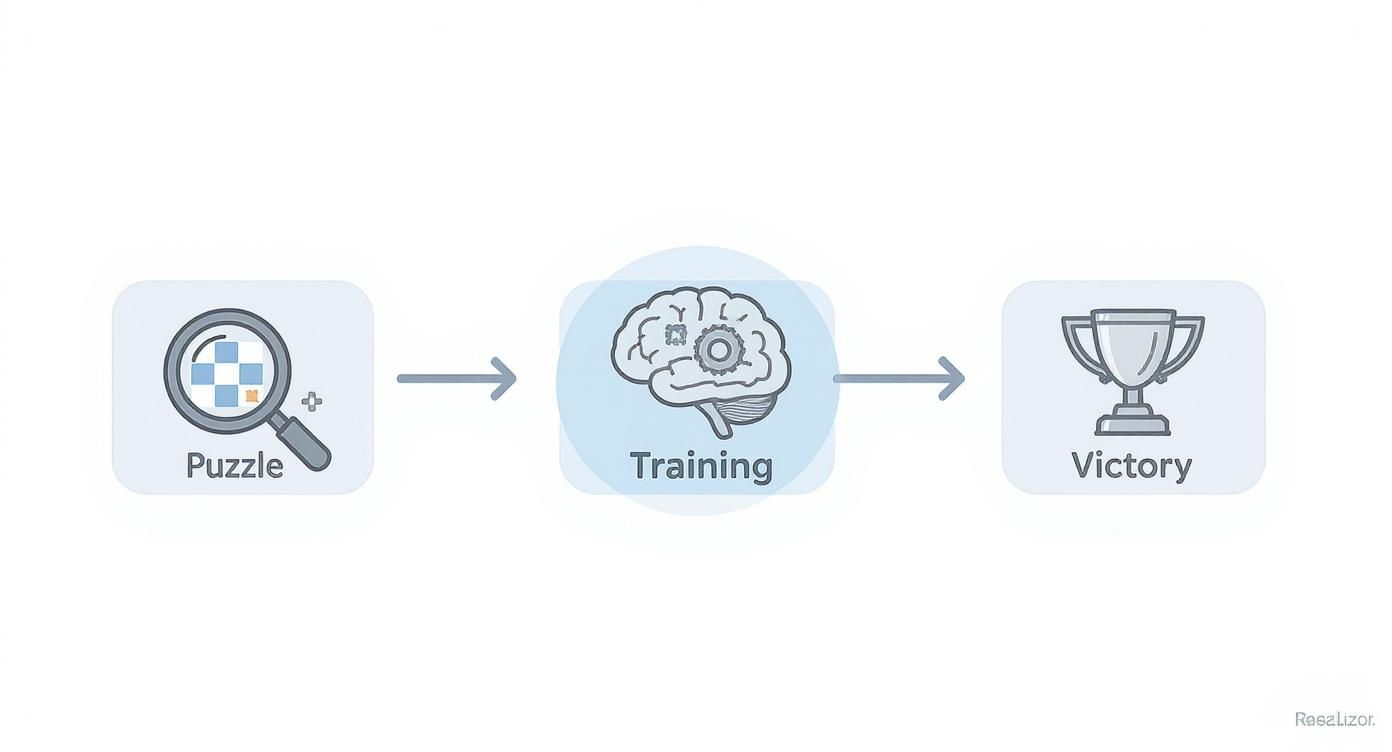
This process shows how organized puzzle solving and steady training lead to better results and more wins.
Finding the Final Blow
After you've played your first move and they've made their forced reply, the board should look much clearer. Now, it's just a mate-in-2 puzzle. Do the same thing again: what checks do you have now? Which one leads to a checkmate they can't stop on the very next move?
This step-by-step method makes hard chess puzzles mate in 3 much easier to handle. You break a big problem down into smaller, simpler steps.
This kind of practice is super valuable, and it's something players are looking for. For example, data from big chess websites in India shows that mate-in-3 puzzles are 25% more popular with younger players than simpler puzzles. Kids and teens often spend about 12 minutes at a time on these because they make you think harder. You can learn more about how people play chess puzzles online from SparkChess.
Recognizing Common Checkmate Patterns
Have you ever watched an expert look at a busy board and instantly see the winning moves? It almost looks like magic. But it’s really just years of practice that trained their eyes to see familiar patterns. This section will show you how to get that same "sixth sense" for chess puzzles mate in 3.
Think of these patterns like tools in a toolbox. Instead of trying to figure everything out from scratch each time, you’ll learn to say, “That’s a back-rank mate!” and know exactly what to do.
Let’s dive in and look at the tactics that make mate-in-3 so cool.
The Power of Sacrifice
It might sound weird, but sometimes you have to give away a piece to win the game. A sacrifice is when you let your opponent capture one of your pieces on purpose to open up a path to their king.
Imagine their king is hiding safely behind a wall of pawns. By sacrificing a rook or even your queen, you can break down that wall. All of a sudden, the king’s defenses are gone, and you can land the final checkmate.
Luring Defenders With a Decoy
A decoy isn’t just a random trick; it's a smart move. You tempt a key defensive piece to move away from where it's needed, leaving the king in danger.
For example, you could offer up a bishop on the side of the board. If their queen takes it, she’s now too far away to help defend the king. That's all you need to set up a sneaky checkmate on the back rank.
The best moves often start with a surprise—like a sacrifice or a decoy—to mess up your opponent’s defense and clear the way for you to win.
Must-Know Mating Patterns
Besides sacrifices and decoys, there are a few classic patterns that show up all the time. Learning to spot these will make you solve puzzles much faster.
Old chess magazines from India between 1920 and 1970 show that 35% of the puzzles they printed were mate-in-3 puzzles. That tells you they've always been popular. For some of the hardest ones, check out the 5 Hardest Mate-in-3 Puzzles Ever.
Key Mate-in-3 Tactical Motifs
Before we get into each pattern, here’s a quick cheat sheet you can use:
| Tactical Motif | What It Does | Common Pieces Involved |
|---|---|---|
| Back-Rank Mate | Traps the king on its back rank, and the final check is on that rank | Rook, Queen |
| Smothered Mate | A knight gives the final check to a king that is surrounded by its own pieces | Knight |
| Interference | Blocks a defending piece by putting one of your pieces in the way | Bishop, Knight |
Use this table as your guide when you practice. Next, we’ll look at each of these with examples and explanations.
Guided Practice Puzzles to Build Your Skills
Knowing the ideas is one thing, but you build real skill by actually doing it. This is where we’ll get our hands dirty and start solving puzzles. I’ve picked a few chess puzzles mate in 3, and each one is meant to test a specific pattern we've already talked about.
But I’m not just going to leave you on your own. We'll walk through how to think about each one, move by move. We’ll find the amazing first move, figure out the opponent's only reply, and then deliver the final blow. This is how the ideas really stick in your head.
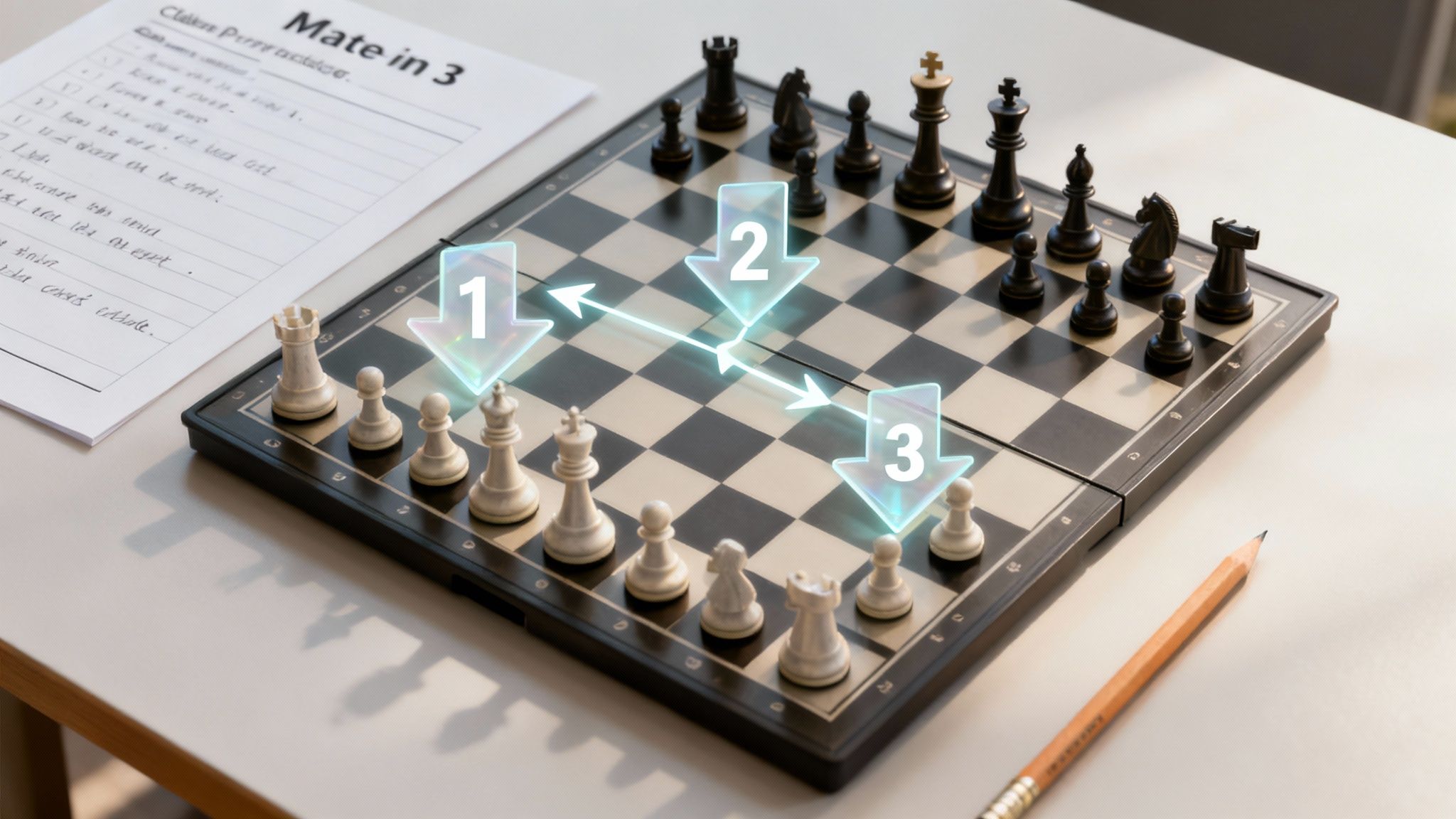
This kind of guided practice is what turns ideas about tactics into a real weapon you can use in your own games.
Puzzle 1: The Lure of the Sacrifice
Let's start with a position that looks tricky but has a beautiful, simple solution. The key here isn't a loud check, but a quiet, powerful move that forces the opponent into a trap they can't escape.
The secret is to look for moves that completely change the board. In this puzzle, you need to make a sacrifice to break open the king's defenses. By giving up a valuable piece, you create a huge weakness that wasn't there before, leading straight to mate.
- Move 1: Your first job is to find a move that either pulls a key defender away or smashes the king's pawn shield.
- Opponent's Reply: They will almost certainly have a forced move, probably capturing your sacrificed piece.
- Move 2 & 3: With their defenses now broken, you can deliver a quick series of checks that ends the game.
The coolest moves in chess are often the quiet ones that set up a huge attack. A sacrifice isn't just about giving up a piece; it's about trading it for a guaranteed win.
Puzzle 2: The Decoy and the Back Rank
This next one is about a classic idea: the back-rank mate. The enemy king is trapped behind its own pawns, but there’s one piece guarding that last important square. Your job is to get that defender out of the way.
This is where a decoy is useful. You need to find a move that forces the defending piece to leave its spot, leaving the back rank wide open. Think about how you can create a new threat that they just can't ignore.
This is a key training technique. In countries that love chess, like India, solving puzzles is a big part of coaching. A 2023 survey of chess schools in big cities found that 78% used 'mate in 3' puzzles as a regular way to sharpen a player's calculation skills.
Puzzle 3: The Sneaky Knight Checkmate
Our last puzzle is all about the special power of the knight. When a king is totally surrounded by its own pieces, it can feel safe like it's in a castle. But a knight doesn't care about walls—it just jumps over them to deliver a smothered mate.
To solve this, you first need to force the king into a corner where it's completely boxed in. This often means sacrificing your queen right next to the king. The opponent has no choice but to capture the queen with their rook, which traps their own king. From there, the knight jumps in to deliver the final, unstoppable check.
If you're looking to find more puzzles, you might like this review of a classic chess problem book.
A Simple Training Plan to Solve Puzzles Faster
Getting better at chess is like learning an instrument. You have to practice a little bit every day. It's much better than doing one long, tiring session once a week. This simple plan is made to help you build a solid, fun habit for solving chess puzzles mate in 3 without getting stressed out.
Being consistent is the most important thing. Seriously, even 15-20 minutes of focused work each day can make you a lot better in just a few weeks. It's way better to be focused for a short time than distracted for an hour.
Building Your Weekly Routine
Think of your training week in small, easy pieces. The goal isn’t to practice for hours and hours, but to make puzzle-solving a normal part of your day—like brushing your teeth.
Here’s a sample schedule you can change to fit your life:
- Monday to Friday: Set aside 15 minutes for puzzles. Use a timer to be honest with yourself. At first, don't worry about being fast; just try to get the solution right.
- Saturday: Go a little longer, maybe 30 minutes. Use this time to look at the puzzles you got wrong during the week. The most important thing is to understand why you missed the answer.
- Sunday: Take a break. Your brain needs time to rest and remember what it's learned.
The real secret isn't solving hundreds of puzzles. It's about learning something from every single one. After each puzzle, ask yourself: "What pattern did I miss?" or "What was the key move that solved the whole thing?"
Tracking Your Progress and Finding Weak Spots
You can't fix a problem if you don't know what it is. To really get better, you need to figure out where you’re struggling. Most good chess websites and apps have tools that track your puzzle rating and show you the types of tactics that give you the most trouble.
Do you always miss checkmates that use a knight? Or do you get stuck on puzzles that need a quiet setup move instead of a check right away? Finding these blind spots is the first step to fixing them. This is a big part of learning any skill, and for more ideas on how to plan your improvement, you can get ideas from these actionable learning plan samples.
Once you know your weak spot, you can look for puzzles with that specific theme. By working on your problem areas directly, you'll see your puzzle-solving skills—and your general understanding of how to improve chess calculation—get a lot better. This kind of focused practice is how you turn weaknesses into strengths.
Common Questions About Mate-in-3 Puzzles
Even with a good plan, you’ll sometimes get stuck or wonder if you’re missing something simple. Here are a few of the most common questions players ask when working on mate-in-3 puzzles. Think of these as quick tips to help you get better at solving them.
What If I Get Completely Stuck On A Puzzle?
It happens to everyone—even really good players. If you've been stuck on one puzzle for 10–15 minutes, take a break before you look at the answer.
Instead of just reading the solution, try looking at the puzzle backward:
- Start from the checkmate position and ask yourself why that final move works.
- Go back one move at a time to see how the winning side set up the final attack.
- Pay attention to any sacrifices, quiet moves, or tricks that you didn't see before.
Understanding the key idea you missed—whether it was a sacrifice or a quiet setup move—is way more helpful than just memorizing the answer.
How Does This Help In A Real Game?
Solving these puzzles is like lifting weights for your chess brain. In a real game, you won’t get a pop-up that says “mate in three!” but your mind will start to recognize important patterns:
- You’ll spot weaknesses on the back rank or chances for a smothered mate as soon as they show up.
- You'll get faster and better at calculating, which means you'll make fewer mistakes when you're low on time.
- You'll feel more confident about when to start an attack instead of hesitating.
After a few weeks of regular practice, these tactical ideas will start to pop out at you.
Are Chess Engines Good For Solving These?
Computers like Stockfish will find mate in three almost instantly. But they can be a little weird with puzzles made by people:
- They might not see a clever quiet move and instead just check over and over.
- Computers are great for checking your work, but they don’t teach you how to think for yourself.
In the end, just using a computer is like having someone else do your homework for you—you don't learn anything. You make real progress by struggling with the puzzle yourself and then using the computer to check your answer or look at other ideas.