Ever played a great game, but then you miss the final move that would have won? We’ve all been there. It's a super frustrating feeling, but luckily, there’s an easy fix: practicing Lichess puzzles mate in 1. Think of them like push-ups for your chess brain. They help you remember checkmate patterns so you don't miss them in real games.
Why Mate In 1 Puzzles Are Your Best Chess Workout
Solving these simple puzzles is one of the fastest ways to get better at chess. The reason is simple: they build a skill called pattern recognition. This is when your brain sees a setup on the board and just knows the right move, almost without thinking.
When you practice mate in 1 puzzles, you're basically building a library of checkmates in your head. You see common winning moves over and over, like back-rank mates or a classic queen and knight team-up. Soon, spotting these patterns becomes super easy.
Building Your Tactical Vision
This isn't just about memorizing. It’s about training your eyes to always look for threats and chances to win. Every puzzle you solve makes your tactical vision sharper and helps you see the whole board better.
This skill is the foundation for harder tactics. You can't find a mate in three if you can't even see the final mate in one. Working on these basic checkmates is a direct way to get better at planning longer move sequences, which is a big part of learning https://nikhildixit.com/how-to-improve-chess-calculation/.
By focusing on the final, winning move, you train your mind to always look for the knockout punch. It changes your thinking from just making moves to actively looking for the win.
A Proven Training Method
There’s a reason this training method is so popular with coaches and strong players—it just works. Chess teachers often use Lichess puzzles to show students basic mating moves. You'll even find YouTubers who make videos of tons of different mate in 1 puzzles from Lichess, showing all the different patterns you can learn.
This focused practice gives you a huge advantage. Instead of feeling lost in a complicated position, you'll start to see a clear path to winning.
- Boosts your confidence: You'll feel less pressure when you know how to win a game that you're ahead in.
- Improves your speed: You'll find winning moves much faster, especially in quick games like blitz and rapid.
- Makes chess more fun: Let's be real, there’s no better feeling than delivering a clean checkmate!
Just a few minutes a day with Lichess mate in 1 puzzles can make a huge difference. It's a simple, effective workout that builds the core skills you need to win more games.
How To Find Mate In 1 Puzzles On Lichess
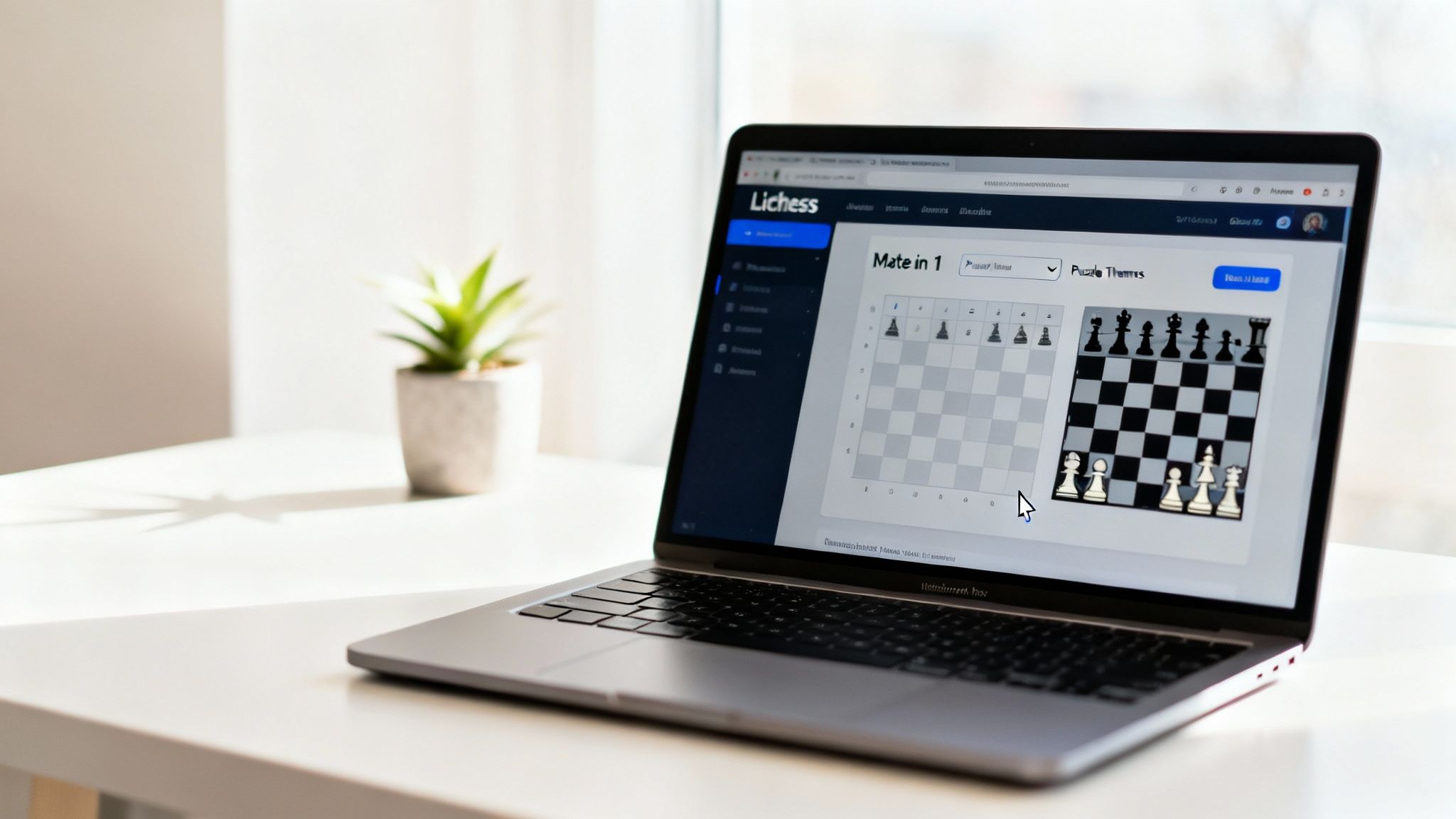
With millions of puzzles, jumping into Lichess can feel like trying to find a specific book in a giant library. But don't worry, the site has awesome filtering tools that let us find the exact skills we want to practice. For this workout, our goal is to get a non-stop stream of lichess puzzles mate in 1.
Getting there is pretty easy. From the Lichess homepage, go to the "Puzzles" section. You can usually find this under the "Learn" tab in the main menu. This takes you to your puzzle dashboard, where you can do random puzzles or start our special training.
Filtering For Mate In 1
This is where the magic happens. To get to the good stuff, you need to open the puzzle filtering options. Look for a button that says "Puzzle Themes" or a little filter icon—this is your control center for practice. Clicking it will show you a menu with dozens of tactical ideas.
The screenshot above gives you a peek at the huge list of "Puzzle Themes" you can choose from. Think of this as your personal toolkit for building specific chess muscles.
Once you're in the themes menu, just scroll down the list and click on "Mate in 1". That's it. You’ve just told Lichess to only show you puzzles where a single move wins the game. You've now made your own custom training session.
By filtering for a specific theme like "Mate in 1," you're not just solving random problems. You're building a specific skill through repetition, which is a much better way to improve your pattern recognition.
Fine-Tuning The Difficulty
Now that you have the "Mate in 1" theme selected, you can also change the difficulty to be just right for you. The "Puzzle Rating Range" setting gives you control over how tough the puzzles are.
- For Beginners: You might want to set a lower rating range to get used to the basic patterns. Get the hang of it first.
- For Stronger Players: You can raise the rating to challenge yourself with more complex and tricky checkmates.
This simple adjustment makes sure your training stays in that perfect spot—hard enough to be helpful, but not so hard that you get frustrated. And you can change it anytime as you get better.
Setting up a session for lichess puzzles mate in 1 takes less than a minute, but it gives you a powerful workout that will help you think faster and sharper in your real games.
Creating A Smart Puzzle Training Routine
Just doing random puzzles is fine for fun, but if you're serious about getting better, you need a plan. A smart training routine helps you practice with a purpose. It creates a structure that helps new patterns and ideas actually stick in your brain.
The goal isn't to practice for hours and hours. It's about being consistent and smart with your time. A little bit of focused practice every day adds up much faster than one long, messy session on a Saturday.
Warm-ups: Your Secret Weapon Before a Game
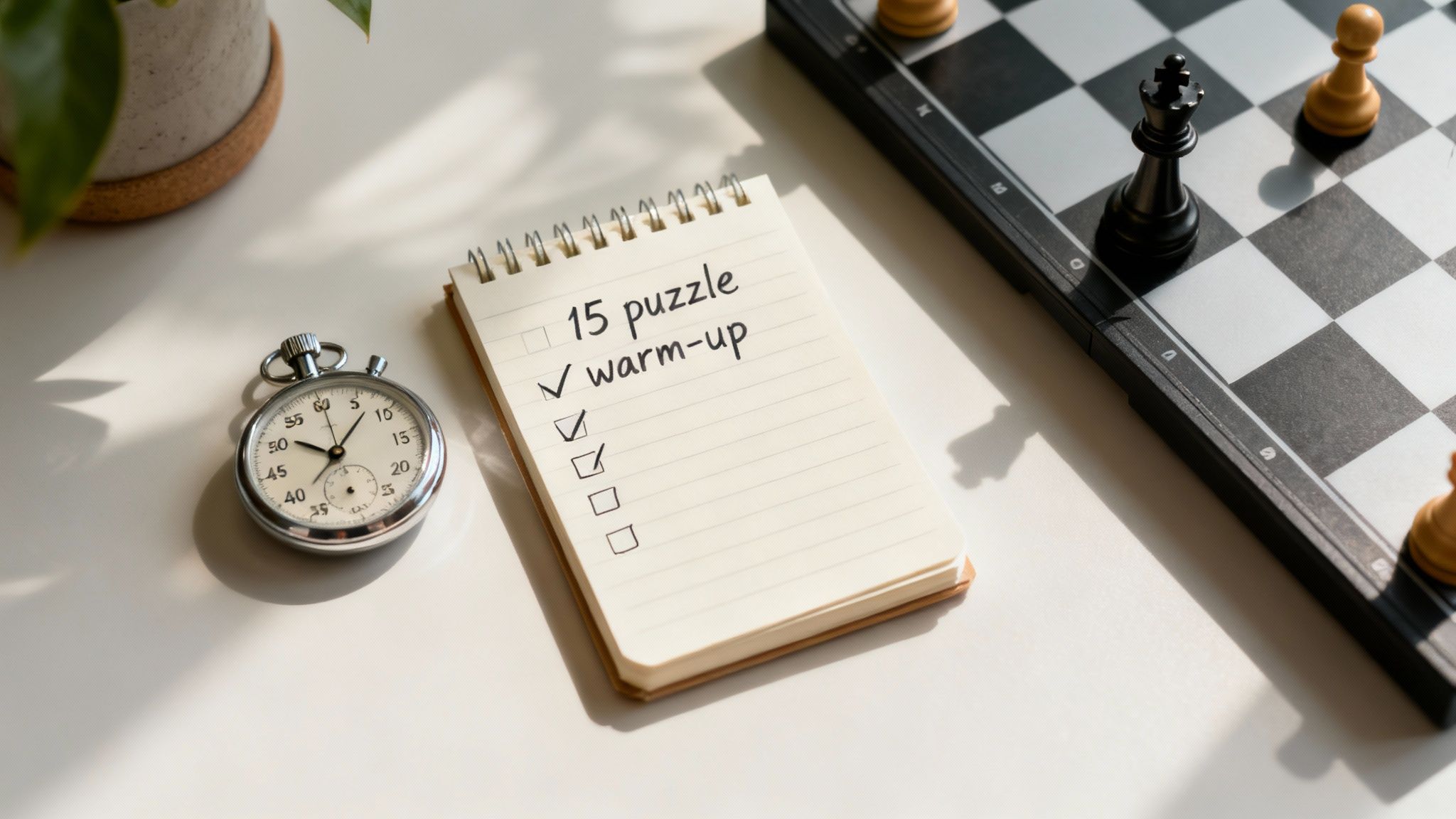
One of the best ways to use lichess puzzles mate in 1 is as a warm-up before a game. Before you click "play" on a rated game, take five or ten minutes to solve about 15 of these puzzles. This simple habit can really help you play better.
Think of it like stretching before you run. This quick drill flips the "chess switch" in your brain, sharpens your tactical eye, and gets you used to always looking for checkmates. You'll be surprised at how many more winning chances you spot in your games after a quick puzzle warm-up.
Different Ways to Drill Puzzles
Don't just solve puzzles the same way every day. Mixing up how you train keeps things interesting and helps you build a more complete set of skills. By challenging your brain in different ways, you force it to get better.
Here are a couple of good ways to practice:
- Timed Sessions: Set a five-minute timer and see how many mate in 1 puzzles you can solve correctly. This is great for building speed and making your brain decide quickly and correctly under pressure—just like in a real game.
- Pattern Drills: Instead of doing random puzzles, focus on one specific checkmating pattern. Lichess lets you filter puzzles by themes like "back-rank mate" or "smothered mate," which is perfect for burning those patterns into your long-term memory.
- Accuracy Focus: For this drill, forget the clock. Take your time on each puzzle and don't make a move until you are 100% sure it's the right one. This trains your mind to be precise and helps you avoid silly mistakes.
The key is consistency over how much you do. Solving 15 puzzles every day is way more powerful than doing 100 puzzles once a week. You're building a habit that slowly makes your tactical skills stronger over time.
Building a Simple Weekly Schedule
A plan can make all the difference. You don't need anything complicated. A basic schedule just keeps you on track and makes training a normal part of your routine. This is a main idea behind how to build a chess study routine that works and helps make sure you're covering all your bases.
Let's put these ideas together in a sample weekly plan. Feel free to change this to fit your own schedule and goals, but it’s a great place to start making lichess puzzles mate in 1 a key part of how you improve.
Your Weekly Mate In 1 Training Schedule
Use this sample plan to build a consistent puzzle-solving habit and improve your pattern recognition.
| Day | Activity | Goal |
|---|---|---|
| Mon/Wed | Timed Session (5 mins) | Improve your speed and quick pattern spotting. |
| Tue/Thu | Pattern Drill (e.g., Back-Rank Mates) | Deepen your knowledge of a specific pattern. |
| Fri | Accuracy Focus (15-20 Puzzles) | Train your mind for precise calculation. |
| Sat | Pre-Game Warm-up (Before playing) | Activate your tactical vision for game time. |
| Sun | Rest or Review Day | Let your brain rest or review tough puzzles. |
This kind of organized practice makes sure you're not just randomly clicking through problems. Instead, you're building the skills you need to finish games with confidence and deliver that final checkmate.
Where Lichess Puzzles Come From
Ever wonder where all the puzzles on Lichess come from? They aren't just made up by a grandmaster. The real process is way more interesting and comes from the millions of games played on the site every day.
A smart, computer system is always scanning these games, looking for important moments. It's looking for missed chances—especially when a player could have won but didn't see the move.
When the system finds a position where someone could have delivered a checkmate in one move but played something else, it flags that moment. That game position is then automatically turned into a lichess puzzles mate in 1 for the rest of us to solve.
This is a big deal. It means every puzzle you try is based on a real game situation. You aren't just practicing fake positions; you're working on the kind of messy, real situations that actually happen in games.
How The Puzzle Rating System Works
Just like you have a rating for playing games, each puzzle has a rating too. When you solve puzzles, you're basically playing a mini-game against the puzzle itself. It's a smart system made to keep you challenged just the right amount.
Here’s a quick look at how it works:
- You solve a puzzle: Your puzzle rating goes up, and the puzzle's rating goes down a little.
- You get a puzzle wrong: Your puzzle rating goes down, and the puzzle's rating goes up.
Lichess uses a system called Glicko-2 to manage this. It's really good at figuring out your skill level quickly and then giving you puzzles that are just right—not too easy, not too hard. This keeps you in that perfect learning zone where you feel challenged but not totally stuck.
This system changes as you get better. Think of it like a personal trainer who knows exactly when to add more weight to the bar, always pushing you to get stronger.
The Massive Puzzle Database
The number of puzzles is truly amazing. Lichess has one of the world's largest chess puzzle databases, with over 5.5 million rated puzzles. Thousands of these are tagged as lichess puzzles mate in 1, giving you a nearly endless supply for your training.
This huge collection was built by looking at over 600 million games. The powerful Stockfish chess engine double-checks every single position to make sure it's correct. You can learn more about how it's all put together on the official Lichess puzzle database page.
Doing puzzles every day is a great habit, but how can you know if you're actually getting better? It's like leveling up in a video game; you want to see your score go up! Luckily, Lichess has some great built-in tools that show you exactly how much progress you're making.
This information is your secret weapon. It tells you what you're good at and which areas need more practice. Let's look at where to find these stats and, more importantly, how to understand them.
Your Personal Puzzle Dashboard
Lichess keeps a detailed report card of your puzzle skills in the "Puzzle Dashboard." To get there, just go to the Puzzles section and click on the "Dashboard" tab. Think of this as your mission control for tracking progress on lichess puzzles mate in 1.
The first thing you’ll probably notice is the graph showing your puzzle rating over time. Watching that line go up is one of the best motivators. It’s solid proof that your hard work is paying off.
The Lichess Puzzle Dashboard gives you a clean summary of how you're doing, from your rating chart to your strengths in different tactical themes.

This screenshot shows how Lichess tracks which puzzle themes you are best at, helping you figure out what to work on next.
Don't worry if the line dips sometimes—everyone gets puzzles wrong. What really matters is the overall trend. Is it slowly climbing? If it is, you're doing something right.
Finding Your Strengths and Weaknesses
Besides the main graph, the dashboard has a "Learning" section that breaks down how you do on different puzzle themes. This part is super helpful. It shows you which types of checkmates you're spotting easily and which ones are still a bit tricky for you.
- Strongest themes: You might see something like "back-rank mate" at the top of your list. Great! That means you know that pattern really well.
- Weakest themes: On the other hand, maybe "smothered mate" is near the bottom. That's a clear sign to spend a little extra time practicing those specific puzzles.
This information helps you train smarter, not just harder. You can focus on the areas that will help you improve the most.
Knowing your stats isn't about judging yourself. It's about getting a clear map of your skills so you can plan your next move and keep getting better.
Simple Tips to Keep the Fun Going
Let's be honest, sometimes the hardest part is just sticking with it. Motivation can change, so it helps to have a few tricks to stay interested and turn puzzle training into a strong habit.
- Set tiny, easy goals. Forget about doing 100 puzzles a day. Just promise to do 10 puzzles every morning. It’s a small win that builds up over time.
- Challenge a friend. A little friendly competition can do a lot. See who can get a higher puzzle rating by the end of the week.
- Focus on learning, not just the rating. Your rating will go up and down. That's normal. Instead of worrying about the number, try to learn one new thing from every puzzle you get wrong.
- Reward yourself! Did you do your daily puzzles for a whole week? Treat yourself. Making it enjoyable is key to building a habit that lasts.
Your Lichess Puzzle Questions, Answered
Players often have the same few questions when they start doing puzzles on Lichess. Let’s answer those so you can get the most out of your training and turn that practice into real wins.
Are Lichess Mate In 1 Puzzles Good For Beginners?
Totally. In fact, they’re one of the best tools for new players. Why? Because they teach the most important skill in chess: how to win the game.
By focusing on just the final, winning move, you start to learn what checkmate looks and feels like. This builds a strong foundation of basic mating patterns without all the extra stuff from long, complicated tactics. It’s the perfect place to start.
How Many Mate In 1 Puzzles Should I Do Each Day?
This is where a lot of players go wrong. They think more is always better, but it's being consistent that really matters. A few puzzles every single day will do more for your memory and pattern recognition than doing a ton of them once a week.
Try to do around 15-20 puzzles a day. This usually only takes about five or ten minutes, which makes it a super easy habit to keep. It’s just enough to keep those patterns fresh in your mind and is a great mental warm-up before you play a game.
Getting stuck is just part of the process—don't let it get you down. The puzzle rating is only a guide; the real win is understanding the why behind each move.
What Should I Do If My Puzzle Rating Gets Stuck?
First, don't worry. Every single player hits a point where they feel stuck. That number isn't as important as what you're learning. The next time you get a puzzle wrong, don't just click to the next one. Take an extra moment to figure out why the right move worked and what you missed.
Sometimes, the best thing you can do is just take a day off and let your brain rest. You can also check out your puzzle dashboard on Lichess. It often shows you specific themes you're having trouble with, so you can focus your practice where you need it most.
Does Solving Mate In 1 Puzzles Help With Longer Tactics?
Yes, it really does, and this is a key point many players miss. Almost all long, complicated attacks come down to a simple checkmate pattern at the very end. Mastering these basic lichess puzzles mate in 1 is like learning the final chapter of a book first.
When you know the common checkmate patterns by heart, you get much better at seeing the final goal of a longer attack. You can see the target you’re aiming for, which makes planning the steps to get there way easier. It’s the skill that connects all your tactical ideas into a real, winning plan.