If you've been trying to get better at chess, you've probably heard this advice a lot: solve more puzzles. That's where a tool like Chess Tempo comes in. Think of it as a gym for your chess brain—a huge, smart puzzle book that makes every challenge just for you.
What Is Chess Tempo Online?
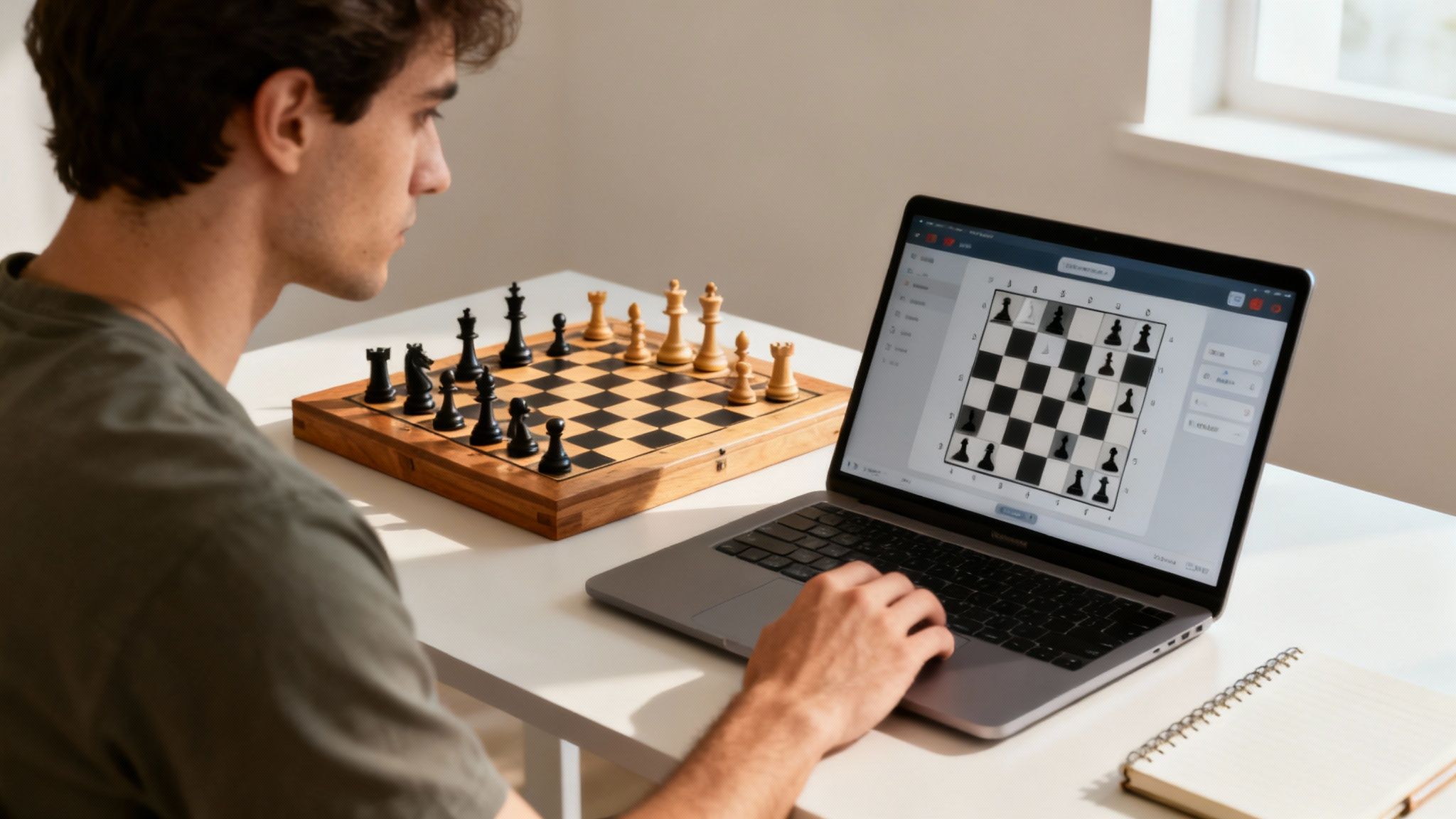
The picture above shows you the clean, simple look of the Chess Tempo website. It's made to get you right into training without having to figure out tricky menus.
The main idea behind Chess Tempo is simple but super strong: you get better at chess by doing chess. Instead of just reading books, you get thrown into the action, solving problems that are just the right level for you. It’s like a video game that gets harder right when you start to level up.
Doing this over and over is the secret to recognizing patterns. That's a fancy way of saying you're training your brain to see winning moves and avoid mistakes without even thinking. The more puzzles you solve, the more these patterns will feel natural in your real games.
A Gym for Your Chess Brain
The best way to think about Chess Tempo is like a gym for your mind. Just like you'd go to a gym to work on different muscles, this website has special exercises to make every part of your chess game stronger.
You can focus your training on:
- Tactics: These are the most common puzzles. You have to find a short series of moves that wins.
- Endgames: This is where you learn how to win when there are only a few pieces left on the board.
- Openings: You can practice and remember the best ways to start your games.
To give you a better idea, here’s a quick look at the main training tools on the site.
Chess Tempo Online Features at a Glance
| Feature | What It Helps You Improve | Best For |
|---|---|---|
| Tactics Trainer | Spotting patterns, thinking ahead, and finding winning moves. | All players, especially those who want to make fewer mistakes. |
| Endgame Trainer | Turning a winning position into a win and saving tough games. | Players who want to get better at the final part of the game. |
| Opening Trainer | Learning and remembering a good set of openings. | Players who want a strong start to their games. |
| Spaced Repetition | Remembering tactics and openings for a long time. | Anyone who is serious about making what they learn stick. |
| Problem Sets | Working on specific weaknesses like forks, pins, or discovered attacks. | Players who know what they need to work on. |
This focused training is why so many players make chess tempo online a part of their daily routine. It gives you a clear, organized way to fix your weaknesses and watch your rating go up.
It’s not just about solving puzzles without thinking. It's about building the mental muscle you need to see the board clearly when you're under pressure. Every puzzle you solve is like one more rep at the gym, making you stronger for your next match.
The site is super popular in India, where a big community of chess players uses it to get better at tactics. With a collection of over 100,000 tactical puzzles, it's not surprising that Indian users solve between 15,000 and 20,000 problems every single day. You can find more stats about the Chess Tempo community on apps.apple.com.
This kind of steady, hard work is exactly what helps players get good enough to compete at a much higher level.
Exploring the Core Training Features
Okay, let's look under the hood and see what makes a ChessTempo training session so good. Think of the website as a special gym for your brain, with each tool made to work a different chess "muscle."
The heart of the website is the Tactics Trainer. Imagine a coach who knows exactly how good you are and gives you a puzzle that’s not too hard, not too easy, but just right. That’s what this trainer does.
You're shown a position from a real game, and your job is to find the winning move. If you get it right, your rating goes up a little, and you get a slightly harder puzzle next. If you miss it, your rating dips, and the system gives you something a little easier. This smart adjustment always keeps you learning—you're challenged, but not crushed.
Mastering Tactics One Puzzle at a Time
The tactics trainer is where you really build up your pattern recognition. It teaches your brain to spot common winning ideas—like forks, pins, and discovered attacks—almost instantly. The more puzzles you do, the more natural it feels.
Here’s a look at the tactics screen. It’s clean and simple, with the board, timer, and your rating history all right there so you can focus on the puzzle.
The simple design is on purpose. It helps you focus on finding the winning move without any distractions. And seeing your rating chart go up over time is a great way to stay motivated.
But becoming a good player isn't just about finding cool moves. ChessTempo knows this, which is why it has special training for the other important parts of the game.
Beyond Tactics: Endgames and Openings
A sharp eye for tactics is great, but tons of games are won or lost in the final stages. That’s where the Endgame Trainer comes in. It gives you positions where only a few pieces are left on the board.
This is where you practice game-winning skills like:
- Turning an Advantage into a Win: Learning the step-by-step way to turn a small lead, like an extra pawn, into a full win.
- Defending Tough Positions: Finding the only moves that can save a game that looks totally lost.
- Learning Key Ideas: Getting a feel for important concepts like opposition and triangulation.
Seriously, getting good at the endgame can easily add 100-200 rating points to your score, mostly because it's something a lot of players ignore.
In the same way, how you start the game often decides how the rest of it will go. The Opening Trainer helps you build a solid set of openings you can trust. You can learn the main moves of your favorite openings and practice them until you know them by heart. This means you’ll start your games with confidence and a clear plan, avoiding those awful early mistakes.
The real magic of ChessTempo is how all these tools work together. You can sharpen your tactics, polish your endgame skills, and strengthen your openings—all on one website.
Finally, you can put it all together by playing full games against other people right on the site. This is the perfect way to use what you’ve been practicing in a real game. It connects the dots between practice and playing, helping you see real results. Each feature is just another block for building a stronger, better chess game.
Free Account Versus Premium Membership
So, the big question is, "Do I really need to pay for this?" The great thing about Chess Tempo is that you can get very far with the free account. For real, the free version is not just a little sample; it's a powerful tool.
But, if you want to get really serious and make your training perfect for you, a premium membership unlocks some awesome tools. Let's look at what you get with each, so you can decide what’s right for your chess journey.
What You Get for Free
Think of the free account as an all-access pass to a great chess gym. You can solve puzzles all day, practice important endgames, and even play games against others. It’s more than enough to build a good training habit and see real improvement without spending any money.
The main things you get for free are:
- Unlimited Rated Puzzles: Do as many tactics as you want. The system changes the difficulty based on how you do, so you're always being challenged.
- Endgame Training: Work on important endgame situations to get better when it matters most.
- Play Online: Test your skills in real games against other players on the site.
This is a powerful set of tools, covering the main parts of a good chess game.
This picture gives you a nice visual of the training areas.
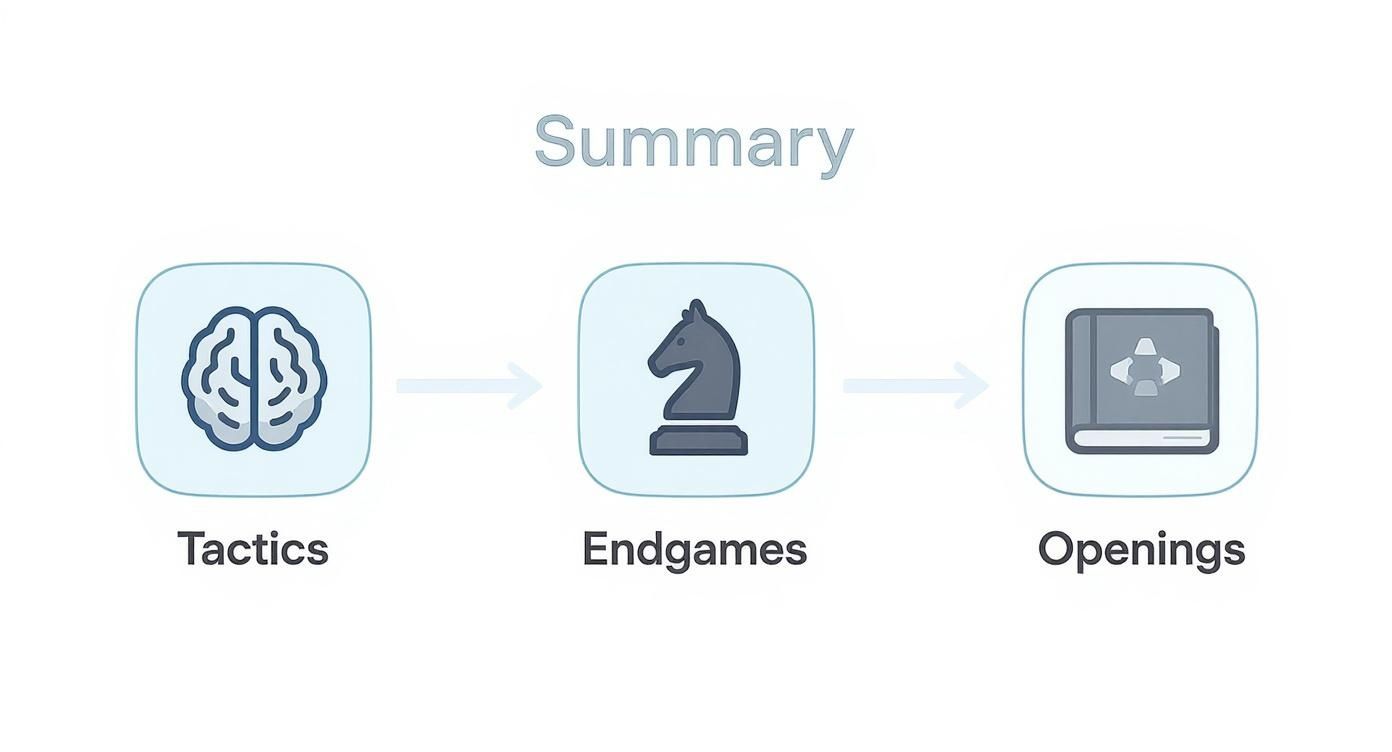
As you can see, the whole website is made to help you get stronger in tactics, endgames, and openings – the things that win games.
Unlocking Advanced Tools with Premium
If the free version is so good, why pay? Simple. Premium is for players who want to be very specific with their training. It gives you the tools to find your exact weaknesses and get rid of them.
The biggest game-changer is the ability to create custom problem sets. Let's say you keep getting tricked by knight forks. With a premium account, you can create a set of puzzles that has only knight forks and practice them until you see them in your sleep.
This kind of specific practice is the fastest way to turn a weakness into a strength. You can work on things like pins, skewers, or discovered attacks until they become easy for you.
Premium also gives you much more information about how you're doing. You can see detailed reports on your performance to figure out exactly what you're doing wrong. For example, you might find out that you have trouble in positions where you need to make a quiet, smart move. Once you know that, you can build a custom set to work on it.
Think of it this way: the free account is for general fitness, while the premium account is your special training camp.
Chess Tempo Free vs Premium Features
To make it even clearer, here’s a side-by-side look to help you choose the right membership for you.
| Feature | Free Account Access | Premium Membership Access |
|---|---|---|
| Rated Tactics & Endgames | Unlimited | Unlimited |
| Custom Problem Sets | ❌ No | ✅ Yes (Work on specific themes, ideas, and openings) |
| Spaced Repetition | ❌ No | ✅ Yes (For openings and endgame theory) |
| Advanced Statistics | Limited (Basic info on how you're doing) | ✅ Yes (Detailed info on your weaknesses) |
| Guess-the-Move Games | ❌ No | ✅ Yes (Play through games from the best players) |
| Engine Analysis on Problems | ❌ No | ✅ Yes (See why a move is right or wrong) |
| Ad-Free Experience | ❌ No | ✅ Yes |
In the end, it's about how much detail you want. The free version is perfect for building a strong base, but if you're ready to find and fix specific problems in your game, the premium tools are worth the money.
How to Build Your Personal Training Plan
Solving random puzzles is a good start, but it’s kind of like going to the gym and lifting whatever weights look cool. You might get a little stronger, but to get really strong, you need a plan. Using a great chess tempo online trainer with a smart routine turns it from a fun website into your own personal coach.
Having a plan is a game-changer. It makes you focus on what you really need to improve, helps you be consistent, and makes every practice session matter. Instead of just wandering around, every puzzle you solve has a clear purpose.
This section gives you simple, ready-to-use plans for different skill levels. Whether you have 20 minutes or an hour a day, you can build a habit that leads to real, long-lasting improvement.
The Beginner's Daily Habit (Under 1200 Rating)
If you're just starting, your goal is simple: build a super strong foundation. You need to train your brain to spot basic tactical ideas—forks, pins, skewers—without even thinking. At this stage, doing it every day is way more important than having long, tough sessions.
A simple 20-minute daily routine is a great place to start.
- Warm-up (5 minutes): Start with a few easy, unrated puzzles. The goal isn't to solve super hard problems; it's to get your brain turned on and in chess mode.
- Rated Puzzles (15 minutes): Now, switch to rated mode and really focus. Take your time on each puzzle. Try to figure out the whole solution in your head before you touch a single piece.
The most important rule for beginners is be accurate, not fast. Rushing and guessing will only teach you bad habits. It's much better to solve three puzzles correctly after thinking hard than to guess your way through ten.
Stick to this simple routine every day, and your ability to spot tactics will get much better. You'll start seeing these patterns in your own games, helping you avoid mistakes and grab winning chances.
The Intermediate Player's Balanced Routine (1200-1800 Rating)
Once you have a good handle on basic tactics, it's time to add more to your training. At this level, a lot of games are decided in the endgame, so ignoring it is a huge mistake. A good plan should mix tactics with endgame practice.
Here’s a sample 45-minute schedule:
- Tactics Session (25 minutes): Keep doing rated puzzles, but now focus on understanding why each solution works. If you get one wrong, don't just click to the next one. Take a minute to figure out where you went wrong.
- Endgame Practice (15 minutes): Hop into the Chess Tempo endgame trainer. Work on basic checkmates (like King + Rook vs King) and simple pawn endgames. Getting good at these will win you a lot of points.
- Review (5 minutes): Quickly look at the puzzles you got wrong. Try to see if you keep making the same mistakes. Are you always missing discovered attacks? Knowing this helps you work on what you need to.
For those who want to build a more detailed schedule, checking out a full chess training plan for rapid improvement can give you a great outline. This can help you balance your chess tempo online work with all the other important parts of your study.
The Advanced Player's Surgical Approach (1800+ Rating)
For advanced players, getting better comes from finding and fixing very specific weaknesses. This is where a premium Chess Tempo account becomes super powerful because it lets you create custom problem sets just for you.
Your job is to be a detective for your own games.
- Analyze Your Games: After every game, look it over and find your mistakes. Did you miss a tactic? Did you mess up an endgame you should have known? Be honest with yourself.
- Create Custom Sets: Use what you learned from your games to build special puzzle sets. If you made a mistake in a tricky position with opposite-colored bishops, create a problem set with that exact theme.
- Drill Your Weaknesses: Spend most of your training time working on these custom sets. Work on your problem areas until they become strengths.
This organized method is how strong players fix the holes in their game. Instead of just getting better at what you're already good at, you're getting rid of the reasons you lose. This kind of focused work is the key to breaking through to the next level.
Learning From India's Grandmasters
Solving puzzles is a great way to get better at tactics, but there's another powerful training method that people often forget: studying how the best players in the world handle tough games. It's like a young cricket player watching hours of Virat Kohli batting. You learn patterns, ideas, and strategy just by watching the experts.
This is where a cool feature of chess tempo online comes in—its huge game database. Think of it as a giant digital library, full of thousands of games from top Grandmasters, including many of India's best players. This tool lets you become a student of how they play.
Stepping Into a Grandmaster's Shoes
Instead of just reading about good chess, you can actually interact with it. Click through the moves of a real game, pause at a key moment, and ask yourself, "What would I play here?" This kind of active learning sticks with you much better than just watching a game happen.
You can study their choices at every step:
- Openings: See what openings players like Praggnanandhaa R. or Gukesh D. use to get a good start.
- Middlegames: Study how they create attacks, defend in tough spots, and outsmart their opponents with deep plans.
- Endgames: Watch the careful way they turn a tiny advantage into a win. This is often what makes a player great.
Studying these games gives you a direct look into how a top player thinks. It's an amazing way to learn new ideas and make better decisions in your own games.
How to Find and Study Their Games
ChessTempo's database makes it super easy to find games from your favorite players. A quick search for a player's name brings up a full list of their games.
Here’s a look at the database search, which lets you look for specific players or tournaments.
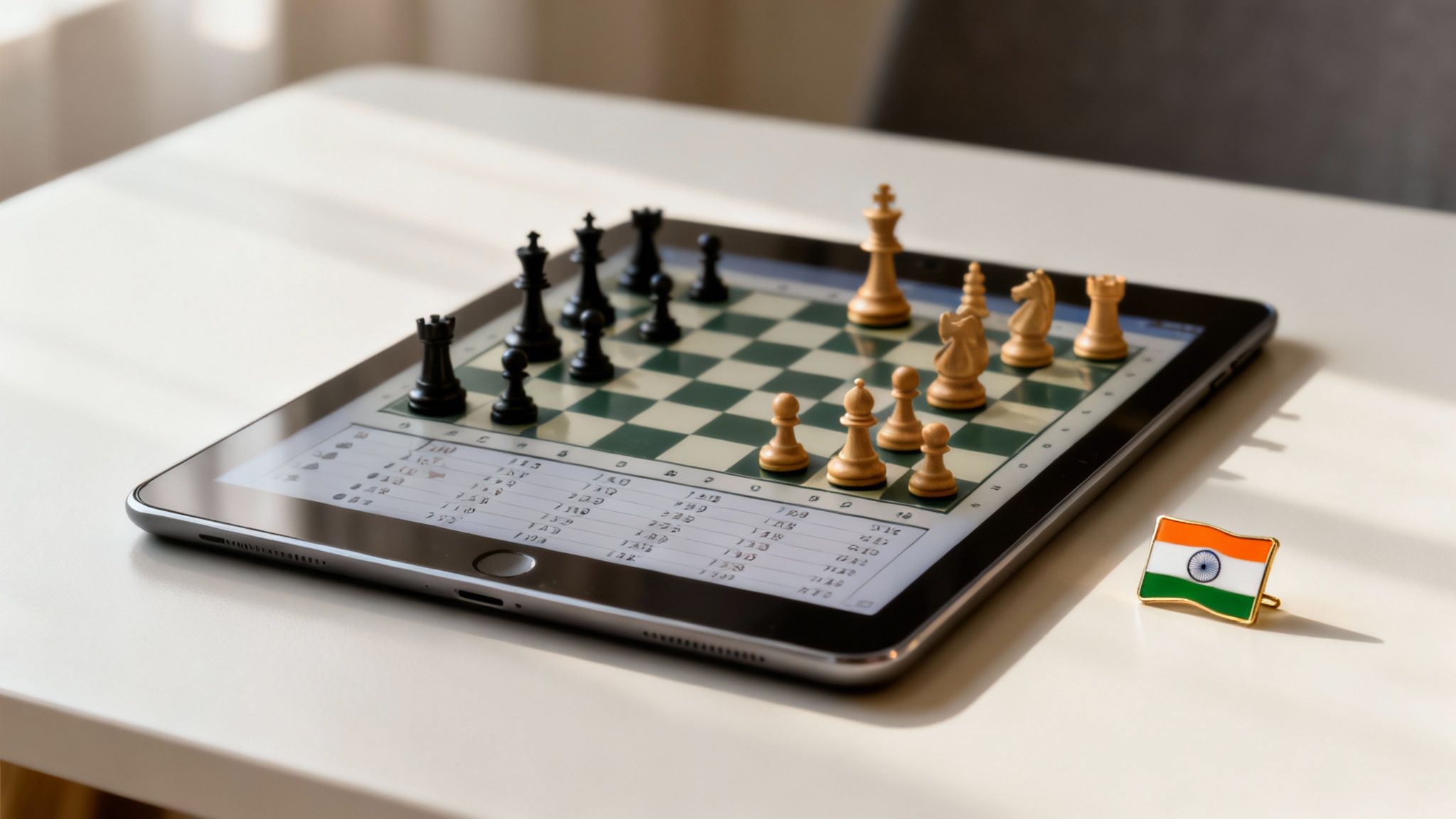
As you can see, you can narrow down your search by player, rating, year, and even the exact opening played.
This feature is a goldmine of information. The database has a huge number of games from India’s top GMs. Praggnanandhaa R., for example, has over 1,280 games you can study, while V Pranav has 1,310. It’s a treasure for anyone serious about learning from the best.
Learning from master games is like having a mentor you don't have to talk to. A real coach gives you direct feedback, but studying top players gives you a steady stream of high-quality ideas and patterns to learn from.
For many players who want to improve, mixing this kind of self-study with a real coach is the perfect way to get better. If you're thinking about that next step, it's worth learning how to find the right chess coach in India to get personal feedback on your games. Using the database to prepare and a coach to help you understand is a powerful combo for getting better.
Common Mistakes to Avoid When Training
Using a tool like ChessTempo is a great way to get better, but it's easy to fall into a few common traps. Think of it like lifting weights at the gym—if your form is bad, you won't make progress, and you might even learn the wrong things. If you avoid these simple mistakes, you'll make sure every minute of your training really helps.
One of the biggest mistakes is just rushing through puzzles to make your score go up. You see a puzzle, make a quick guess, and hope it's right. This turns serious training into a video game where you're just clicking buttons instead of actually thinking.
The goal isn't to solve the most puzzles; it's to get the most learning out of each puzzle. It's much better to solve three problems correctly with deep thought than to rush through ten by guessing.
When you rush, you don't give your brain time to think things through or spot the little details in the position. Taking your time to think through the whole combination before you even touch a piece—that's how you build mental muscle for real games.
Don't Obsess Over Your Rating
Another classic mistake is worrying too much about your puzzle rating. Sure, it’s fun to watch it go up, but it feels terrible when it goes down. Remember, your puzzle rating is just a tool to give you problems at the right difficulty level. It's not a measure of how good you are as a person or a player.
Your rating will naturally go up and down. That's a totally normal part of learning! Some days you'll feel sharp and focused, and on other days, you'll be tired and miss a simple tactic. The important thing is what you do when you get a puzzle wrong.
- Analyze your mistakes: Don't just get mad and click to the next problem. Take a moment to understand why your move was wrong and why the correct answer works.
- Embrace the struggle: Getting problems wrong is where the real learning happens. It points out a weakness in your thinking that you now have a chance to fix.
Treat your rating as a guide, not a final grade. The real prize is the improvement you're making, not the number on the screen.
Avoid Only Practising Tactics
Tactics are super important, but they aren't everything. So many players spend all their time on tactical puzzles and completely forget about other key parts of the game, like endgames. This makes their skills unbalanced.
A balanced approach is just so much better. Your ChessTempo training should be like a balanced meal for your brain. Make sure you're spending time in different areas to become a more complete player.
Think about it this way: what good is winning a piece with a cool tactic if you don't know how to turn your lead into a win in the endgame? A little bit of endgame practice can turn those hard-fought advantages into sure wins. By avoiding these common mistakes, you'll make your training sessions better, more focused, and a whole lot more useful.
Frequently Asked Questions
Have a few questions? Good. You're not the only one. Here are some simple, straight answers to common things people wonder about when they start using ChessTempo's training tools.
How Does the Puzzle Rating System Work?
Think of your puzzle rating like a smart difficulty setting in a video game. It uses the Glicko system, which is similar to the Elo rating you see in real chess tournaments.
Here's how it works in a simple way:
- You solve a puzzle: Awesome! Your rating goes up a little. If the puzzle was rated much higher than you, you get a bigger boost.
- You get a puzzle wrong: No big deal. Your rating goes down a little.
- The system adjusts: Based on your new rating, ChessTempo gives you the next puzzle, perfectly matched to your current level.
This keeps you in the perfect learning zone—it's hard enough to challenge you but not so hard that you want to quit. It’s a smart way to make sure your training is always helpful.
What Is the Best Way for a New User to Start?
Starting with a powerful tool like ChessTempo can feel like a lot. My advice? Keep it super simple at the beginning. Focus on just one thing: building a habit.
Don’t get lost in all the cool features on day one. Your only job is to solve a few puzzles every single day. Just aim for 15-20 minutes of focused work in the normal Tactics Trainer.
For the first week or two, pretend your rating doesn't even exist. Seriously. Just show up and get used to looking at a position, thinking about a few moves, and finding the winning idea. Once that daily session feels automatic, then you can start checking out the endgame trainer or other features. Doing it every day is the secret to success.
How Can I Get the Most Value from My Account?
Whether you’re on the free plan or have a premium membership, the real key is to be an active learner, not just a passive puzzle-clicker. This all comes down to learning from your mistakes.
When you fail a puzzle, don't just sigh and hit the "next" button. Stop for a second. Figure out why you got it wrong. Ask yourself:
- What was the tactical idea I missed? A fork? A pin? A deflection?
- Did I rush and play a move without checking what my opponent would do next?
- Why does the correct answer actually work? What makes it so strong?
For premium users, the best thing you can do is use custom problem sets. This is where you can go from general training to specifically targeting your weaknesses. If you keep messing up puzzles with rook endgames, create a set with only those. Practice them until they feel easy. This is the fastest way to fix the holes in your game and see real, solid progress.