The fastest way to get better at chess is to stop guessing and start focusing on what really matters. For most players, that means a simple, powerful loop: play, analyze, learn. It’s the engine that helps you get better, whether you’re just starting out or trying to reach a new high score.
This way, you work on the right things by focusing on puzzles, playing longer games, and—most importantly—looking at your mistakes without feeling bad about them.
Find Your Starting Point on the Chessboard
Before you can make a good training plan, you have to know what you need to work on. It’s like a mechanic figuring out what's wrong with a car; you can’t just start changing parts and hope for the best. The first real step is to take an honest look at your games to see what’s really going on. This isn't about being hard on yourself; it's about finding clues.
Most players make the same kinds of mistakes over and over without even noticing. Maybe you play the first 10 moves like a pro but then have no idea what to do next. Or maybe you build a winning position but then miss the final move to win the game. For many players, the endgame is a total mystery.
Digging Into Your Game History
The best clues are sitting right there in your past games on Chess.com or Lichess. Don’t just look at whether you won or lost. Put on your detective hat and start looking for patterns that show up again and again.
Here’s what to look for:
- Opening Troubles: Are you often in a bad spot by move 15? This isn’t about memorizing moves; it’s a sign you need to understand the basic ideas of the opening.
- Middlegame Blind Spots: Do your plans just stop once the opening is over? This is a classic sign that you need to work on your strategy—not knowing where your pieces should go and why.
- Endgame Errors: How do you do when there are only a few pieces left? If you can't win a winning game or save a game that should be a draw, then working on the endgame will give you a huge boost right away.
The point isn't to list every single mistake. It’s to find the type of mistake you make on repeat. Once you find your biggest weakness, you finally have a clear goal for your training.
To make this even clearer, here’s a simple way to check your skills.
Your Personal Chess Skill Check-Up
A simple way to find your strengths and weaknesses in each part of the game.
| Chess Area | What to Look For | Question to Ask Yourself |
|---|---|---|
| Openings | Getting into bad positions early, wasting time, not having a clear plan. | "Do I usually get a good position after the opening?" |
| Tactics | Missing simple forks, pins, skewers, or checkmates (for you or your opponent). | "Am I missing easy tactical moves in my games?" |
| Strategy | Not knowing where to place pieces, having no long-term plan, making random moves. | "After the opening, do I know what I'm trying to do?" |
| Endgames | Losing won games, failing to draw lost ones, not knowing basic checkmates. | "Am I confident when there are only a few pieces left on the board?" |
| Mindset | Losing focus, playing too fast, getting frustrated after a mistake. | "Does my attitude help me or hurt me during a tough game?" |
Taking a few minutes to honestly answer these questions based on your last 20-30 games will give you more direction than a hundred random chess videos ever could.
Spotting Your Personal Patterns
As you look through your games, some mistakes will feel very familiar. Are you always falling for knight forks? Do you keep missing easy checkmates? These are tactical mistakes, and they are the number one reason players at the club level lose games.
Look at the exact moments where the game went wrong. Did you move too fast? Did you forget to look at your opponent's last move and what threat it made? Finding these habits is the first real step toward getting a lot better.
It turns a fuzzy wish like "I want to get better at chess" into a clear mission: "Stop missing simple knight forks." Now that is a goal you can actually make a plan for and achieve. It all starts with knowing where you are right now.
Create a Chess Training Habit That Sticks
Knowing what you're doing wrong is half the battle. But actually fixing those weaknesses? That takes a real plan. So many players get excited, study for hours and hours, get tired, and then quit. But here's the secret: getting better at chess isn't about studying for a really long time all at once. It's about building a simple habit that you can actually do over and over.
Think of it like learning to play the guitar. You wouldn't practice for eight hours one day and then not touch it for a month. A little bit of smart practice every day is what really builds skill. Chess is the same way. The goal is to create a routine that works on all your chess skills, not just one.
Make Daily Tactics Your Top Priority
If there's one thing that will help you the most, it's solving tactical puzzles. Every. Single. Day. For most players, tactics decide who wins or loses in more than 90% of games. By training your brain to see these patterns all the time, you'll start noticing them in your own games without even trying.
You don't need hours for this. Seriously, just 15-20 minutes of focused puzzle-solving each day is enough to make a huge difference. This daily workout makes your board vision sharper and, more importantly, improves your calculation. If you want to learn more about this, check out our complete guide on how to improve your chess calculation, which explains the thinking process for solving tough positions.
Build a Simple Weekly Schedule
A good training plan doesn’t need to be a complicated spreadsheet. In fact, simpler is almost always better because you're more likely to actually do it. The key is to find a good balance so you’re not just working on one skill while the others get forgotten.
Here’s a sample weekly plan you can use and change to fit your life:
- Daily (15-20 mins): Tactical Puzzles. This is a must-do! Use the free puzzles on sites like Lichess or Chess.com.
- Twice a Week (30 mins): Opening Ideas. Don't memorize moves. Pick one opening for White and one for Black and just learn the main plans. Ask yourself: Where do my pieces want to go? What am I trying to control?
- Once a Week (60-90 mins): Play and Analyze. Play one long game (at least 15 minutes with 10 seconds added per move). After, go through it without a computer first. Try to find your mistakes on your own. Then, turn on the computer to see what you missed.
This plan helps you work on all parts of your game without feeling overwhelmed. Of course, to make any of this work, you have to learn how to maintain concentration during your study sessions.
From Openings to Endgames: A Balanced Diet
It's tempting to spend all your time learning cool opening traps you saw on YouTube, but that won't get you very far. A strong player is good in every part of the game.
Think of your study time like a balanced meal. Puzzles are the main course, for sure, but you still need the side dishes. A little bit of time on openings helps you get a good position, and learning basic endgames helps you turn those good positions into wins.
This simple flow shows how to use your games to find out what you should be working on next.
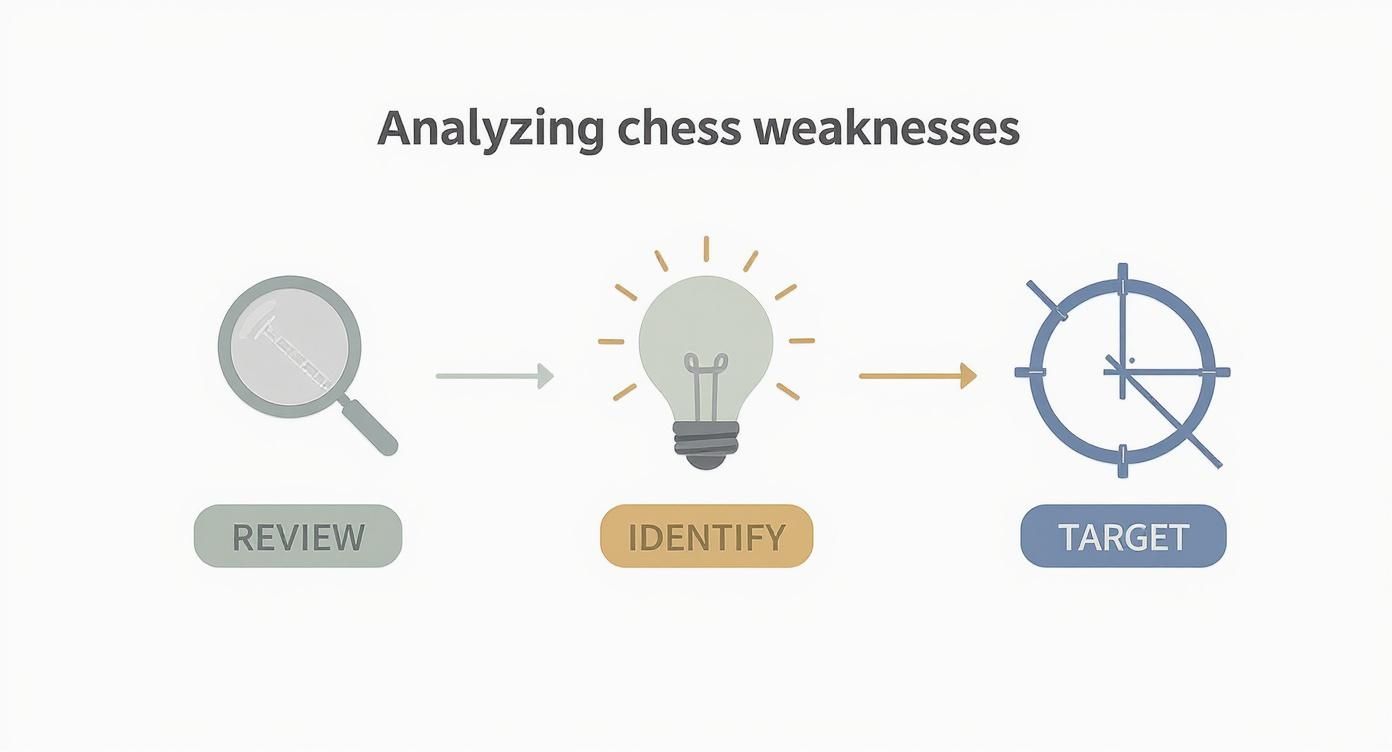
This cycle of reviewing, identifying, and then targeting your weak spots makes sure your training time is always spent where it will help you the most.
The most important part of any training plan is doing it regularly. It's much better to study for 30 minutes four times a week than to study for two hours only on a Sunday. Build the habit, and you'll see the results.
Playing longer games gives your brain a chance to actually think and use what you've been learning. Quick blitz games are fun, but you mostly play on instinct, not deep thought. A weekly slow game is your lab—a place to try new ideas and really practice your thinking. The real learning, though, happens after the game when you analyze it. Be super honest with yourself about your mistakes, and you'll get better faster than you thought you could.
Master Chess Tactics to Win More Games
If chess is a battle, then tactics are the sword fights. They’re the short, quick moves—like forks, pins, and discovered attacks—that often decide who wins and who loses. A great long-term plan means nothing if you miss a simple tactic and lose a piece. Honestly, getting better at tactics is the single fastest way to see your score go up.
Think of tactics as the basic words of chess. The more patterns you know, the better you can show your ideas on the board. Getting good at tactics isn't just for attacking; it's also your best defense. You'll start to see your opponent’s threats from far away, giving you plenty of time to stop them.
Learn the Most Common Tactical Patterns
You don't need to memorize every trick in the book. Just focus on the few tactical ideas that show up in almost every single game. Once you master these main patterns, you’ll be ready for most situations you'll face on the board.
These are the big ones you absolutely have to know:
- The Fork: This is when one of your pieces attacks two enemy pieces at the same time. The knight is famous for this, but pawns and other pieces can do it too. Your opponent can only save one piece, so you get to take the other.
- The Pin: A pin stops an enemy piece from moving. You attack it, but it can't move because the king (or a more valuable piece) is right behind it.
- The Skewer: This is the opposite of a pin. You attack a valuable piece, and when it has to move, you capture a less valuable piece that was hiding behind it.
- Discovered Attack: This is a sneaky one. You move a piece out of the way to let another piece behind it attack. It’s like a surprise attack your opponent never saw coming.
Learning to see these patterns instantly is a huge part of improving your chess skills. The more you see them, the faster your brain will spot them in a real game.
"Tactics is knowing what to do when there is something to do." – Savielly Tartakower
This famous quote says it all. Tactics are all about taking chances. When your opponent makes a small mistake, a sharp tactical eye lets you punish it right away and take control.
Make Puzzle Websites Your Best Friend
So, how do you get good at spotting these patterns? It's simple: solve lots of puzzles. Websites like Lichess and Chess.com offer unlimited, free tactical puzzles that are perfect for your skill level. Doing puzzles trains your brain to see these tactical ideas without even thinking about it.
Think of it like a basketball player practicing free throws. The more you do it, the more automatic it becomes. Spending just 15-20 minutes a day on puzzles will build your "tactical muscle" faster than anything else.
A Simple Process for Finding Tactics
During a game, you need a good way to think that helps you find these chances. Before you make any move, ask yourself these three simple questions:
- Are any of my opponent's pieces undefended? An undefended piece is a big red target. Always look for pieces you can attack for free.
- Can I make any checks, captures, or threats? These are called "forcing moves" because they force your opponent to react, which limits their choices. They are the start of almost every tactical combo.
- What did my opponent’s last move do? Did it create a new weakness? Did it leave something undefended? Every move changes the board, so always figure out your opponent's idea.
Using this checklist on every single move will keep you paying attention and help you avoid simple mistakes. It's a key part of building the right mindset, and you can learn more about finding the best moves with online tools in our article about using Chess Tempo effectively. Mastering tactics is your ticket to winning more games and feeling way more confident at the board.
Develop a Plan for the Middlegame
So, you’ve made it through the opening, your pieces are out, and your king is safe. Now what? For many players, this is where they start to feel confused. The middlegame is where the real fight starts, and winning it comes down to having a good plan.
Just making moves that "look okay" isn't enough. Strong players always have a reason for their moves; every move is part of a bigger idea. This is the real difference between just moving pieces and truly understanding chess. Without a plan, your pieces just wander around. With one, your pieces work together like a team.
Let the Pawns Be Your Guide
The simplest way to create a plan is to look at the pawn structure. The way the pawns are set up is like a map for the game. It tells you where the action is likely to happen and where your pieces should go.
For example, if you have a chain of pawns pointing towards your opponent's king, that's a huge clue. Your plan should probably be to move your powerful pieces over to that side to start an attack.
Think of your pawns as the bones of your position. Your pieces are the muscles, and they work best when they're positioned where the bones give them the most support. Understanding this idea is a key to getting better at chess.
Find and Attack Weaknesses
A weakness is any spot in your opponent's position that's hard for them to defend. A great plan often involves creating and attacking these weak spots. But what does a weakness look like?
- Weak Pawns: Look for pawns that can't be defended by other pawns. We call these isolated, backward, or doubled pawns, and they make perfect targets.
- Weak Squares: A square is weak if your opponent can't control it with their own pawns. If you can put a powerful piece, like a knight, on a weak square deep in their territory, it can cause a lot of trouble for them.
Once you see a weakness, your whole plan can be about attacking it. See a backward pawn? A simple plan is to pile up pressure on that pawn with your rooks and queen. This forces your opponent to defend, letting you take control.
Your goal isn't just to make good moves; it's to make moves that fit together into a single, strong idea. A simple plan that you understand is always better than a complicated one you don't.
Improve Your Worst Piece
When you're stuck and not sure what to do, ask yourself this one question: "Which of my pieces is doing the least?" Every piece on the board needs to have a job. If you have a knight stuck on the side of the board or a bishop staring at your own pawns, your plan could just be to find it a better spot.
This one simple idea can completely change your game. A single, well-placed piece can turn a quiet, even game into a winning one. This focus on making your pieces better is a sign of a strong player.
The growing chess scene in India is a great example of this deep strategic thinking. In fact, the Government of India increased its funding for chess from 4 crore INR to 5.5 crore INR in 2019 to help train the next generation of smart thinkers. You can explore more about India's growing impact on the chess world.
Fight for Important Squares
Some squares are just more important than others. The four squares in the center (d4, e4, d5, and e5) are almost always the most important part of the board. Controlling the center gives your pieces more room to move and lets them get to either side of the board quickly.
Your middlegame plan should almost always include fighting for these key squares. This doesn't just mean putting your pawns there; it also means using your pieces to control them from far away. A bishop, knight, or queen that puts pressure on the center can be just as powerful as a pawn sitting right on it.
By building a plan around these simple ideas—pawn structure, weaknesses, and key squares—you'll stop feeling lost in the middlegame. You'll start playing with a purpose, and you'll become a much harder opponent to beat.
Learn Basic Endgames to Secure the Win
Let's be honest, endgames can feel a bit boring. They're like the last few minutes of a suspenseful movie—slow, but where everything is decided. So many players get bored and skip studying them, but that's a huge mistake. Knowing just a few key endgame ideas is like having a secret weapon.
This is where games are truly won, lost, or saved. Mastering a few basic ideas can turn a losing game into a draw, or an even game into a win. You don't need to read a giant book; just focus on the situations you'll actually see on the board.
Your King Is Now an Attacker
For most of the game, your king is the important person you need to hide away. But once the board is clear and most of the powerful pieces are gone, that all changes. Suddenly, your king turns into a strong attacking piece.
One of the biggest mistakes I see from improving players is leaving their king on the back rank in the endgame. Get it into the fight! Use your king to block the opponent's king, attack their weak pawns, and walk your own pawns down the board.
A simple rule to live by is king activity. The player with the more active king almost always has a huge, often winning, advantage. Your first thought in any endgame should be, "How do I get my king to the center?"
An active king is worth at least a minor piece. Don't be afraid to use it! In the endgame, the king stops being a weakness and becomes one of your best pieces.
The Most Important Endgames to Know
Forget about memorizing hundreds of weird positions. If you just learn the absolute basics of these common endgames, you'll already be way ahead of most of your opponents.
Here are the ones you have to know to start:
- King and Pawn Endings: This is the most basic endgame knowledge. You absolutely must know how to win when you have an extra pawn and, just as importantly, how to get a draw when you're down a pawn. A great starting point is learning the "rule of the square," a quick visual trick to see if your king can catch a pawn that's running to promote.
- Basic Checkmates: You have to know how to checkmate with a queen and king, and also with a rook and king. There is nothing more frustrating than outplaying your opponent for 50 moves, only to mess up the win because you can't deliver the final checkmate. Practice these until they're easy.
- Simple Rook Endgames: These happen all the time. Two of the most important ideas are the "Lucena position" (how to win with an extra pawn) and the "Philidor position" (the key defensive setup to get a draw). Understanding these will save you tons of games.
Why Endgame Study Is Good for Your Brain
Working on endgames does more than just win you chess games; it makes you a better, sharper thinker. The deep focus and careful thinking needed to play a tricky endgame build mental muscles that help you in other parts of your life.
For example, a cool study on how chess helps academic skills was done with middle school children in rural India. The students who got regular chess training showed big improvements in subjects like English and science over a year. It's proof that the focused thinking chess makes you do can strengthen your mind for everything.
Spending even a small part of your study time on these basics will help you a lot. You'll go into the late game with confidence, knowing you have a clear plan to get the win.
Common Questions About Getting Better at Chess
When you start taking chess seriously, a lot of questions pop up. That's totally normal. You start wondering if you're studying the right way or when you'll finally see yourself get better. Let's answer some of the most common questions players have.
How Long Does It Take to Get Good at Chess?
This is the big one, right? The honest answer is, there’s no magic number because "good" means something different to everyone. For one person, it's beating a family member for the first time. For another, it's winning a local tournament.
But if you want a general idea, to go from a total beginner to a solid club player, you should probably plan on at least six months to a year of regular practice. And I don't mean just playing endless quick games online. I’m talking about focused work—solving puzzles, playing longer games where you actually have time to think, and then looking over your mistakes.
Some people learn faster than others, but what really makes a difference is how you use your study time.
A focused 30-minute puzzle session is way more helpful than playing a hundred random 1-minute games. The real secret is patience. Just focus on enjoying the journey and getting a tiny bit better every day.
Should I Focus on Tactics or Strategy?
For almost every player who isn't already an expert, the answer is super clear: tactics are king.
Just think about your own games for a second. How many have been lost because someone lost a piece or missed a simple two-move checkmate? It happens all the time for most players. Those are all tactical mistakes.
- Tactics are the quick, specific moves like forks, pins, and skewers that win pieces or force a win.
- Strategy is your big, long-term plan—things like controlling the center or deciding which side of the board to attack.
A beautiful strategic plan means absolutely nothing if you lose your queen to a simple tactic. Get really good at spotting tactical patterns, and you will start winning a lot more games. Period.
A great rule of thumb is to spend about 80% of your study time on tactics and the other 20% on everything else. As you get better and your opponents stop making easy mistakes, strategy will become a bigger part of your game. But for now, tactics are your fastest way to get better.
Do I Need to Memorise Chess Openings?
This is one of the biggest traps new players fall into. They spend forever trying to memorize 20-move lines of an opening, but honestly, it’s not a great use of your time when you're starting out. It's so much more important to understand the ideas behind the opening.
Instead of memorizing a long list of moves, just learn the basic goals of the opening. For example, in the Sicilian Defense, Black's main idea is to fight for the d4-square and make the game exciting and unbalanced.
For most players, the best thing to do is just stick to the basic opening rules:
- Control the center with your pawns and pieces.
- Develop your pieces by getting your knights and bishops into the game.
- Get your king safe, which usually means castling.
If you can do those three things every game, you'll come out of the opening with a perfectly good position almost every time. Just pick one simple opening for White and one for Black, and really focus on learning their main plans. That way, when an opponent plays some weird move you've never seen, you'll still know what you're trying to do.
How Do I Know If I Am Making Progress?
It can be really hard to see your own progress from one day to the next. Your online rating is one way to measure, but it goes up and down so much that it can be more frustrating than helpful. A much better way is to look for other, smaller signs of improvement.
Are you starting to spot tactical ideas that you know you would have missed a few months ago? When you look at your games, are your mistakes starting to make more sense to you? Maybe you're starting to win endgames that you used to draw or even lose.
Those are the real signs that your hard work is paying off. Getting better at chess is a slow, steady climb, not a sudden jump to the top. Keep building good habits, and trust that your skills are getting sharper with every game you play and every puzzle you solve.