If you feel like your chess skills have hit a wall, you're not alone. The secret to getting better often isn't just playing more games—it's about training your brain with hard chess puzzles.
These puzzles are like a gym for your mind. They build the mental muscles you need to find winning moves when it really matters.
Why Hard Puzzles Are a Chess Player's Best Friend
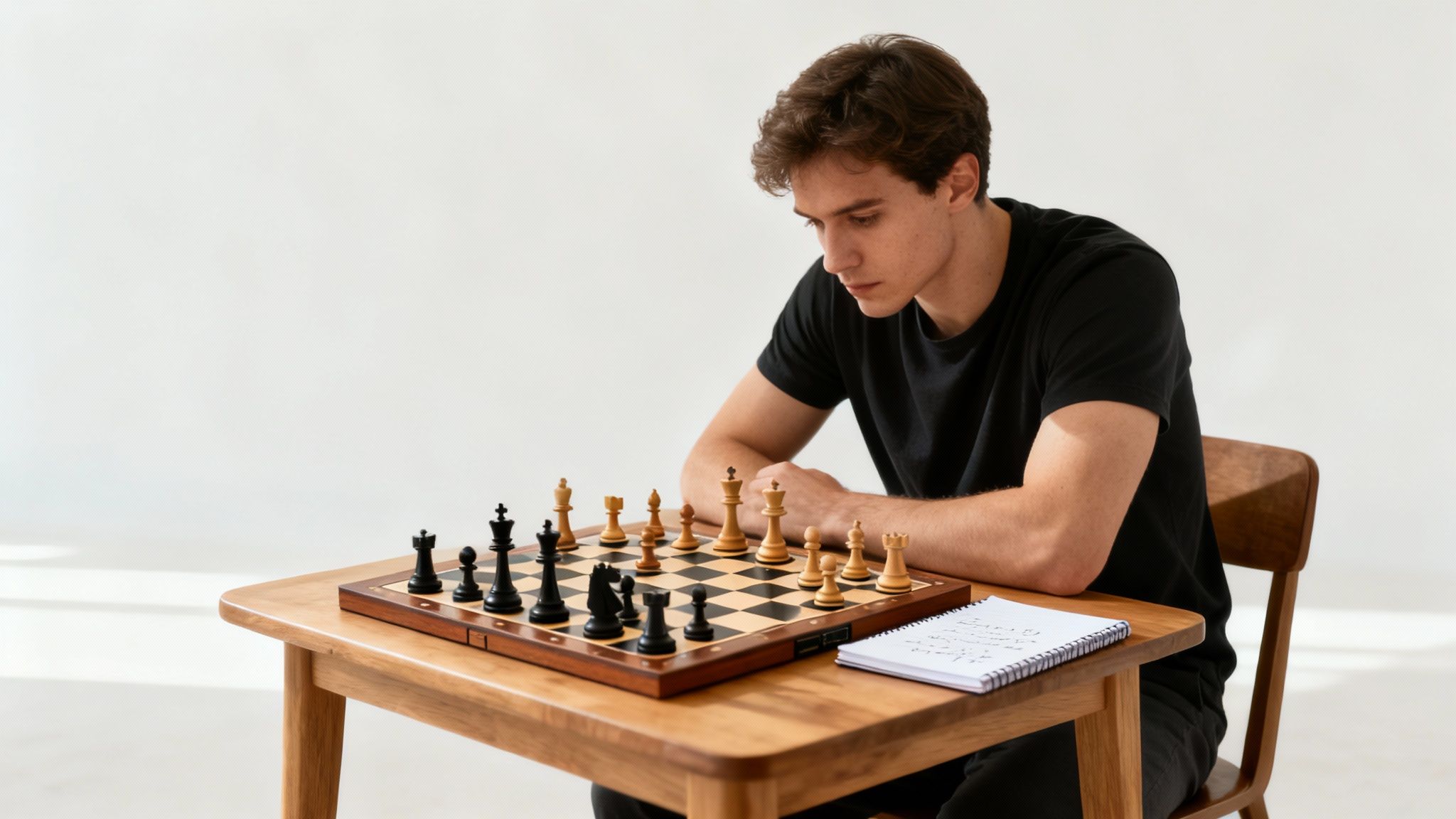
Ever look at the board in a game and feel completely stuck? You know there must be a good move, but you just can't see it. This is where puzzle training helps a lot. Solving hard chess puzzles makes you look deeper than you normally would.
Easy puzzles are great for spotting simple tricks like forks and pins. But hard puzzles teach you something way more important: how to calculate. Calculation is just the skill of seeing a few moves ahead, guessing what your opponent will do, and finding the best way to go.
Building Your Mental Stamina
Think of it like this: a short sprint is easy, but running a marathon takes a lot of training. Hard puzzles are like marathon training for your brain. They teach you to stay super focused on a tricky position for several minutes without getting distracted or giving up.
This mental energy is super important in real games. A normal chess game can last for hours, and the biggest moments often need deep, long thinking. If you’ve only ever solved easy, one-move puzzles, you'll get tired when you need to figure out a long, tricky plan over the board.
"If I stop practicing tactics for one day, I notice; if I stop two days, my opponent notices it; if I stop three days, the world notices it."
This popular saying among chess players shows why practicing with puzzles is so important. Top players are always solving tough puzzles to keep their minds sharp.
Seeing the Unseen Moves
Hard puzzles are often built around surprising or "hidden" moves. These are the cool sacrifices and quiet moves that win games but are super easy to miss.
By trying these hard puzzles, you start to get better at spotting more advanced ideas. You begin to ask better questions during your games, like:
- What if I sacrifice my rook here? Does it lead to checkmate?
- Is there a quiet move that makes my position better and causes problems for my opponent?
- Which of my opponent's pieces is their most important defender? Can I get rid of it?
Thinking this way is what separates good players from great ones. It helps you stop just reacting to what your opponent does and start making your own winning plans.
The Real Goal of Puzzle Solving
Remember, the goal isn't just to get a high puzzle rating online. That number can be fun to watch, but it doesn't always show your true skill. The real win comes from the process.
Every hard puzzle you try—even if you get it wrong—is a chance to learn. When you finally see the solution, you're adding a new idea to your chess toolbox. Over time, all those new ideas add up.
Soon, you’ll start seeing those same winning ideas in your own games, and that’s when your rating will really start to go up.
Developing the Right Mindset for Tough Puzzles
Before you even touch a piece, solving a hard puzzle starts in your head. It’s super easy to get frustrated when the answer doesn't pop out right away. But the best puzzle solvers I know all have a certain attitude that helps them get through the toughest positions.
This isn’t about being a chess genius; it's about building a winning mindset. Try to see a hard puzzle not as a test you might fail, but as a fun mystery you get to solve. All the clues are right there on the board, and your job is to be the detective who puts them together.
Embrace Patience and Curiosity
The most important thing you need is patience. You just can't rush a hard chess puzzle. Guessing or playing the first move that looks okay is a great way to get frustrated. What you need to do is slow down and really look at the position.
Take a deep breath. What’s really going on here? Who is attacking what? Where are the weaknesses for both sides? Looking at the board with real curiosity changes everything. You stop looking for a quick answer and start enjoying the fun of figuring it out. This simple change in your thinking can turn a hard task into an exciting challenge.
When you feel stuck on a puzzle, don't try to force it. Step away for five minutes, then come back and look at the board with fresh eyes. You’d be surprised how often the main idea suddenly becomes clear.
Being patient also builds the mental energy you need for long, tough games. Studies on expert players always show that their ability to stay focused and calm is just as important as their skill at calculating moves.
See Mistakes as Clues
Nobody likes getting a puzzle wrong. It stings when you spend ten minutes thinking, play your move, and then see that red 'X'. But what you do next is what really separates players who improve from those who stay stuck.
Getting a puzzle wrong isn't a failure; it's a clue. That wrong move tells you something important about the position that you missed. Maybe you didn't see a quiet defensive move for your opponent, or maybe you messed up a series of checks.
Instead of just shrugging and clicking "next puzzle," take a minute to figure out why your idea didn't work. Use the analysis tool to play through the right moves and compare them to your own. Looking back at your mistakes is one of the best ways to learn. Every mistake you figure out is like adding a new tool to your brain, making you less likely to fall for a similar trick again.
Think Methodically, Not Magically
Great chess players don't just magically find amazing moves. They use a structured, organized way of thinking. When you see a tough puzzle, don't just start looking for a cool sacrifice right away. Start with the basics.
A simple but really helpful method is to look at all the checks, captures, and threats you can make. This is often called the "CCT" method. By looking at these powerful moves first, you can quickly find the best ideas to focus on.
- Checks: Are there any checks you can make? Even if they don't lead to mate, they limit what your opponent can do and can create new problems for them.
- Captures: Can you capture any of their pieces? Figure out if the capture is safe and how it will change the number of pieces on the board.
- Threats: Can you make a big threat, like attacking a valuable piece or setting up a checkmate on the next move?
By working through these options one by one, you bring order to what might seem like a messy position. This organized way of thinking helps you not miss simple answers and builds a clear path to the right move. It replaces wild guessing with a solid process—which is how you become a great puzzle solver and a better chess player.
A Practical Method to Analyse Any Position
Got the right mindset? Great. Now, let’s talk about a real, step-by-step way you can break down any hard chess puzzle. This isn’t about finding a magic trick; it’s about building a solid process that makes a messy board look simple.
When you first see a tough position, it’s totally normal to feel a little overwhelmed. Your brain might jump from one idea to another without a clear plan. The goal here is to replace that chaos with a calm, organized approach that helps you find the best moves.
The whole puzzle-solving mindset really comes down to three main ideas: Patience, Method, and Resilience.
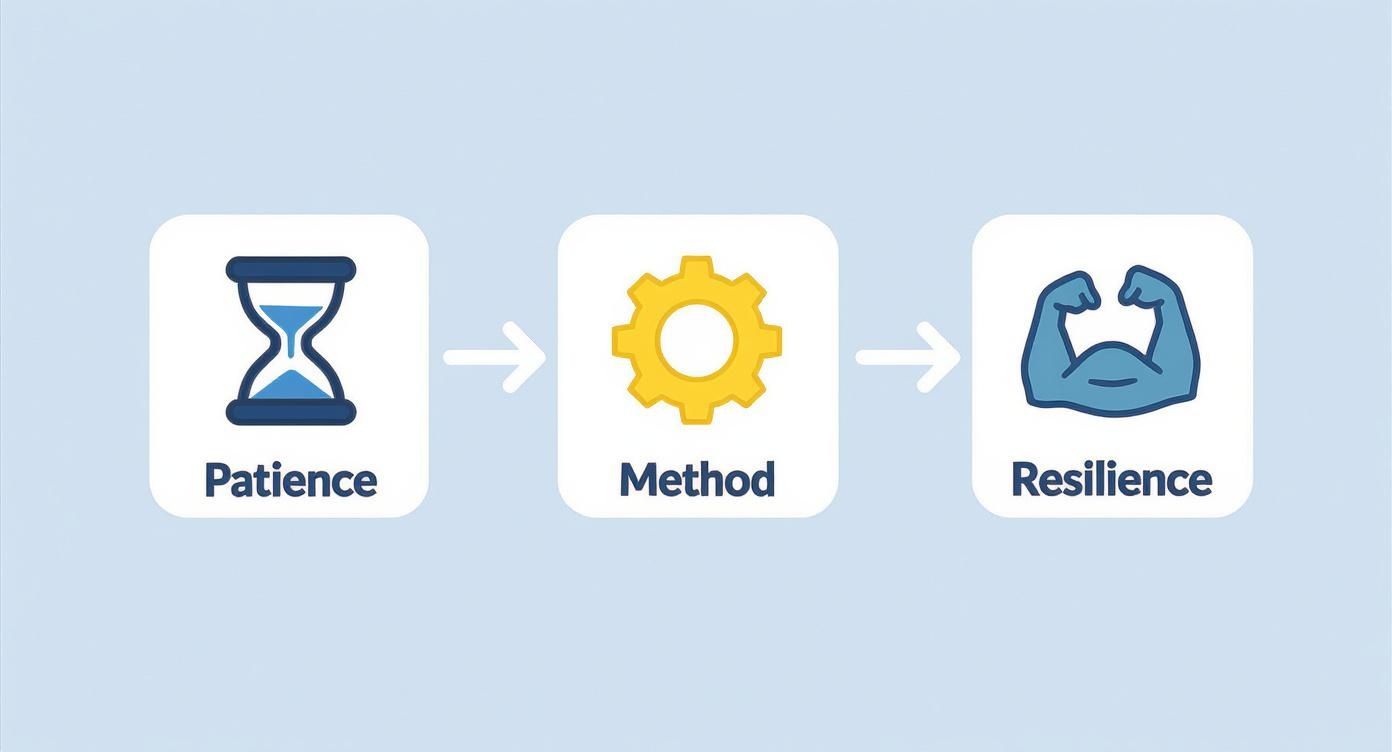
This picture says it all. A good approach starts with patience, uses a solid method, and is backed by the strength to keep learning from your mistakes.
Scan the Board for Clues
Before you even start thinking about what you should do, take a moment and just be a detective. The very first step is to simply understand what’s actually happening on the board. Don't rush this! A quick but careful scan can show you the most important things about the position.
Just ask yourself these simple questions:
- Who is attacking what? See which pieces are in danger on both sides. Are any of your pieces about to be captured? Are you threatening any of theirs?
- What are the biggest threats? Look for immediate dangers. Is your opponent threatening checkmate? Are you about to lose an important piece?
- Which pieces are the most active? Find the most powerful pieces on the board. Is there a rook controlling an open column or a knight on a great square?
This first scan gives you the "story" of the position. It tells you where the action is and what needs your attention right away.
Identify Your Candidate Moves
Once you have a feel for the position, it’s time to brainstorm your own moves. But instead of trying to check every single move (which is impossible), you need to narrow it down to a few candidate moves. These are the 2-4 best ideas that seem worth looking at more closely.
So, how do you find them? A great place to start is to look for forcing moves—the ones that make your opponent react in a specific way.
A forcing move is any move that seriously limits your opponent's choices. By focusing on checks, captures, and threats first, you can guide your thinking and not get lost in too many options.
Start by looking for these three things:
- Checks: Can you check the enemy king? Even if it’s not mate, a check is the most forcing move in chess and puts you in control.
- Captures: Can you take one of their pieces? Figure out if the capture is safe and how it changes the game.
- Threats: Can you create a major threat, like attacking their queen or setting up a mate-in-one?
By finding a few strong candidate moves, you give your brain a clear focus. You’re no longer just staring at a confusing board; you have a short list of ideas to test.
The Real Work: Calculation
This is where the magic really happens. Calculation is the art of seeing ahead, move by move, to picture what might happen next. It's the hardest part of solving hard puzzles, but it's also the most important. The key is to be organized.
For each candidate move you've picked, you have to ask one very important question: "If I make this move, what is my opponent’s best reply?"
This is so important. A common mistake is to only think about your own plan, hoping your opponent makes a bad move. Great puzzle solvers always look for the strongest defense.
Let’s say you're thinking about sacrificing a rook on h7. Your thought process should look something like this:
- "Okay, I play Rxh7. It’s a check."
- "My opponent's only legal move is to take it back with their king: Kxh7."
- "Right, after Kxh7, what's my next best move? I can check with my queen on h5."
- "After Qh5+, where can their king go? It can move to g8 or h8."
This step-by-step thinking helps you see a few moves ahead without getting confused. You’re basically building a small tree of moves in your mind. This is a skill top players use all the time, like at the 44th Chess Olympiad in Chennai. During that tournament, the Indian chess star Praggnanandhaa showed how perfect calculation leads to winning attacks.
Solving Hard Puzzles: A Walkthrough
Knowing how to solve hard chess puzzles is one thing, but seeing it in action makes it all click. Now, we’re going to solve a couple of tricky puzzles together, from start to finish. Think of me as your guide, talking you through my thoughts just like I would in a real game.
We'll look at a messy middlegame where lots of pieces are flying around, and then we'll check out a sneaky endgame that needs careful thinking. For each one, I’ll explain my thoughts so you can see exactly how to use the method we just talked about.
This hands-on practice is all about building your confidence. Let's dive in.
Walkthrough 1: A Complex Middlegame Tactic
Imagine you get this position in a game. It's White to move. Take a good look at the board. It feels a little crazy, right? Black's king on h8 looks like it might be in trouble, and our queen on d3 is putting a lot of pressure on the board.
My first step is just to scan and see what’s going on. I see Black's queen on a5 is a very strong piece, looking at our weak pawns. Their rook on f8 is also very active. But, we have our own strengths. Our knight on e5 is a great attacker, and our rook on f1 controls an important column.
Now, let's find some candidate moves. Following our method, I'll look for checks, captures, and threats.
- Checks: The most obvious check is
Nxf7+. This forks the king and rook. It looks really good. - Captures: We could play
Qxa6, taking a pawn. It's a move, but it doesn't feel like it uses the weakness of Black's king. - Threats: Maybe a move like
Qh3? It puts more pressure on the kingside but seems a bit slow.
Out of these, Nxf7+ is easily the best one to check first. It's a forcing move and creates immediate problems for Black. So, let’s start our calculation there.
"If I play 1. Nxf7+, what is Black’s best response?"
Black has to deal with the check. Their only legal move is to capture our knight with their rook: 1... Rxf7. They have no choice.
Okay, so after 1. Nxf7+ Rxf7, what do we do next? Now the f-file is open for our rook. Our queen on d3 and rook on f1 are both staring at the f7 square. This screams "attack!"
The natural move is to take back with our queen: 2. Qxf7. This move keeps the pressure on. Now, what does Black do? They can't take our queen. Their knight on c6 is pinned by our bishop on b5. That pin is a very important detail!
So, after 2. Qxf7, Black has to move their king to safety. The only move is 2... Kh7.
Now we pause and check again. The moves so far are 1. Nxf7+ Rxf7 2. Qxf7 Kh7. It feels like we're on the right track. Our queen is deep in their area. What's next? We need another forcing move to keep the attack going.
I see 3. Be8!. This move is killer. It threatens checkmate on g6 (Qxg6#) and also traps the Black king. Black has no good way to stop this. They can try to block with their knight, 3... Ne7, but then we just play 4. Qxe7, and the mate threat is still there. Black is losing.
So, the full solution is: 1. Nxf7+ Rxf7 2. Qxf7 Kh7 3. Be8!. We found it by focusing on the most forcing moves and thinking just a few steps ahead.
Walkthrough 2: A Tricky Endgame Study
Endgame puzzles are a different kind of challenge. There are fewer pieces, so every single move is important. In this position, it's White to move.
At first, it looks like a draw. White has a king and a pawn, and Black has a king and a knight. Our pawn on h6 is close to becoming a queen, but Black's knight on f6 is blocking the queening square (h7). It seems impossible to make progress.
Let’s use our method.
- Checks: There are no checks for White.
- Captures: There are no captures for White.
- Threats: Our only real threat is pushing the pawn to h7.
So, our main candidate move has to be 1. h7. Let's calculate. If we play 1. h7, Black has to stop the pawn. Their only move is 1... Nh7.
Now our pawn is gone. We have just a king against a king and knight. That's a draw. So, 1. h7 by itself doesn't work. This is where many people would give up.
This is the key to solving hard chess puzzles. When your first idea doesn't work, you can't get sad. You have to look deeper for those quiet, surprising moves that you missed at first.
Let's go back to the start. Is there another idea? The problem is the knight on f6. What if we could force it to move?
This is where we need to get creative. What if we use our king to attack the knight? Let's try 1. Kg6!. This is a much quieter move. It doesn't check or capture anything, but it creates a serious threat: we're going to attack the knight.
Now, what is Black's best reply to 1. Kg6?
- If Black moves the knight away, say to e8 (
1... Ne8), then we just push our pawn:2. h7. The knight can no longer stop it, and we get a new queen. - Black's only other idea is to try and check our king with the knight to slow us down. For example,
1... Ng8+.
Let’s follow that line: 1. Kg6 Ng8+. We have to move our king. Where to? If we play 2. Kf7, the knight can check us again from h6. But if we play 2. Kh5!, we step away from the checks. Now Black’s knight is stuck. If it moves, our pawn becomes a queen. If it stays, our king will eventually help win.
The solution is all about that weird-looking first move: 1. Kg6!. It doesn’t look fancy, but it's the only move that wins. We found it by realizing our obvious plan didn't work and then looking for a quieter, smarter idea.
This shows just how tough solving hard puzzles can be. Chess history is full of amazing puzzles, with some having forced checkmates that are over 16 moves long. Modern puzzle websites even give difficulty ratings, with one of the hardest mate-in-three puzzles reaching a rating of 2218. You can discover more record-breaking chess puzzles and see how they are rated.
How to Create Your Personal Puzzle Training Plan
To get better at anything, you need a plan. Just doing random hard chess puzzles without a goal is like trying to build a house without a plan. A simple, regular training schedule is what turns a little effort into real improvement in your games.
Making a personal plan isn't about practicing for hours every day. It’s about being smart with your time and focusing on what really matters: quality over quantity. The right plan will fit your schedule and keep you excited to keep going.
Quality Over Quantity Is the Golden Rule
The biggest mistake I see players make is trying to do as many puzzles as possible in a short time. They speed through dozens of easy ones to get that good feeling from each green checkmark. But this builds bad habits and doesn't help with the deep thinking skills you need in a tough game.
It is way, way better to spend 15 minutes working on one really hard puzzle than it is to rush through ten easy ones in five minutes.
Deeply studying one hard position and truly understanding the answer will teach you more than a hundred quick puzzles ever could. It builds the mental focus and thinking habits that win games.
This way of practicing forces you to slow down, think carefully, and see the hidden ideas in a position. This is the real skill you want to bring to your games.
Finding Puzzles at the Right Difficulty
Your goal is to find puzzles that are in your "stretch zone." They should be hard enough to make you think but not so hard that you feel hopeless. A good rule of thumb is that if you're solving a puzzle in under two minutes, it's probably too easy for deep training.
If you're still completely lost after 15-20 minutes, it might be a little too hard for now. Look for puzzles you can solve with 5-15 minutes of focused effort. That’s the perfect spot for building new mental muscles.
Building Your Weekly Schedule
Doing a little bit regularly is key. A little bit of focused work every day is much better than one long, tiring session on the weekend.
Here’s a simple but powerful starting plan:
- Daily Target: Aim to solve just 1-3 hard chess puzzles each day.
- Time Commitment: Set aside 20-30 minutes of quiet, focused time where you won't be interrupted.
- Review Your Mistakes: For any puzzle you get wrong—or even one you got right but had trouble with—spend a few minutes looking at the solution with a computer to see what you missed.
This small, daily habit adds up over time. It keeps your brain sharp and slowly improves your thinking skills without making you feel burned out.
The Best Places to Find Quality Puzzles
The good news is that there are amazing places to find puzzles online. Chess has become super popular, with around 800 million players worldwide. In some countries, it's a huge deal, which has created a need for great training tools. You can read more about the global rise of chess on passivesecrets.com.
Here are my top recommendations for finding hard chess puzzles:
- Lichess Puzzles: It’s completely free and has a giant collection of puzzles rated by difficulty. You can even search for puzzles based on specific ideas you want to work on.
- Chess.com Puzzles: Has the popular Puzzle Rush and Rated Puzzles, with a huge community and great puzzles for all levels.
- ChessTempo: This site is amazing for serious training. It lets you customize everything, so you can focus on specific types of puzzles and difficulty levels. You can learn more about how to get the most out of this platform in our ChessTempo guide.
Common Questions About Chess Puzzles
As you start getting into the tougher world of hard chess puzzles, you'll probably have some questions. It's totally normal to wonder if you're doing things the right way. Let's go over some of the most common questions that come up when players get serious about their puzzle training.
Think of this as a quick FAQ to clear up any confusion and get you back on track.
How Do I Know if a Puzzle Is Too Hard for Me?
That's a great question, and the answer is about finding your "stretch zone." A puzzle is probably just right if it takes you somewhere between 5 and 15 minutes of focused thought to solve it.
- If you see the solution almost right away, it's too easy for serious training. These are good for practicing basic ideas, but they won't build your thinking muscles.
- If you’re still completely lost after 15-20 minutes with no real ideas, it might be a bit too hard for you right now. And that's okay.
Don't be afraid to look at the solution when you're truly stuck. The real learning happens next: spend time figuring out why the solution works. Look at the moves, understand the idea, and store that new pattern in your brain for later.
Is It Better to Solve Many Easy Puzzles or a Few Hard Ones?
Both are useful, but if you want to get a lot better, spending time on a few hard puzzles is way more powerful. Think of easy puzzles as quick drills—they're great for getting better at spotting simple tricks instantly.
Hard puzzles, on the other hand, are where you build patience and serious calculation skills. They force you to look deeper, guess your opponent's best moves, and find those cool, hidden moves that win games. A mix is good, but always make time for the tough puzzles that really make you think.
"A common mistake is to only focus on your own plan, hoping your opponent makes a weak move. Great puzzle solvers always look for the strongest defence."
This is exactly the mindset you get from working on hard positions, not by quickly clicking through dozens of easy ones.
Should I Use a Real Board or a Screen?
This is mostly up to you, but many experienced coaches, including me, strongly suggest using a real chessboard for hard puzzles. There are a couple of good reasons for this.
First, setting up the position on a real, 3D board can actually change how you see things and help you spot new ideas. More importantly, it directly trains you for the same situation you'll be in during a real tournament game.
Using a physical board also stops you from just guessing moves with a mouse click. It forces you to think through the whole plan in your head before you even touch a piece—a very important habit for any serious player. For quick daily puzzles, a screen is fine, but for your deep, focused training, get the board out.