Picking your first chess book can feel like staring at a giant, confusing puzzle. You just need something that is clear, fun, and makes you feel good about learning. The best chess books for beginners, like the classic Bobby Fischer Teaches Chess or Pandolfini's Ultimate Guide to Chess, are great places to start because they do just that. They walk you through the rules without using big, confusing words and show you the basic moves that help you win games.
Your First Move: Finding the Right Chess Book
Jumping into the world of chess is super exciting, but there are so many books out there it can be hard to know where to start. So, how do you pick the right one?
Think of a great beginner's chess book like a friendly coach. It won't throw complicated stuff at you on the first page. Instead, it starts with the simple things, like how each piece moves and what its special job is on the board.
A good book makes learning feel like a game, not like homework. It should have lots of pictures and diagrams to show you exactly what’s going on. Seeing the moves helps you understand ideas way faster than just reading long, boring paragraphs. You'll learn the most important parts of the game one step at a time.
Starting With the Basics
Before you can pull off cool checkmates, you need to know the basics really well. The best books for new players focus on two main things: knowing all the rules and learning basic tactics. Tactics are like the special moves in chess—short combos that help you capture your opponent's pieces or win the game.
These books teach you to see simple but strong ideas, like:
- Forks: Using one of your pieces to attack two of your opponent's pieces at the same time.
- Pins: A smart move that stops an opponent's piece from moving because a more important piece is sitting right behind it.
- Skewers: The opposite of a pin, where you attack a valuable piece, forcing it to move and letting you take a less valuable piece behind it.
Learning these ideas is your first big step to becoming a good player. If you're totally new to the game and want a full plan of what to learn, our complete chess starter pack for new players is a great guide to check out.
This simple chart can help you decide what to focus on first.
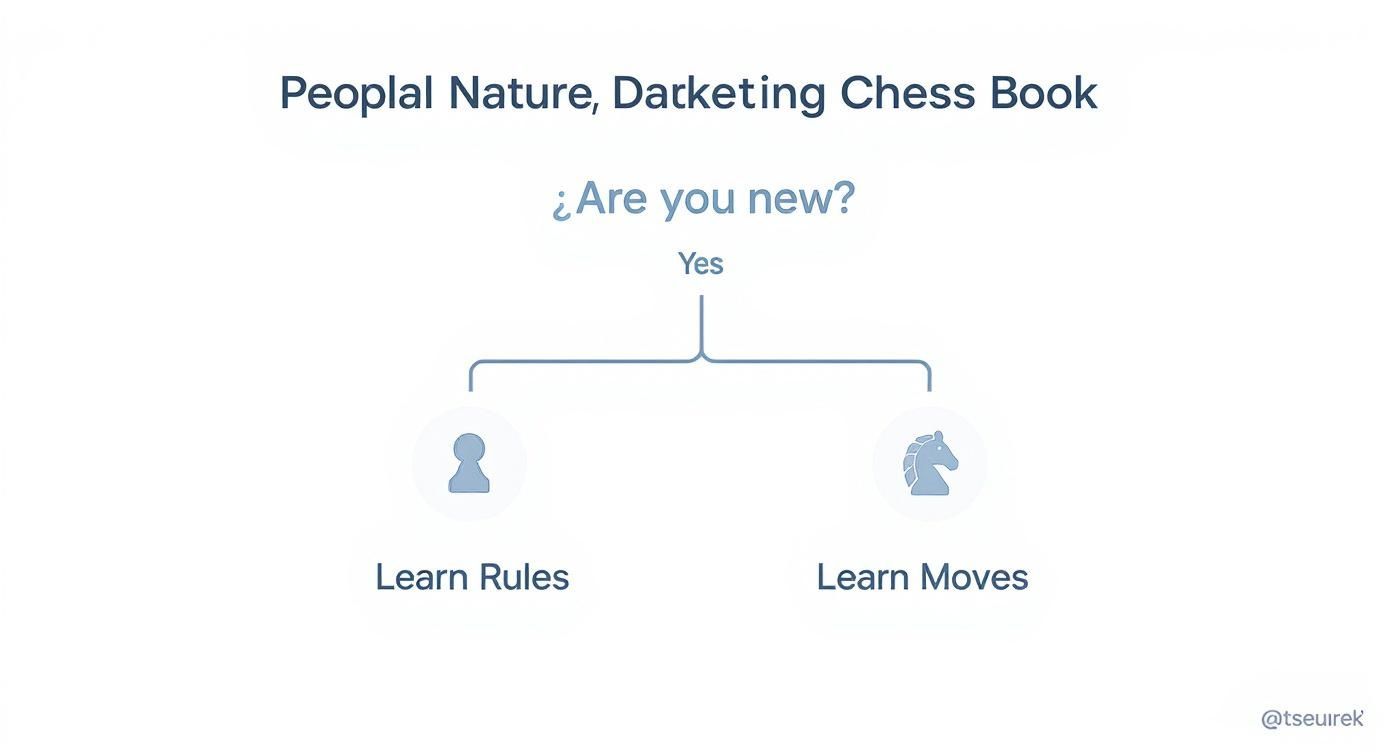
As the picture shows, your journey starts with a choice: either get the rules down solid or jump right into learning the moves that win games.
Building Your Confidence
The main goal of your first chess book is to make you feel more confident. It should make you feel smart and like you can do it, not lost and confused. When you finish a chapter, you should be excited to try out what you just learned in a real game.
A great book doesn't just teach you what to do; it teaches you how to think. It helps you see the board in a new way and spot the patterns that lead to a win. This is how you really start to become a strong player.
Choosing the right book is all about finding one that feels like it's talking to you. It's a tool that will help you enjoy chess more and see yourself get better at your games. With a good starting point, you’ll be ready to make your first move and start your journey to mastering this awesome game.
What Every Great Beginner Chess Book Needs
Let's be real, not all chess books are the same. This is especially true when you're just starting. Picking the wrong one can feel like trying to read a secret code—it’s annoying, confusing, and will make you want to quit.
But the best chess books for beginners have a few things in common. They make learning feel less like a school lecture and more like a friendly chat with a coach who really wants you to do well. They don't use fancy words and explain things in a way that just makes sense.
The goal is to help you learn from the very beginning, not to show off how many complicated words the author knows. When a book is easy to understand, you'll actually want to keep reading, and the lessons will stick.
Making Learning Visual and Fun
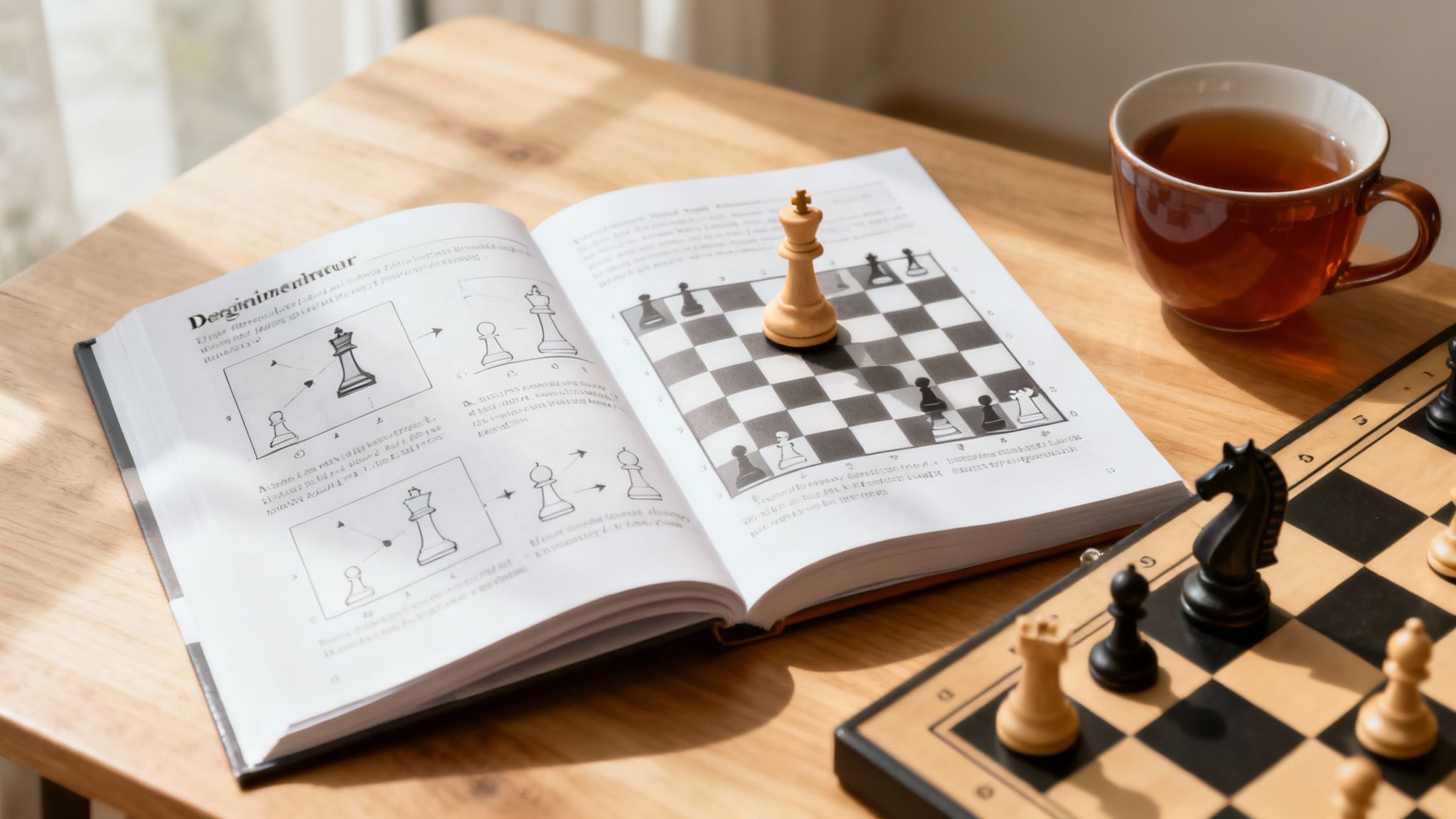
Chess is a visual game, so it makes sense that your first book should be, too. A huge wall of text is a quick way to lose focus. The best beginner books are full of diagrams, showing you exactly what’s happening on the board for every example.
These diagrams are super important. They let you see the position and follow the moves without having to set up a real board every time. Seeing the patterns helps them stick in your memory.
Books that have puzzles and exercises are even better. This is where you stop just reading and start actually learning. When you have to solve a problem or find the best move, you're thinking about the lesson on a much deeper level.
Look for a book that has:
- Lots of Diagrams: There should be a diagram for almost every important position the author talks about.
- Practice Puzzles: Questions at the end of chapters are a great way to test what you just learned.
- Clear Answers: The answers shouldn't just tell you the right move, but also explain why it's the right move.
This interactive style is like having a coach give you a quiz after every lesson. It makes sure you really get it before you move on.
Building Your Skills Step by Step
A great beginner's book doesn't just throw you into the deep end. It builds your skills in a smart order, one piece at a time. Think about it—you wouldn't build a house by starting with the roof. It’s the same with chess; you need a good foundation first.
A well-planned book starts with the absolute basics, like how the pieces move and the main rules. Only then will it slowly teach you more advanced ideas.
A great book is like a map. It guides you from point A (knowing nothing) to point B (playing a confident game) without skipping any important steps. Learning this way builds your confidence and keeps you from feeling overwhelmed.
The journey should make sense. You might learn basic checkmates first, then simple tactics like forks and pins, and later, the first ideas of a good opening. This step-by-step way makes sure each new skill is built on something you already know, making the whole thing feel smooth and fun.
Top 5 Chess Books for Beginners Reviewed
Ready to find the perfect book to start your chess journey? Looking through all the options can be a lot, so I've done the hard work for you. Here are five of the best, most trusted classics that have helped thousands of players get better.
For each book, I’ll explain what makes it so good, who it’s best for, and what skills you’ll learn. This will give you a clear idea of how each one works, helping you pick the one that fits your learning style.
Bobby Fischer Teaches Chess by Bobby Fischer
This is probably the most famous chess book ever written, and for a good reason. Bobby Fischer Teaches Chess is an amazing first book because it uses a special method where you're not just reading; you're actively solving little puzzles and answering questions on every single page.
This question-and-answer style works really well. The book shows you an idea, then immediately asks you a question to make sure you understood it. This helps lock the ideas in your mind way better than just reading.
The whole book is focused on one thing: checkmate. It's a masterclass in seeing and using checkmate patterns, which is the most important skill for a new player. Best of all, you don’t have to learn any confusing chess notation, so it’s easy to pick up even if you’ve never played a game before.
Silman's Complete Endgame Course by Jeremy Silman
The "endgame" can sound scary, but Jeremy Silman makes it simple and useful. What makes this book so awesome is how it’s organized. Instead of throwing everything at you at once, it breaks down endgame knowledge by skill level.
Just starting out? You only need to read the first chapter. As you get better and your rating goes up, you move on to the next one.
This way of teaching is genius because it stops you from getting stuck on advanced stuff you don’t need yet. You learn exactly what’s important for your current skill level, making the info easy to understand and use in your games right away.
For example, the first parts cover basic checkmates like King and Queen vs. King. It's only much later that you'll get into tricky rook and pawn endings. It’s one of the most useful and well-organized best chess books for beginners you can find.
Pandolfini's Ultimate Guide to Chess by Bruce Pandolfini
If you’re looking for a single book that covers a little bit of everything, this is it. The famous coach Bruce Pandolfini has packed a whole beginner's course into one book, making it cover more topics than a specialized book like Bobby Fischer Teaches Chess.
The book covers:
- Basic Rules: How every piece moves, including special rules like castling.
- Tactics: You'll learn about forks, pins, skewers, and other key tactical moves.
- Strategy: It introduces big ideas, like controlling the center of the board.
- Openings and Endgames: It gives you a simple introduction to the first and last parts of the game.
Pandolfini's writing is friendly and easy to follow. He explains ideas clearly, making this a fantastic all-in-one book for anyone who wants a solid, well-rounded start in chess.
Winning Chess Tactics by Yasser Seirawan
At the beginner level, chess is 99% tactics. Most games are won or lost because of a simple mistake. That's why a great book on tactics is a must-have, and Yasser Seirawan’s Winning Chess Tactics is one of the best.
This book does a great job of explaining different tactical ideas one by one. You’ll learn all about the double attack, the pin, the skewer, and many other patterns in their own chapters.
What really makes it great is Seirawan’s fun and clear writing. He doesn't just give you puzzles; he explains how to think so you can find these moves yourself. After you work through this book, you’ll start to see the board in a whole new way, spotting chances you would have missed before.
Logical Chess Move by Move by Irving Chernev
This book does things a little differently. Instead of teaching ideas one at a time, Irving Chernev walks you through 33 complete games played by masters. But the magic is that he explains the reason for every single move.
Why did White push that pawn? What was Black’s plan with that knight move? Chernev answers these questions in simple, plain English. This is a game-changer for beginners who often feel lost and don't know what to do after the first few moves.
By studying these games, you learn how a strong player thinks. You see how openings, middlegame plans, and tactics all work together in a real game. It’s the perfect book to pick up once you know some basic tactics because it teaches you how to make a plan and play with a purpose.
These books have been popular for a long time for a reason. In India, classics like Bobby Fischer Teaches Chess and Silman’s Complete Endgame Course are still top choices for beginners. Their clear instructions and great results make them a solid foundation, and they continue to sell well year after year. You can learn more about the most popular chess books for newcomers.
To help you decide, here is a quick comparison of our top recommendations for players in India.
Beginner Chess Book Comparison
| Book Title | Main Skill | Learning Style | Price (INR) |
|---|---|---|---|
| Bobby Fischer Teaches Chess | Checkmating Patterns | Interactive Q&A | ₹400 – ₹600 |
| Silman's Complete Endgame Course | Endgames | Level-Based | ₹1,200 – ₹1,500 |
| Pandolfini's Ultimate Guide to Chess | All-Around Basics | Full Course | ₹900 – ₹1,200 |
| Winning Chess Tactics | Seeing Tactics | Topic by Topic | ₹800 – ₹1,100 |
| Logical Chess Move by Move | Strategy and Planning | Game Walkthroughs | ₹700 – ₹1,000 |
In the end, any of these books will give your game a huge boost. The best choice depends on what you want to learn first: checkmates, endgames, tactics, or overall strategy. Just pick the one that sounds most exciting to you, and you'll be on your way to becoming a much stronger player.
How to Actually Learn from a Chess Book
Getting one of the best chess books for beginners is a great first move, but it's only the start. The real improvement happens when you get the information from the page into your brain. Just reading a chess book like a novel isn't going to help your rating much.
You need to make reading an active, hands-on activity. Think of it like a science class; you wouldn't just read about an experiment, you’d do it yourself to see what happens. Learning chess is the same—you have to do the moves to really understand them.
This just means you need to slow down and really pay attention to what you're reading. A few small changes to how you study can turn that book into your best training buddy.
Bring the Book to Life with a Real Board
This is the most important tip for learning from a chess book: always have a real chessboard next to you. Don't just try to imagine the moves in your head. When the book shows you a position or a few moves, set up the pieces and play through it yourself.
Physically moving the pieces does some amazing things for your brain:
- It builds muscle memory. Touching the pieces and seeing the position in 3D helps lock the patterns in your memory way better than just reading.
- It makes you slow down. You can't just skim the page when you have to stop, set up the position, and think about what’s happening on the board.
- It shows you what you don't get. As you play out the moves, you might suddenly realize you have no idea why a certain move was played. That’s your signal to go back, reread that part, and figure it out.
This one habit will easily double what you learn from every chapter.
Treat Puzzles Like a Test You Have to Pass
Most good beginner books have lots of puzzles and exercises. It's really tempting to look at a puzzle for ten seconds and then flip to the back for the answer. Don't do it!
Every puzzle in your book is a mini-test. It’s checking if you really learned the lesson from the chapter. If you can’t solve it, it means you missed something important.
Make a rule for yourself to spend at least 5-10 minutes on each puzzle before you even think about looking at the solution. If you get it wrong, don't just shrug and move on. Go back and reread that part of the chapter to understand where you went wrong. This is exactly how you find and fix the weak spots in your chess knowledge.
Create a Simple Study Plan
Studying a little bit every day is way better than trying to do it all at once. Spending just 20-30 minutes a day with your chess book works much better than a four-hour study session once a week. Your brain needs time to let new ideas sink in, and short, regular sessions are perfect for that.
A simple, good schedule could look like this:
- Monday: Read a new chapter and play through every example on your board.
- Wednesday: Do all the puzzles from Monday's chapter.
- Friday: Quickly review the chapter's main ideas, then play a few online games and try to use what you learned.
This way of learning breaks things down into smaller, easier pieces. If you want more ideas on how to plan your time, we have a complete guide on how to build a chess study routine that works that can help you make a plan that fits your life.
Finally, to make sure what you read actually sticks, it's a good idea to learn some powerful knowledge retention strategies that work for any skill. By studying actively and reviewing often, you make sure the lessons from your book stay with you long after you've put it back on the shelf.
Going Beyond the Book with Practice
A chess book is a great guide, but it’s only half the story. Reading about tactics is one thing, but actually using them to checkmate someone is totally different. To really get better, you have to mix your reading with a lot of practice.
Think of it like learning to ride a bike. You can read a book about how to balance and pedal all day, but you won't get anywhere until you actually get on the bike and start riding. The same is true for chess. The best beginner books give you the map, but you're the one who has to drive.
This means you need a plan that includes both reading and playing. When you use what you've learned, the ideas suddenly make sense and become real skills you can use again and again.
Put Your Knowledge to the Test Online
The fastest way to practice is by playing online. Websites like Chess.com and Lichess have millions of players ready for a game anytime, day or night. This is your personal training gym, where you can try out all the new ideas from your book.
Just finished a chapter on the fork? Great! Log in and start looking for them. You might make a few mistakes, and that’s okay. Every time you try, you're burning that pattern into your brain.
Playing online is like an open-book test. You have all the ideas from your book fresh in your mind, and now you get to see if you can use them when it matters. It's the fastest way to go from knowing something to actually doing it.
Playing real games also shows you where you need to improve. If you keep getting beaten by a certain attack, you know exactly which chapter you need to read again. This cycle of learn, play, review is how everyone gets better at chess.
Sharpen Your Mind with Puzzles
Besides playing full games, another great tool is solving puzzles. These are small chess problems where you have to find the best move, which usually leads to a checkmate or a big advantage.
Most chess sites have free puzzle trainers that give you an endless supply of problems. Think of it as a workout for your chess brain. It trains your mind to see patterns quickly—a very important skill when the clock is ticking in a real game.
A simple but really good practice routine could be:
- 15 minutes of reading: Focus on one idea from your book.
- 15 minutes of puzzles: Practice seeing tactics with puzzle trainers.
- 30 minutes of playing: Play one or two longer games online, and try to use the idea you just read about.
This balanced routine makes sure you're not just learning information but also building the skills to use it. In India, this kind of studying has become super popular. Thanks to heroes like Viswanathan Anand and more access to books, the number of people wanting good beginner books has gone way up. It shows that players are serious about getting better and are using great books to help them. You can check out some of the best books for rising Indian players to see what's popular now.
Where to Buy Chess Books in India
So, you’ve picked out the perfect book to start your chess journey. Awesome! But now for the next question: where can you actually buy it?
Luckily, for players in India, getting your hands on the world's best chess books for beginners has never been easier or cheaper.
The days of paying a lot for shipping or not being able to find certain books are over. Today, special online stores have made these amazing books easy to get right here at home. This has been a huge help for the growing community of Indian chess players.
A great place to start looking is an online shop that only sells chess stuff. These stores are run by people who love chess—they know what players need and often have the best books that you can't find anywhere else.
Your Best Bet for Buying Books Online
For chess players in India, one of the best and most popular choices is the ChessBase India shop. It’s an online store made by chess players, for chess players. They have a huge number of international books, including all the top ones we've talked about.
Here’s why it’s a great choice:
- Good Prices: You can get books from other countries without paying for expensive international shipping.
- Great Selection: They have books from the best authors and publishers from all over the world.
- Fast Delivery: The books ship from inside India, so you get them faster and without any problems.
Having a local store like this is a real game-changer. It means you can spend your money on the books themselves, not on shipping. This makes building a good chess library much easier for everyone.
The prices and availability on sites like ChessBase India show just how much easier it is now. Most key beginner books, including classics from authors like Jeremy Silman and Bobby Fischer, usually cost between ₹999 and ₹1,249. This makes learning from the best books affordable for a huge number of players across the country.
If you're curious about how a book gets onto these online stores, a guide on how to publish a book on Amazon gives some interesting info about how it all works. With these stores, finding and buying the best chess books for beginners is simple and easy.
Common Questions About Chess Books
As you start your chess journey, you're probably going to have some questions. Let's go over some of the most common ones I hear from new players who are trying to pick the right books.
Tactics First or Openings First?
This is a common question, but for beginners, the answer is super clear. You should always learn tactics before you even think about studying openings.
Why? Because when you're just starting, almost every game is decided by a simple mistake, like leaving a piece unprotected or missing a simple threat. Knowing how to use forks, pins, and skewers will help you win games right away. It doesn't matter if you know 20 moves of a fancy opening if you're going to lose your queen on move 21.
Physical Books or Ebooks?
So, is a real paper book better than an ebook for learning chess? Honestly, there’s no single right answer—it's all about what works best for you. Both have their good points.
- Physical Books: There's something about a real book that just helps you focus. It’s also really helpful to set up a real board right next to it and play out the moves. This hands-on way of learning really helps the ideas stick in your mind.
- Ebooks: You can't beat how easy they are to carry around. Ebooks are portable, and many digital versions have interactive boards built right in. Tapping on a move and seeing it appear on the screen is a great way to learn.
In the end, the best one is the one you’ll actually sit down and use. If you love the feel of a book in your hands, go for it. If you prefer digital, an ebook is a great choice.
A common myth is that you need a huge library to get better. Really, one good beginner book that you study carefully is worth more than ten advanced books just sitting on a shelf.
Do I Need More Than One Book?
When you're just starting out, one good book is all you need. In fact, it's perfect. It’s much better to learn everything from a single great book, like Bobby Fischer Teaches Chess, than to read a little bit from three or four different ones.
Once you’ve finished your first book and feel good about the basics, then it’s a good time to think about getting another one. Maybe a book that goes deeper into a different topic, like endgames or basic strategy. But at the very beginning, keep it simple and focus on mastering one book at a time.