If you want to get better at chess, some of the best books are old classics. Think of Jeremy Silman's How to Reassess Your Chess for strategy, or The Woodpecker Method for tough tactical puzzles. These aren't just books; they're like training programs that teach you to really understand the game, not just know the rules.
Why You Feel Stuck and How Books Can Help
If your chess rating isn't going up, you’re not alone. This is called the "intermediate plateau." It's that annoying spot where you know how the pieces move and you've learned a few simple tricks, but winning games still feels like a puzzle. It feels like you're not getting any better, which can make you want to quit.
This is where the real work—and the real fun—starts. To get better, you need to do more than just play fast games online or solve random puzzles. You need a plan to build your skills step by step. A good chess book is like having a top-level coach walking you through everything.
Moving Beyond Random Puzzles
Online puzzle trainers are great for keeping your brain sharp, but they usually just throw random positions at you. A good book, however, teaches you important ideas in a smart order. This helps you build a strong foundation that you can actually use in your games.
Here’s what a great book gives you that random online play can’t:
- A Clear Learning Path: Books are set up to teach you things one step at a time. You start with the basics of a topic and then move on to harder stuff.
- Deeper Understanding: They don’t just show you the right move; they explain why it's the right move. This helps you see the same patterns in your own games so you can find winning ideas.
- Focused Improvement: You can pick a book that helps with your biggest weakness, whether it’s finding tactics, making good plans, or winning in the endgame.
Finding the right book can be tricky, though. There are tons of books for total beginners. Some people say that 60-70% of chess books are for new players. This means players like you have to search a little harder for books that help with your specific problems. You can read more about this at chessdoctrine.com.
Feeling stuck doesn't mean you've reached your limit. It means you're ready to learn the deeper, cooler ideas that separate casual players from serious ones.
This guide will show you the most important books to help you get better. We’ll cover the books that turn struggling players into smart, confident thinkers. By the end, you'll know exactly which book to grab to start getting better and raising your rating.
Choosing the Right Chess Book for Your Game
Picking a chess book isn’t like choosing a novel to read. The right one can really help your game and make your rating go up. But the wrong one? It’ll just sit on your shelf and collect dust.
So, where do you start? You have to be honest about how you play. Think of yourself as a detective looking for clues in your past games. Finding your weaknesses is the only way to fix them. For any new topic, figuring out where to start can feel like the hardest part, but it's worth it.
You need to figure out what part of your game is holding you back. Once you know what you struggle with, you can find a book that feels like it was written just for you.
Find Your Biggest Weakness
To find the best chess books for intermediate players, you have to look at your own games. Don't just play and forget! After a game, especially one you lost, take a minute to figure out why you lost.
Look over your games, without a computer helping you at first, and ask yourself some hard questions. This will show you exactly what you need to study next.
Here’s a quick checklist to help you check your games:
- The Opening: After the first 10-15 moves, did you feel good about your position, or were you already in trouble? If you often feel lost at the start, you might need an opening book.
- The Middlegame: Do you get into a good position but then have no idea what to do next? This is a very common problem. It's a big sign that you need to work on your strategy and planning.
- Tactics: Did you miss a simple fork, pin, or skewer that lost you a piece? If you make mistakes like this or miss chances to win, a tactics book should be your new best friend.
- The Endgame: Do you get a winning position but can't finish the game with a checkmate? If you're up a pawn but can’t win, it’s time to work on your endgame skills.
Answering these questions honestly gives you a clear plan. You’ll stop guessing and start working on what will help you the most.
Match the Author's Style to Your Learning Style
Once you know what you need to learn, you have to find an author who can teach you. Not all chess writers are the same. Their styles can be very different, and finding one you like is a big deal.
Some authors, like the famous Jeremy Silman, write in a friendly, casual way. Reading his books feels like a coach is sitting with you, explaining everything patiently. He uses easy examples and simple words to explain big ideas. Many players say he helped them get much better.
Finding an author you like reading is just as important as the topic. If you think a book is boring, you won't read it, no matter how good the advice is.
Other authors are more serious and sound like teachers. Their books might be harder to read, with lots of long moves and deep thinking. These are great for serious study but can feel like a dry textbook if you're not in the mood. There’s no “better” style here—only what’s better for you. Before you buy a book, try to read a few pages online. See if you like how the author writes. This simple step can help you find a book you'll want to read over and over.
Building Your Tactical Vision
Tactics are the heart of chess, especially for intermediate players. Forget about quiet, slow moves for a minute. Most of your games are decided by a surprise attack, a smart trick, or a final blow. If you want to get better, becoming great at tactics isn't a choice—it's a must.
You might be doing a lot of puzzles online, and that's great for keeping your mind sharp. But sometimes, it feels like you're just solving random problems. A good book is different. It’s like having a coach teach you how to aim and spot different targets before you start shooting.
This organized way of learning helps you see patterns better. You stop just "solving" a puzzle and start understanding why a tactic works. That’s the real secret to seeing winning moves before they even happen.
The Power of Structured Tactical Training
So, why is a book often better than a random puzzle website? Think of it like learning a language. Random puzzles are like learning random words from a dictionary. You might know what "apple" and "house" mean, but you can't make a sentence.
A good tactics book teaches you the grammar of chess. It puts puzzles into groups—like pins, forks, and discovered attacks—and shows you how they work together. You learn to see the signs of a tactical opportunity, which turns you from a defensive player into a dangerous attacker. This is what we call developing tactical vision.
A good tactics book doesn't just give you the answers; it teaches you a new way to see the board. It trains your brain to look for chances to attack in every position.
Top Recommendation: The Woodpecker Method
For serious tactical improvement, one of the best books is The Woodpecker Method by Axel Smith and Hans Tikkanen. The name comes from the idea of "pecking" at the same puzzles over and over until you know them by heart. It sounds tough because it is, but it can really change your game.
The book is based on a simple but strong idea: doing something over and over helps you do it without thinking. By solving the same puzzles many times, trying to get faster each time, you burn the patterns into your brain. Soon, you'll start seeing them in your own games right away.
The book is set up in a smart way:
- Easy Puzzles: These are your warm-ups to get your brain working and build your confidence.
- Intermediate Puzzles: This is the main part of the book. These puzzles are tricky but doable for most intermediate players and cover all kinds of tactical ideas.
- Advanced Puzzles: These are very hard. They will make you think hard and push your skills to the limit.
What makes books like this so good is their modern, organized style. They often have puzzles from real games played by top players, and they get harder as you go. If you want to know more about why this kind of training helps, the House of Staunton blog has a great article about it.
How to Study with a Tactics Book
Just reading a tactics book isn't enough. You have to really work with the puzzles. The goal isn't just to find the right move but to get better at your whole thinking process.
Here’s a simple plan to get the most out of your study time:
- Set Up the Position: Always use a real chessboard. Touching the pieces and seeing the board in 3D helps your brain understand it better than looking at a flat picture.
- Solve It in Your Head: Before you look at the answer, try to solve the puzzle completely in your mind. Figure out all the important moves and decide on your final answer.
- Write It Down: Don't just keep the moves in your head. Write down your main idea. This makes you be exact and stops you from fooling yourself into thinking you saw everything.
- Check the Solution: Now, compare your notes with the book's answer. Look closely at any moves or ideas you missed. Most importantly, ask yourself why you missed them. Was it a mistake in calculation? Did you just not see it?
- Review, Review, Review: This is the most important step! A week later, go back to the same puzzles. Can you solve them faster now? Doing this over and over is what helps you remember patterns for good.
By following a plan with one of the best chess books for intermediate players, you're not just solving puzzles—you're building a weapon. You'll get better at spotting winning moves, you'll feel more confident, and your opponents will start to worry about your tactical skills.
Learning the Art of Positional Chess
You’ve been practicing your tactics, and you’re feeling good. But then you play a game where there are no obvious forks, pins, or tricks. The game is quiet. You have no idea what to do.
Your opponent makes a few slow, strange-looking moves, and all of a sudden, their position just feels… better. Does that sound familiar?
Welcome to the world of positional chess.
This is the tricky art of making small improvements to your position that slowly add up to a win. It’s about building pressure, controlling important squares, and making small problems for your opponent. Think of it like building a house, one brick at a time. A single move might not seem like a big deal, but together they make a strong, solid position.
Understanding positional chess is what makes a good player a great player. It's the skill that helps you know what to do when there's no clear winning move, helping you slowly take control of the game.
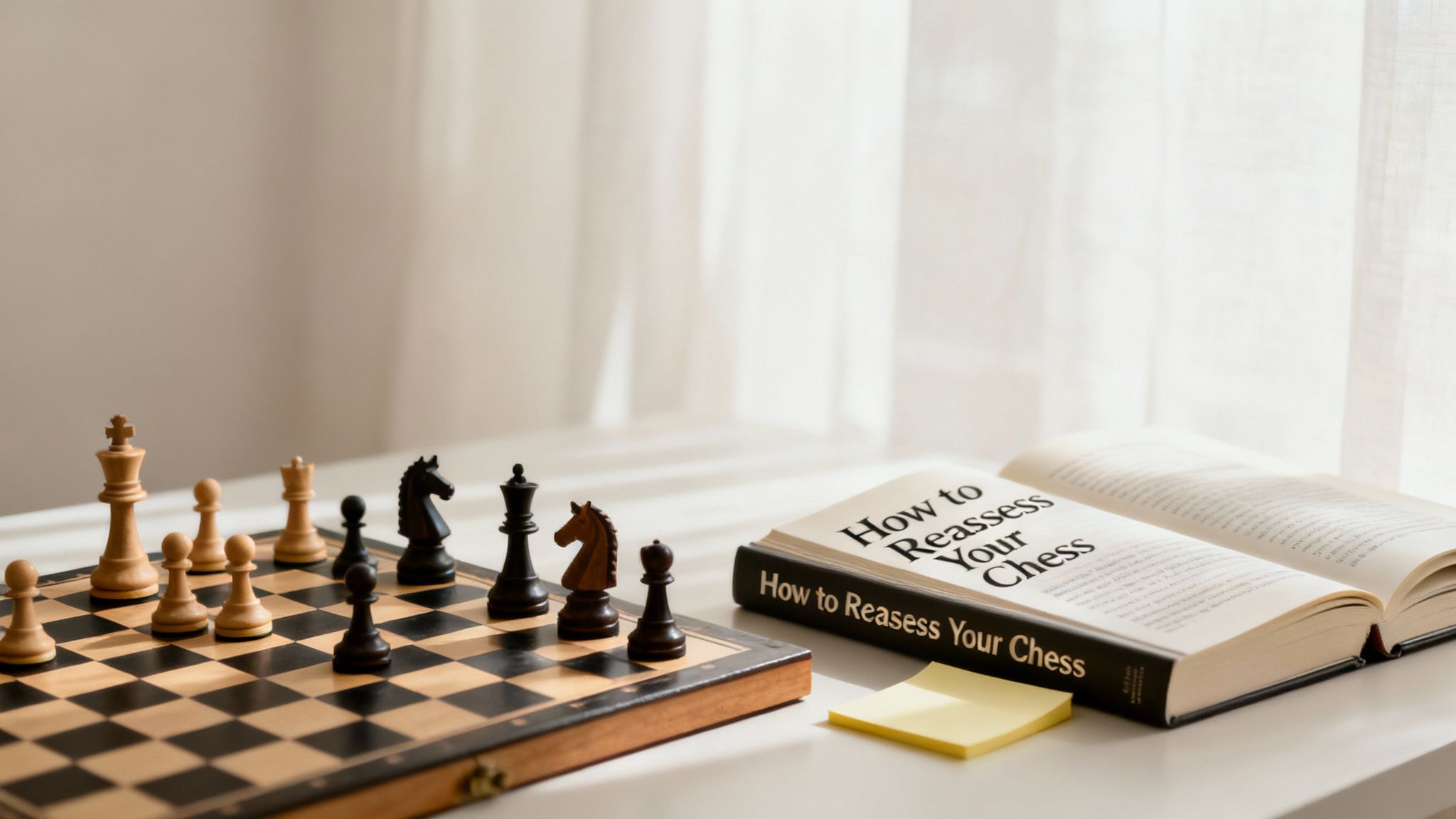
How to Reassess Your Chess by Jeremy Silman
When it comes to learning positional chess, one name is more famous than any other: Jeremy Silman. His book, How to Reassess Your Chess, is one of the best chess books ever written for intermediate players. With over 600,000 copies of his books sold, Silman basically became a coach for a whole generation of chess players.
Silman was a genius at making hard ideas feel simple and easy to understand. He didn't just give you a list of rules; he gave you a whole new way to think about chess.
The main part of his teaching is the idea of imbalances—the key differences between your position and your opponent's. By learning to see these imbalances, you can make a plan that uses your strengths and attacks their weaknesses.
Silman talks about several key imbalances:
- Better Minor Piece: Figuring out why a bishop is great in one position but bad in another, and when a knight is better.
- Pawn Structure: Learning how to break your opponent's pawn formation while keeping yours strong.
- Space: Knowing how to use a space advantage to choke your opponent's pieces and give your own pieces room to move.
- Material: Looking beyond the simple point values of pieces to understand how good they are on the board.
- Control of Key Squares or Files: Taking over important parts of the board to stop your opponent's plans before they even start.
Once you learn to see the board by looking for imbalances, you’ll never feel lost again. Even in the quietest positions, you’ll have a clear idea of how to make your position better and cause problems for your opponent.
My System by Aron Nimzowitsch
Long before Silman, another book set the stage for modern positional chess: My System by Aron Nimzowitsch. Written almost 100 years ago, this book is a true classic. Some people say its ideas are a little old, but many top players, like superstars Hikaru Nakamura and Wesley So, still say it's a must-read.
Why? Because the main ideas will always be important.
"The advice given in My System is timeless and just as relevant today as when it was written and would benefit any intermediate player, if not beyond." – Grandmaster Jacob Aagaard
Nimzowitsch introduced ideas that are now basics of chess strategy, like prophylaxis (stopping your opponent’s plans before they happen), the blockade (using a piece, like a knight, to stop an enemy pawn), and how important it is to control the center.
A quick warning, though: Nimzowitsch’s writing can be hard to read and a bit old-fashioned. It’s not as easy and friendly as Silman’s book. The best way to read My System is with a real board. Play through the examples slowly and give yourself time to really understand the deep ideas behind the moves. This is a book that helps you if you are patient.
For any player who wants to build a strong, classic understanding of chess, My System is a must-read. It gives you the basic knowledge you need to enjoy the amazing games of the great players and, more importantly, to start making your own smart moves. Using Silman's practical advice with Nimzowitsch's deep ideas will give you a great understanding of positional chess that will help you for your whole life.
How to Win in the Endgame
The endgame. It's the part of the game most players either ignore or don't like. They see it as slow and boring. But here's a secret that strong players have known for a long time: the endgame is where games are really won and lost.
Think of it like the last few minutes of a close basketball game. All the cool moves at the beginning don't matter if you can't make your shots when it counts. Getting good at the endgame is one of the fastest ways to see your rating go up, because you’ll start winning games you should win and saving draws from games that looked lost.
When you're a beginner, a lot of games end with a quick checkmate. But as an intermediate player, you've probably noticed your opponents are harder to beat. They defend better, and more of your games come down to just a few pieces left on the board. This is where your endgame knowledge becomes your best weapon.
Building Your Endgame Foundation
The first step isn’t to memorize hundreds of weird positions. It’s about learning the absolute must-knows—the basic checkmates and pawn endings that happen all the time.
Learning these basics is like learning your multiplication tables. Once you know them by heart, you can solve much bigger, harder problems without even thinking. A great book for this is Silman’s Complete Endgame Course by Jeremy Silman.
What makes Silman's book so good is how it’s organized. It’s split up by rating level, so you only study what you need to know right now. You start with the most important stuff for players under 1400 and go up from there.
- For Under 1400: Master the King and Rook vs. King checkmate. It’s the most common endgame with a major piece, and messing it up in a real game is a bad feeling.
- For 1400-1599: It’s time to learn basic pawn endings. You'll learn key ideas like the "opposition" and the "rule of the square," which will help you win or draw tons of pawn races.
- For 1600-1799: Now you can start learning the trickier rook and pawn endings. Since rooks are often the last pieces on the board, getting good with them is a huge step.
The endgame isn't about memorizing; it's about understanding. Once you really get a few main ideas, you'll start solving endgame puzzles you've never even seen before.
Mastering Practical Endgame Strategy
Once you know the basics, it’s time to learn how to handle the messy, real-life endgames that show up in your games. This is less about perfect, textbook moves and more about making smart choices when the position isn't so clear.
For this, 100 Endgames You Must Know by Jesus de la Villa is the modern classic. The title says it all. The book focuses on the 100 most important endgame positions that happen most often in real games.
De la Villa's book is great because it teaches you what is useful over what is just theory. It teaches you the key ideas and patterns, so you can handle similar situations when they happen in your games. If you want a closer look at why this book is so helpful, check out our book review of 100 Endgames You Must Know.
A Simple Endgame Study Plan
Studying the endgame doesn't have to be a boring task. Here’s a simple way to start getting better without getting tired of it.
- Pick One Topic: Start with one basic endgame, like King and Pawn vs. King. Don't try to learn everything at once.
- Read and Understand: Use a book like Silman's to read about the main ideas. Don't just read it—set up a real board and play through the moves yourself. Get a feel for the positions.
- Drill the Position: Use an online tool (or a friend) to practice the position against someone trying to stop you. Can you win it perfectly every single time?
- Spend 15 Minutes a Day: That's all it takes. Just 15 minutes of focused endgame practice each day will build a very strong foundation over time.
By treating the endgame like the important skill it is, you’ll have a huge advantage over players who ignore it. You won't just win more games; you'll become a better, more confident, and more dangerous chess player.
Creating Your Chess Study Plan
https://www.youtube.com/embed/gxfBW41YD14
So, you’ve got a pile of the best chess books for intermediate players. That’s a great start, but those books won’t just magically put their knowledge into your brain.
To actually get better, you need a plan. A good study plan turns a pile of books into a real training program that gives you real results.
It doesn’t need to be a super complicated schedule. The real goal is to be consistent. Even a little bit of focused time each day is very helpful. In fact, a sharp 30 minutes of study will help you much more than a random two-hour session once a week.
How to Actually Learn From a Chess Book
One of the biggest mistakes players make is reading a chess book from start to finish like it's a story. To make the ideas stick, you have to get involved and work with the book. This is called Active Learning.
It's a pretty simple idea. Instead of just reading, grab a real chessboard and set it up next to you.
- Set Up the Position: Always play the moves out on a real board. Seeing the position in 3D helps your brain see and remember patterns much better than looking at a flat picture in a book.
- Guess the Move: When you're looking at a game in a book, cover up the next move before the author shows it. Ask yourself, "What would I play here, and why?" This makes you think instead of just reading.
- Talk it Out: Try explaining the author's ideas out loud, like you were teaching a friend. This simple trick helps you see if you really understand an idea or just kind of get it.
This active approach is what makes the learning stick. Besides just picking the right books, your study plan should include effective strategies to study a textbook and retain information to really get the most out of your time.
Sample Weekly Study Schedules
The best plan is the one you can actually follow. You don’t need to find hours every single day; being consistent is what really matters. It's also important to have a good balance in your training, which is a big part of learning how to build a chess study routine that works.
Here are a couple of sample schedules you can change to fit your own life.
The '30-Minute Daily Workout' (For busy players)
- Monday & Thursday: Tactics (1 book, 30 mins)
- Tuesday & Friday: Strategy/Positional Play (1 book, 30 mins)
- Wednesday & Saturday: Endgame Practice (1 book, 30 mins)
- Sunday: Play a long game and review it.
The 'Weekend Warrior' (For players with more time on weekends)
- Weekdays: 15-20 minutes of tactics puzzles daily.
- Saturday: 1 hour of deep study (Strategy or Endgame book).
- Sunday: 1 hour of playing and reviewing long games.
Think of a good study plan as a map, not a cage. Be flexible. If you’re really excited about tactics one day, do more of that. The most important thing is to show up and do the work.
Sample Weekly Chess Study Schedule
This table is a simple guide to help you plan your week. It makes sure you cover all the important parts of the game. You can change the days and topics based on your schedule and what you want to improve.
| Day | Focus Area (30-60 mins) | Recommended Book Type |
|---|---|---|
| Monday | Tactics Puzzles | Tactics |
| Tuesday | Positional Play | Strategy/Middlegame |
| Wednesday | Endgame Study | Endgame |
| Thursday | Tactics Review | Tactics |
| Friday | Opening Principles | Strategy/Opening |
| Saturday | Play & Analyse a Game | Game Collection |
| Sunday | Rest or Light Review | (Review notes from the week) |
Remember to change this to fit your needs. The goal is to build a good habit that keeps you getting better.
A planned approach is especially important for the endgame, where you need to build from the basics up to real-game situations.
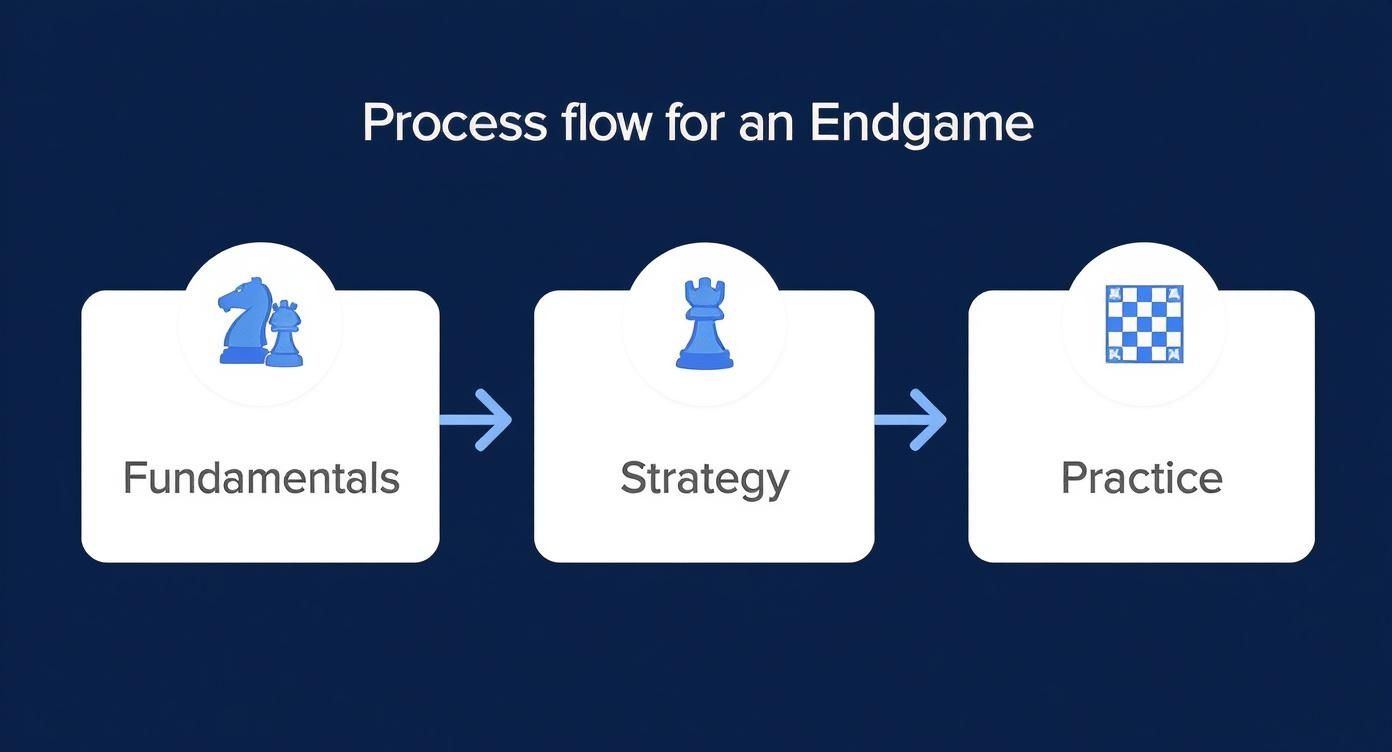
This picture shows that getting good at the endgame isn't about memorizing random positions. It's about understanding the main ideas first, so you can use them when it really matters.
Common Questions About Chess Books
When you're trying to get better at chess, having questions is a good sign. It means you're thinking about how you learn. Choosing the right books is a big decision, so it’s normal to have a few questions. Let’s answer some of the most common ones.
Should I Get a Real Book or a Digital Version?
This is really up to you, because both have good points.
A physical book is great for deep, focused study. There are no notifications or other things to distract you. It's just you, the book, and a real chessboard, which is how many people learn best.
On the other hand, digital books, like the ones on Chessable, are super easy to use. You can carry all your books on your phone or tablet and use special features to play through moves right on the screen.
So, what should you choose? Be honest with yourself. If you get distracted easily by your phone, a real book is probably better. If you like things to be easy and want to use online tools, go digital.
How Do I Know if a Book Is Too Hard for Me?
Have you ever felt totally lost while reading a chess book? It happens. Here's a simple way to avoid that: use the "ten-minute test".
Open a chapter somewhere in the middle of the book. Read for about ten minutes, playing through the moves and trying to understand what the author is saying. If you can get the main ideas, you've probably found a good book for you.
But if you feel like you're reading another language and the ideas are going over your head, the book is probably too hard for now. It’s much better to learn everything from a book that's a little easier than to get upset and quit on one that’s too tough.
The best book is one that's just a little bit harder than your current level. It should make you think and help you grow, but not so much that you want to give up.
How Many Chess Books Should I Study at Once?
Focus is key. Trying to read six books at once sounds cool, but it usually just makes it harder to learn and slows you down.
A much better way is to work on just one or two books at a time.
- One book for deep study: This is your main book—something on strategy or endgames that you need to think carefully about.
- One book for daily practice: Think of this as your daily exercise. A tactics book full of puzzles is perfect for this.
This keeps your training balanced without being too much. Try to actually finish a book before you start the next one on the same topic. This way, you’ll really learn its lessons and see them in your games.