A FIDE rating is your official score in the chess world. It shows everyone how good you are at the game. Think of it like a level in a video game—it's one number that chess players all over the world understand. This number is important for getting into the right tournaments and playing fair games.
What a FIDE Rating Says About You
Your FIDE rating is more than just a number. It's like your chess passport. It tells a story about your skill and how much you've played. When you play in a tournament, this rating gives you and your opponent a quick idea of what to expect.
Imagine a game of tug-of-war. If two people with the same strength pull, nobody moves. But if one is stronger, they will pull the other person forward. The FIDE rating system, called the Elo system, works a lot like that.
The Tug-of-War of Points
When you play a real game, your rating and your opponent’s rating are on opposite sides of the rope. If you win, you pull your rating up. If you lose, it gets pulled down. It’s a constant back-and-forth that gets more accurate with every game you play.
This simple idea is what makes the system work so well. It’s not just about winning or losing. It’s about who you win or lose against.
Beating a player who is much better than you will give your rating a big boost. It's like winning a tough tug-of-war match. But losing to a player with a much lower rating will pull your rating down a lot more.
Why This Number Matters
Having an official rating is your ticket to the big world of chess. It opens up new chances to play and gives you a clear goal to aim for. Here’s why it’s so important:
- Fair Games: It helps tournament organizers put you against players who are at a similar skill level. This makes sure your games are fun and challenging.
- Getting into Tournaments: Many big events have rating rules. Your FIDE rating is the key that lets you into bigger and tougher tournaments.
- Seeing Your Growth: The rating gives you honest feedback. Watching it go up is one of the best parts of getting better at chess.
Before you can get a rating, you need a FIDE ID. This is the very first step. By knowing how this number works, you can get ready for tournaments and set goals for your chess journey.
The Simple Math Behind Rating Changes
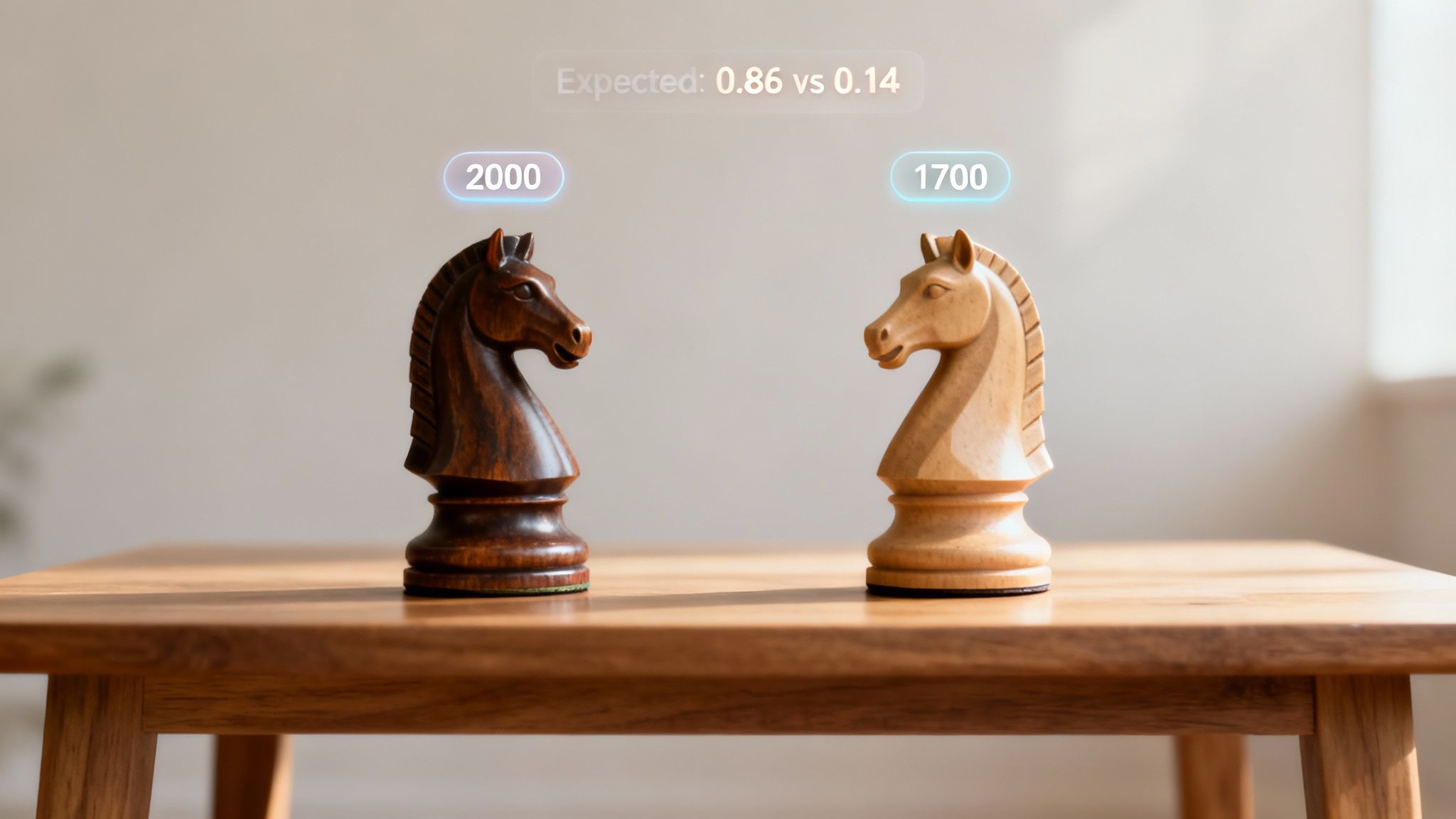
So, how does the system figure out how many points you win or lose? It might seem complicated, but the way a FIDE rating calculator works is actually pretty simple. It's just about comparing what was supposed to happen with what really happened.
To figure out a rating change, you only need three things: your rating, your opponent’s rating, and the result of the game. That’s it!
Let's look at two players, Rohan and Priya. Rohan is an experienced player with a rating of 1600. Priya is a newer player with a rating of 1400. Because Rohan's rating is higher, he is expected to win.
Guessing the Winner
Before the game even starts, the FIDE rating system makes a guess. This is called the Expected Score. It's a number between 0 and 1 that shows how likely a player is to win. A score of 1 means you will definitely win, 0 means you will definitely lose, and 0.5 means it's a 50/50 match.
Think of it like a race. If one runner is always faster, you'd expect them to win. You might say they have a 75% chance. The rating system does the same for chess.
Because Rohan is rated 200 points higher than Priya, the system thinks he will do better. The formula predicts an expected score of about 0.76 for Rohan.
For Priya, the underdog, her expected score is what's left over: 0.24. You'll notice that the two scores always add up to 1 (0.76 + 0.24 = 1.0).
Comparing the Guess to Real Life
Now, let's say Priya plays a great game and wins! Her score for the match is 1 point. Rohan’s is 0 points.
This is where the magic happens. The system looks at the difference between what was expected and what actually happened.
The main idea is simple: If you do better than expected, your rating goes up. If you do worse than expected, your rating goes down.
Priya was only expected to score 0.24 points, but she scored a full 1 point. She did way better than expected! So, her rating is going to get a big boost.
For Rohan, it's the opposite. He was supposed to score 0.76 points but got 0. He did worse than expected, so his rating is going to drop. A FIDE rating calculator just turns this difference into rating points. How many points also depends on something called a K-factor, which we’ll talk about next.
This simple system makes every game count. It’s not just about winning or losing; it’s about how your game compares to the prediction.
Understanding Your K-Factor
We've seen how the FIDE rating calculator compares your game result to what was expected. But there's one more thing that decides how much your rating moves: the K-factor.
Think of it as a speed setting for your rating.
The K-factor is a number that decides how much your rating changes after each game. A high K-factor means your rating will jump up or down a lot. A low K-factor means it will only move a little. FIDE gives you a K-factor based on your age and rating.
The Different Speed Settings
Imagine you're watering plants. A small, new plant needs a lot of water fast. An old, big tree only needs a little water. The K-factor works the same way for chess ratings.
New and young players get a high K-factor because their skill is often growing quickly. Their rating needs to catch up, so the system puts them on the "fast" setting. For master players whose skills are very steady, the system uses a "slow" setting because their ratings are already pretty accurate.
This smart system keeps things fair. A new star player doesn't get stuck with a low rating for long, and a grandmaster's rating doesn't crash after one bad tournament.
Which K-Factor Is for You?
So, how do you find your K-factor? FIDE has clear rules for most players. It depends on your age, rating, and how many rated games you've played.
This system is great for helping young players grow, especially in countries like India where lots of kids play chess. For example, in 2022, most of the new FIDE players in India were kids. A high K-factor helps their ratings catch up to their fast-improving skills.
Here's a quick look at the main K-factors.
FIDE K-Factor Rules at a Glance
This table shows the different K-factors and who gets them.
| K-Factor | Who It's For | What It Means |
|---|---|---|
| K=40 | New players (until they play 30 rated games) OR any player under 18 years old with a rating below 2300. | Fastest Setting: Your rating changes a lot with every game. This is perfect for kids and beginners who are getting better fast. |
| K=20 | Players who have played over 30 games and their rating has never hit 2400. | Standard Setting: This is the most common K-factor. It's good for most tournament players. |
| K=10 | Any player who has reached a rating of 2400 at any time (even if it drops below that later). | Slowest Setting: Your rating is very stable. This is for strong, expert players like International Masters and Grandmasters. |
As you can see, the system is made to change quickly for new players and stay steady for experts.
The K-factor is like a multiplier. A win that gets you +5 points with a K-factor of 10 would get you a huge +20 points with a K-factor of 40. That shows how much it matters.
Knowing your K-factor is a must for using any FIDE rating calculator correctly. It tells you how much your next tournament could change your rating.
Calculating a Rating Step by Step
Knowing the ideas is good, but seeing the numbers work is the best way to understand the FIDE rating system. Let's walk through a couple of examples to make it all clear.
First, we'll look at a single game where a big underdog gets a surprise win. Then, we'll follow a new player through their first tournament to see how they get their first rating.
Example 1: The Big Upset
Let's imagine a game between Arjun and Sameer. Arjun is an experienced player with a rating of 1800. Sameer is a younger player rated at 1500. On paper, Arjun should win easily.
With a 300-point difference, the system really expects Arjun to win. His Expected Score is about 0.85. This leaves Sameer with a very small Expected Score of just 0.15.
But chess isn't played on paper. Sameer plays a fantastic game and checkmates Arjun. A huge surprise!
So, how does this change Sameer's rating? We'll use the formula: Rating Change = K x (Actual Score – Expected Score). Since Sameer is a young player, his K-factor is 40.
Step 1: Find the difference between his actual score and his expected score.
Sameer won, so his actual score is 1. His expected score was only 0.15.
The difference is: 1 – 0.15 = 0.85
Now, we just use this number in the formula with his K-factor.
Step 2: Multiply the score difference by the K-factor.
40 x 0.85 = 34
Just like that, Sameer gets 34 rating points from one game! His new rating jumps from 1500 to 1534. He did way better than expected, and his high K-factor makes sure his rating takes a big leap to show his real strength.
For Arjun, the same math would show a painful loss of points.
Example 2: An Unrated Player's First Tournament
Now, let's meet Maya. She's a good player entering her first FIDE-rated tournament. Her goal is to get a rating. To do that, she needs to play at least five rated players and score at least half a point.
Maya starts with a K-factor of 40—the highest one—because she's a new player. Let's follow her through the five games.
Round 1: Maya (Unrated) vs. Opponent (1200)
Maya has a great start and wins her first game.
Round 2: Maya (Unrated) vs. Opponent (1350)
She faces a tougher player this time and gets a draw, earning half a point.
Round 3: Maya (Unrated) vs. Opponent (1300)
Feeling good, Maya plays an attacking game and wins again. She now has 2.5 points out of 3.
Round 4: Maya (Unrated) vs. Opponent (1450)
This is her hardest game yet. She fights well but loses to the stronger player.
Round 5: Maya (Unrated) vs. Opponent (1400)
In her last game, she bounces back with another win.
Maya finishes with a great score of 3.5 points out of 5 games. Now it's time to figure out her very first FIDE rating.
Calculating an Initial Rating
For a first-time rating, the math is a little different. First, we need to find the average rating of her opponents.
- Add up her opponents' ratings: 1200 + 1350 + 1300 + 1450 + 1400 = 6700
- Divide by the number of games: 6700 / 5 = 1340
The average rating of the players Maya played was 1340.
Next, we look at how she did. She scored 3.5 out of 5, which is a 70% score. FIDE has a chart that turns this percentage into a rating difference. A 70% score means you played about +149 points better than your opponents' average rating.
To get her first rating, we just add this difference to her opponents' average rating.
1340 (Average Rating) + 149 (Performance Difference) = 1489
And there it is! Maya's first official FIDE rating will be 1489. This shows how a first rating is a picture of how you did against your first group of rated players. After this, her rating will change game by game using the K-factor, just like Sameer's did.
This chart shows how a player's K-factor changes as they get better, from a new player to a master.
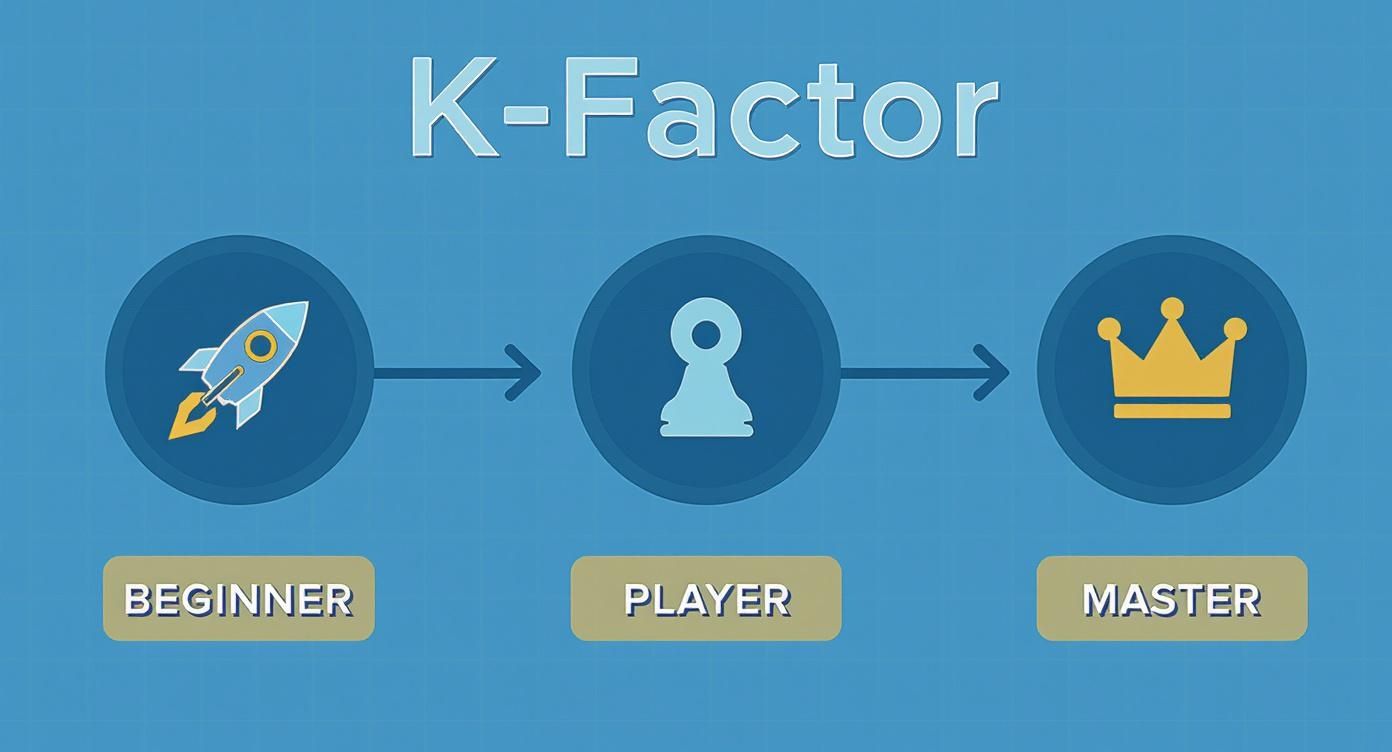
As you can see, the better a player gets, the less their rating will change from one tournament to the next.
How to Make Your Own Rating Calculator
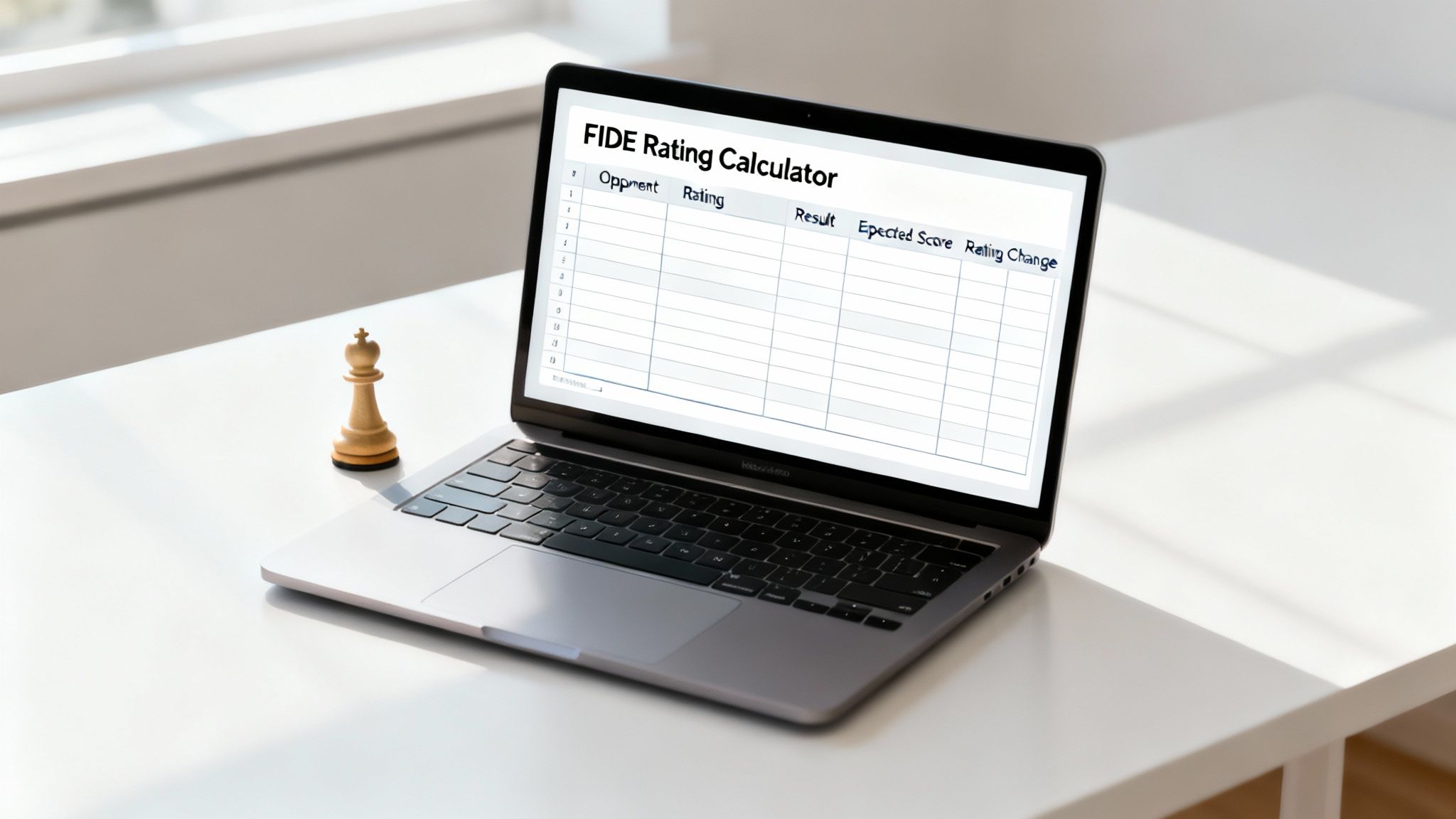
Knowing the math behind your rating is one thing. Being able to guess your own rating changes after a tournament is even better. You can find calculators online, but building your own in a spreadsheet like Google Sheets or Excel is a great way to really understand how it all works.
Doing this turns the ideas into a real tool you can use anytime. Think of it as your own scoreboard, showing you exactly how each game changes your rating.
Setting Up Your Spreadsheet
First, open a new spreadsheet and make a few columns. This will be the frame for your calculator. It doesn't have to be fancy, it just has to work.
Here are the columns you’ll need:
- Opponent's Rating: Where you'll type in the rating of each person you play.
- Your Score: Simple. A 1 for a win, 0.5 for a draw, and 0 for a loss.
- Rating Difference (D): The space between your rating and your opponent's.
- Expected Score (E): Your spreadsheet will figure this out for you with a formula.
- Rating Change: The final number of points you win or lose from that game.
With those columns ready, just put your current FIDE rating and your K-factor in a spot near the top. Now you're ready for the fun part.
The Formulas You Will Need
This is where your spreadsheet comes to life. The most important formula is for your Expected Score (E). The FIDE formula looks a bit scary: E = 1 / (1 + 10^(-D/400)).
Don't worry! It looks harder than it is to set up in a spreadsheet.
Let’s say your rating is in cell B1, your K-factor is in B2, and your first opponent's rating is in cell A5.
- Calculate Rating Difference (D): In the 'Rating Difference' column (let's say
C5), the formula is just=B$1-A5. That$sign just locks your rating cell so the formula doesn't break when you copy it. - Calculate Expected Score (E): In the 'Expected Score' column (
D5), type in this formula:=1/(1+10^(-C5/400)). This automatically figures out your chances of winning. - Calculate Rating Change: Finally, in the 'Rating Change' column (
E5), the formula is=B$2*(B5-D5). Here,B5is the cell where you put your actual score (1, 0.5, or 0).
Once you have these formulas in the first row, you can just click and drag them down for every game you play. Your spreadsheet will instantly show you the rating change for each game! If you want to build something with more features, looking at tools like online quiz makers can give you some cool ideas.
When you build this yourself, you get a real feel for how much a win against a strong player is worth compared to a loss against a weaker one. It’s a great way to learn.
Popular Online Calculators
Of course, if you don't want to build your own, there are plenty of great ready-made calculators online. These websites let you type in your tournament info and give you instant results. They're perfect for a quick check or for making sure your own spreadsheet is right.
Chess is growing like crazy in India. The FIDE rating system in India has gotten huge, with over 32,500 rated players as of 2023. This makes it the second-biggest chess group in the world. With ratings updated every month, Indian players can track how they're doing, which makes them want to get even better.
Having a good FIDE rating calculator—whether it's one you built or one you found online—is super helpful. It makes the whole system easy to understand and lets you track your progress after every tournament.
As you play more serious chess, you'll probably have questions about how the FIDE rating system works. It has its own rules, and knowing them is important for planning your tournaments and checking your progress.
This part is a quick FAQ to answer the most common questions players have. Let's clear things up with some simple answers.
How Do I Get My First FIDE Rating?
Getting your first official rating is a big deal. It’s the moment you join the worldwide chess scene. To get it, you need to play in an official, FIDE-rated tournament.
In the tournament, you have to do two key things. First, you must play against at least five players who already have a FIDE rating. Second, you need to score at least half a point from those games—even one draw is enough.
After the tournament is over, the organizers send the results to FIDE. If you did what you needed to do, your name and your new rating will show up on the next official FIDE rating list. Welcome to the club!
Can My FIDE Rating Drop to Zero?
This is something players worry about when they're not playing well, but don't stress. Your FIDE rating can never fall to zero from losing games. The lowest possible rating is 1000.
Even if your score in a tournament works out to be a number below 1000, your official rating will not go under 1000.
This rule is like a safety net. It makes sure every rated player keeps a basic rating. It means you never have to worry about losing your rating completely, no matter how bad a tournament goes.
So, while your rating will go up and down, it will never disappear.
What Happens When I Play an Unrated Player?
It's normal to play against an unrated player, especially in big tournaments. When this happens, the game is treated very differently for you and for them.
For you, the rated player, the game simply does not count for your rating. Your rating won't change at all, no matter if you win, lose, or draw. Your rating only changes when you play against other rated players.
For your unrated opponent, this game is a huge deal. It's one of the five games they need against rated players to get their own first FIDE rating. So while the result won't change your number, it’s a big step for them.
How Often Are FIDE Ratings Updated?
The FIDE rating system works on a regular schedule. The official rating lists are updated on the first day of every single month.
This means that all the tournaments you played in April, for example, will be calculated at the end of the month. Your new rating will then be posted and become official on May 1st.
This monthly update is great for players. It lets you see the results of your hard work pretty quickly. You don't have to wait forever to see how a great tournament helped your rating. It helps you set new goals for the next month. Knowing your rating is also a step towards bigger goals. You might be interested in our guide that has a helpful chess title calculator for planning how to become a master.