Hard chess puzzles are more than just a quick brain teaser. They are deep, tricky problems that make you look several moves ahead to find the only winning path. They’re not like simple puzzles that show you the same patterns over and over. These are made to build your brainpower and help you spot cool ideas in a real game. This is the kind of practice that turns good players into great ones.
Why Hard Chess Puzzles Make You a Better Player
Do you ever feel stuck doing the same easy puzzles? You’re not the only one. Simple puzzles are great for learning basic tricks like forks and pins, but they don't get you ready for the messy, confusing situations that happen in real games. That’s where hard chess puzzles come in. Think of them as a workout for your chess brain.
Solving these puzzles does more than just help you find the right move. It changes how you think about chess. You learn to look deeper, figure out moves more carefully, and—most importantly—guess what your opponent is going to do next. This whole process builds some serious mental muscle.
From Simple Patterns to Deep Thinking
Easy puzzles are all about finding one, often obvious, tricky move. A hard puzzle, on the other hand, usually hides the answer. You have to look at a bunch of possible moves and tricky defenses to find it. This forces you to think in a more organized way instead of just guessing or looking for a pattern you already know.
This kind of deep thinking is a skill you can use right away in your games. Once you get used to solving tricky puzzles, you’ll start seeing similar winning ideas when you're playing for real.
The best part isn't just getting the puzzle right. It's the struggle—the work you put in, trying different moves, and pushing your brain to see things that aren't obvious. That’s the hard work that makes you a stronger player.
Building Confidence and Brain Power
It feels great when you solve a challenge that’s a little bit out of your comfort zone. Every hard puzzle you solve is proof that you can find awesome, game-winning moves. That mental toughness is super important during a long, tough game where you might feel like giving up.
This kind of tricky problem-solving has been around for a long time. For example, India's connection with chess puzzles goes back hundreds of years. The famous 'Indian Problem,' a mate-in-four puzzle from way back in 1845, is a great example of how long people have been fascinated by hard chess challenges. You can check out this classic puzzle and learn more about the deep history of chess puzzles in India.
In the end, working on hard puzzles teaches you to stay focused and strong under pressure. You learn to manage your time and energy, which is just as important as knowing the moves. If you're looking for other ways to sharpen your brain, you might find some great tools on Shortgenius.com.
This practice of pushing your brain is what turns a good player into a scary opponent.
A Smart Way to Solve Hard Puzzles
We've all been there: staring at a hard chess puzzle, just hoping the answer will magically appear. But the best players don't use hope; they have a system. The good news is that you can learn this system, too. It’s a step-by-step way to handle even the toughest puzzles.
You don't have to be a genius at this. It’s just about being organized. When you follow a routine, you’re less likely to miss something important or get lost in a bunch of confusing moves. The idea is to turn a big, scary problem into a clear, simple search for the best move.
This method breaks the puzzle down into smaller, easier questions. The picture below shows you how it works, from your first look to finding the winning idea.
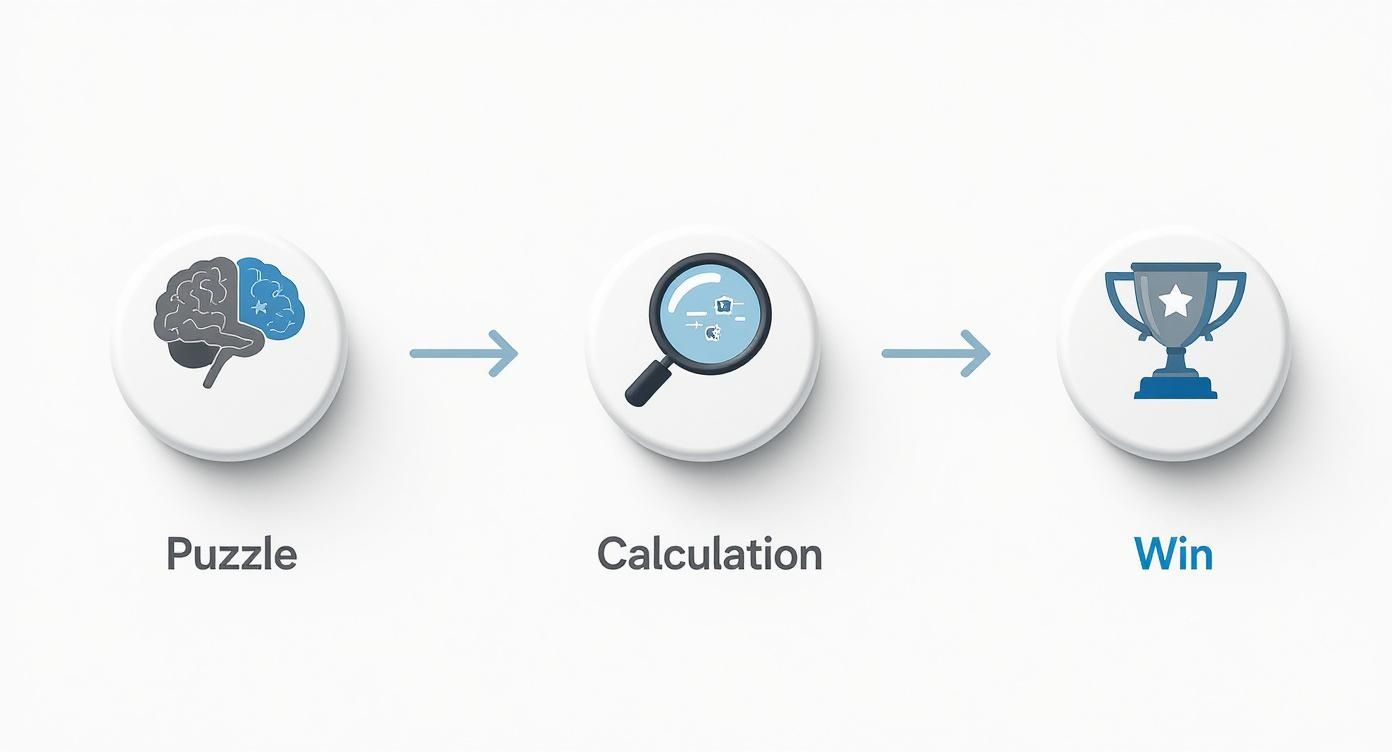
As you can see, thinking hard about the moves is what connects just looking at the board to really understanding how to win.
The First Look: A Quick Scan
Before you start thinking about long, complicated moves, just take a second. A quick look at the board is where you start. Think of yourself as a detective looking for clues. Your goal is to find all the strongest moves you can make.
Start with the most powerful moves:
- Checks: These are the strongest moves in chess. They force your opponent to respond right away, which makes it much easier to figure out what they can do. This often points right to the answer.
- Captures: Taking a piece can change who has more pieces, open up new paths for your other pieces, or get rid of a key defender. Always look closely at captures of important pieces like the queen or a rook.
- Threats: These are moves that get your opponent into big trouble, like setting up a checkmate or a nasty fork. Finding these aggressive moves gives you a great list of ideas to check out first.
Choosing Your Best Moves
After you look for checks, captures, and threats, a few ideas will stand out as the best ones. These are your candidate moves. Instead of trying to think about every single possible move—which is impossible—you’ll focus your brainpower on just the two or three that look the most promising.
Maybe you've found three cool moves: a queen check, a knight capture that wins a pawn, and a quiet move that sets up a trap. These three become your candidates. Now your job is to figure out which one really works.
A big part of solving hard puzzles is being disciplined. Don't fall in love with the first move you see. Make yourself find at least two other good ideas before you start thinking deeply about any of them. This simple habit will stop you from missing quieter, better answers.
By focusing on just a few candidate moves, the puzzle becomes way less scary. It’s not a huge maze anymore. Now you have a clear mission: check out these specific moves and see where they go.
I've made a simple table to use as a checklist. Going through these steps every time will help you build good habits.
Your Puzzle Solving Checklist
| Step | What to Do | Key Question to Ask |
|---|---|---|
| 1. The Scan | Find all checks, captures, and big threats. | What are the strongest moves I can make right now? |
| 2. Selection | Pick the top 2-3 best-looking moves (your candidates). | Which moves put my opponent under the most pressure? |
| 3. Thinking | For each move, figure out their best defense. | If I make this move, what is their very best response? |
| 4. Check-in | After their reply, look at the board again. Are you winning? | Is my advantage big enough to win after their defense? |
| 5. Double-Check | Look over your chosen moves for any mistakes or tricks. | Did I miss anything? Is there a hidden defense? |
Following a routine like this is what makes you a real problem-solver instead of just a guesser. It builds the brainpower you need.
The Art of Thinking Ahead
This is where the real work happens. You have to take each of your best moves and follow it a few moves ahead. But here's the most important rule: always pretend your opponent will play their best possible defense.
This is the total opposite of "hope chess," where you make a move and hope your opponent messes up. For every move you think about, you have to ask yourself, "What is their best reply?"
- If I check the king, how can they get away? Can they move, block the check, or just take my piece?
- If I take their rook, what will they do? Will they just take my piece back? Or will they ignore it and make an even bigger threat of their own?
- If I make a quiet threat, can they see it and stop it? What's their strongest defense against my idea?
You have to be super honest about what your opponent can do. A move might look amazing at first, but if your opponent can easily shut it down, it’s not the answer. For those who want to get really good at this, you can learn more about how to improve chess calculation in our detailed guide.
This back-and-forth process—your move, their best reply, your next move, their next best reply—is what thinking ahead is all about. It’s what lets you see into the future of the game and find that winning path your opponent just can't stop.
Let's Solve Some Real Chess Puzzles
Okay, we've talked about the ideas, but that only gets you so far. The best way to really get this stuff is to see it happen. Let's solve a few tough puzzles together, and I’ll show you exactly what’s going on in my head.
We’ll start with a tricky one, then move to a puzzle that has a very clever idea, and finish with a real brain-twister. Think of this as getting a behind-the-scenes look at how a good puzzle-solving plan works with real examples.
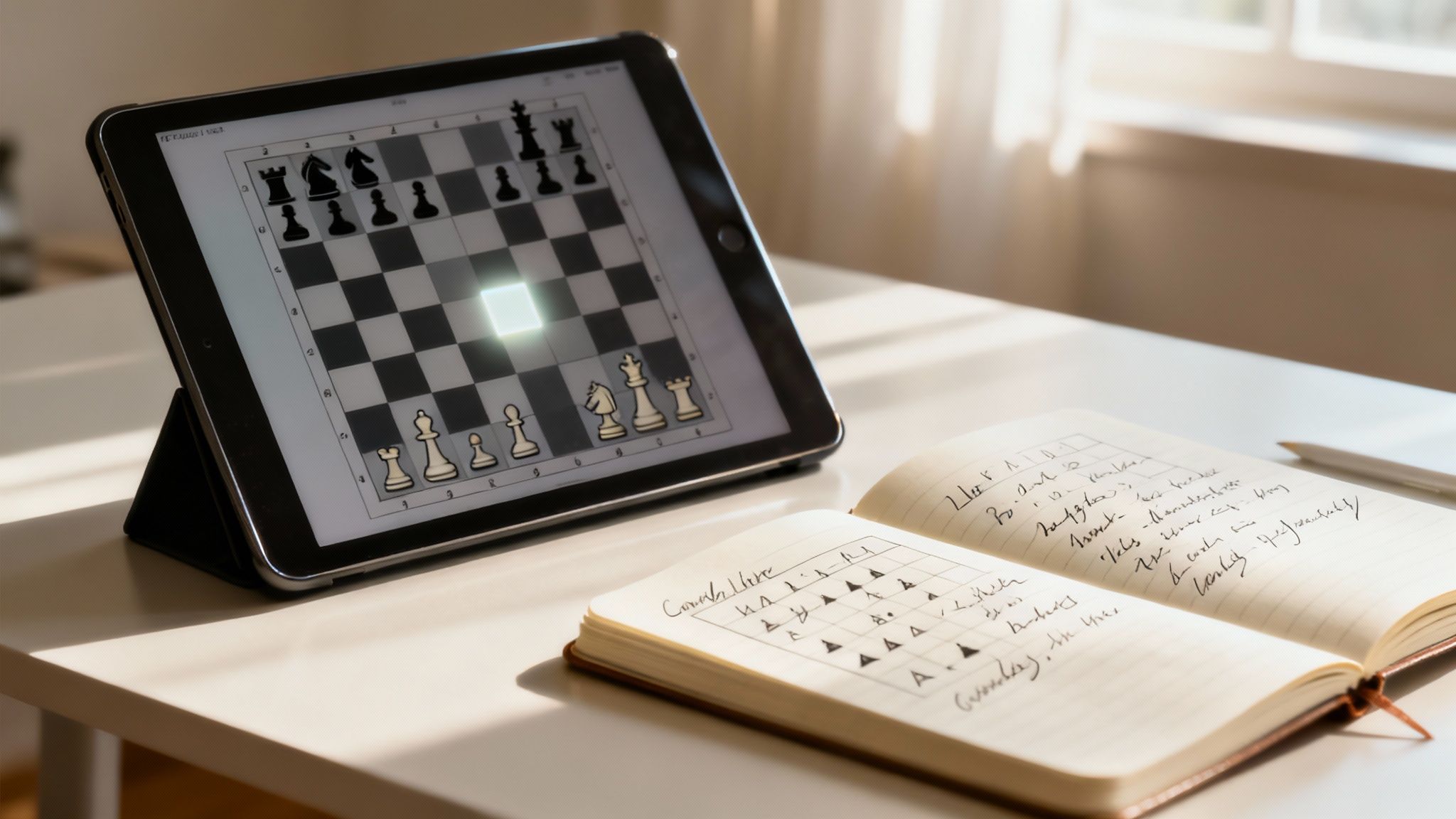
Puzzle 1: A Classic Attack with a Sacrifice
Let's say White has a queen, two rooks, and a knight all pointed at the Black king. Black’s king looks a little unsafe, with only a few pawns and one knight to protect it. This is a perfect setup for a big attack.
My first scan is always for checks, captures, and threats.
- Checks: The most obvious check is sacrificing a rook on h7. It's a very aggressive move and forces Black to react.
- Captures: There aren't any good captures of important pieces right away.
- Threats: Moving my knight to g5 would put a lot of pressure on Black's king and threaten checkmate.
My best moves seem to be the rook sacrifice (Rxh7+) and the knight move (Ng5). I'll start with the sacrifice because it’s the most forcing move. If I play 1. Rxh7+, Black has only one legal move: 1…Kxh7.
Now, from this new position, I look again. My next move has to be a check. The clear choice is 2. Qh5+. Black’s king has to run, and the only square is g8 (2…Kg8). From here, the plan is clear. I bring my other rook into the attack with 3. Rh1, and suddenly Black can't stop the checkmate on h8. I've found a way to win for sure.
Puzzle 2: The Power of a Quiet Move
Time for something a bit harder. Imagine a messy middlegame. White has a strong queen and rook, but Black’s king is tucked away and seems totally safe. The obvious checks and captures just don't seem to work.
This is where a lot of players get stuck. They look for a big, flashy move but can't find one. My first look for forcing moves also comes up empty. This is a huge clue that the answer is probably a quiet move—a move that isn't a check or a capture but sets up a threat that can't be stopped.
So, I change my thinking. Instead of asking, "How can I checkmate him right now?", I ask, "What move sets up a winning threat for my next turn?"
Let's say my possible moves are:
- A pointless rook check that Black easily avoids.
- Moving my queen to a slightly better square.
- A sneaky pawn push, maybe to g4.
The first two are okay, but they don't cause any real problems. That pawn push, 1. g4, however, does something special. It doesn't attack anything right away, but it gets ready to open up the h-file for my rook. It also takes control of an important square.
After 1. g4, my new threat is to play Qh7, then bring my rook over. Black has to do something about this plan. Let's say they try to cause trouble on the other side of the board. I ignore it. I stick to my plan. By making that one quiet pawn move, I've built a trap that Black can't get out of.
Quiet moves are often the secret to hard chess puzzles. They test if you can see beyond what’s happening right now and understand threats, not just checks. When the loud moves don’t work, start listening for the quiet ones.
Puzzle 3: An Expert-Level Surprise
Finally, let’s try a puzzle that would be tough even for very strong players. These are the kinds of problems where the answer is often something you'd never guess.
In today's chess world, India has become a top spot for solving hard puzzles under pressure. Top Indian grandmasters compete in puzzle events all over the world where the problems are super hard. For puzzles with a rating over 3000, only about three out of every hundred people solve them correctly. You can find some cool examples of these top-level challenges and the amazing players who solve them.
In this puzzle, let's say White is down a lot of pieces—maybe a whole rook. But Black's king is very open, with all my pieces swarming around it.
My first thought, since I have fewer pieces, is to look for a way to check the king forever and get a draw.
- Idea 1: A bunch of queen checks that force the king back and forth.
- Idea 2: A knight sacrifice to open more lines for my attack.
- Idea 3: A weird-looking king move.
I think about the forever-check idea. After a few moves, I see the Black king can escape. It's close, but it doesn't work. The knight sacrifice also looks good, but after a few minutes of thinking, I find a smart defense for Black.
I’m almost ready to give up, but then I look at the wildest idea on my list: the king move. Let's say the move is 1. Kh2. It looks totally crazy. Why would I move my king away from the action?
But then I see why it’s a great move. By moving my king to h2, I do two very important things:
- I get out of the way of a back-rank check that I hadn't even seen yet.
- I free up the g1 square for my rook, which I need to make the final winning move.
The move 1. Kh2 is a prophylactic move—a move that stops an opponent's future plan before it even starts. After this smart little step, Black has no good moves left. If they do nothing, my rook moves to g1, and it's checkmate. The answer wasn't a direct attack but a quiet defensive move that made the win possible. This is the kind of deep thinking that hard chess puzzles teach you.
Building Your Personal Training Plan
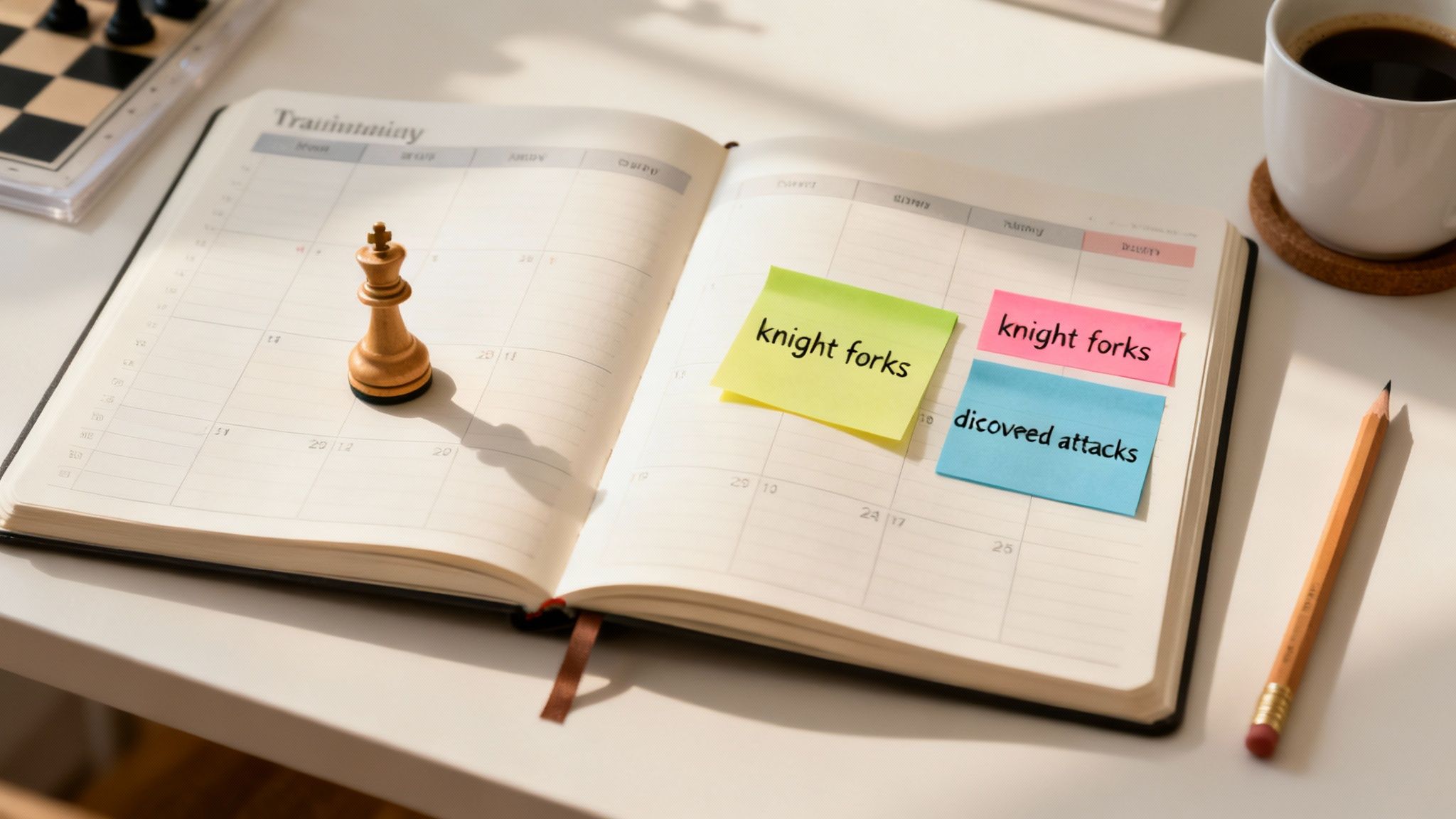
To get better at anything, you need a plan. Just doing a few random hard chess puzzles here and there is okay, but it won’t give you the big results you want. A little bit of a schedule goes a long, long way.
Think of it like going to the gym. you wouldn't just show up and lift whatever, right? You’d have a plan for what to work on each day. Your chess brain needs the same thing. A simple training plan helps you stay on track and work on the things you really need to improve.
Finding Your Rhythm
First, figure out how much time you can really spend each day. Doing a little bit every day is way better than doing a lot once a week. It's much better to solve puzzles for 20-30 minutes every day than to do a huge three-hour session on the weekend.
Daily practice keeps all the important tricks fresh in your mind and builds a strong habit. Find a time that works for you—maybe with your breakfast or before you go to bed—and make it a regular thing.
The Power of Themed Practice
Instead of just solving any random puzzle, try spending a whole week on one specific idea. This is called themed practice, and it's a great way to burn patterns into your memory.
You could focus a whole week on puzzles about one theme:
- Knight Forks: Spend a week solving tons of puzzles where a knight fork is the winning idea.
- Discovered Attacks: Focus on positions where moving one piece reveals a nasty attack from another piece.
- Back-Rank Mates: Practice this common pattern until you can see it in your sleep.
- Mating Nets: Do puzzles where you have to trap the enemy king with a team of pieces.
By focusing on one theme at a time, you'll start to see these chances much faster in your real games. Most good puzzle websites let you choose puzzles by theme. If you're looking for a tool that does this well, our guide on using Chess Tempo online can help you set up this kind of training.
The most important part of your training isn't getting puzzles right—it's understanding why you get them wrong. Your mistakes are like a map showing you exactly what you need to work on.
The Golden Rule: Look at Your Mistakes
This is the one step most people skip, but it’s where all the real learning happens. When you get a puzzle wrong, don't just get annoyed and click "next." You have to take a minute to understand what you missed.
Ask yourself a few simple questions:
- What was the right answer?
- Why didn't I see it? Was I too focused on the wrong idea?
- Did I totally miss a good defensive move for my opponent?
- What was the main trick or pattern in the solution?
It can feel bad to look at your mistakes, but it's the fastest way to get better. A study of players solving hard chess puzzles showed that getting better isn't a straight line; it has ups and downs. The players who improve the fastest are the ones who look at their mistakes instead of just getting mad about them.
Your Sample Weekly Plan
Here's a simple schedule you can use or change to fit your needs. The idea is to mix up your training to keep things interesting while staying consistent.
Sample Weekly Puzzle Training Schedule
This plan helps you organize your puzzle practice to get the most improvement.
| Day | Focus Area | Time |
|---|---|---|
| Monday | Knight Forks & Pins | 25 minutes |
| Tuesday | Difficult Puzzles (No time limit) | 30 minutes |
| Wednesday | Discovered Attacks & Skewers | 25 minutes |
| Thursday | Review Wrong Puzzles from the Week | 20 minutes |
| Friday | Mating Nets & Combinations | 25 minutes |
| Saturday | Difficult Puzzles (No time limit) | 30 minutes |
| Sunday | Rest or Light Puzzle Rush | 15 minutes |
This kind of plan gives you a clear path to follow. It turns random puzzle-solving into smart, organized training that will make you a much better chess player.
Common Mistakes and How to Avoid Them
Even really good players fall into the same traps when solving hard chess puzzles. The good news? Once you know what these traps are, you can learn to see them coming and avoid them. Let’s make sure these common mistakes don't trip you up.
One of the biggest mistakes is called "hope chess." This is when you make a move and just cross your fingers, hoping your opponent misses the best defense. In a real game against a weaker player, this might work sometimes. But a good puzzle always assumes your opponent is a genius who will find the best reply.
You have to be your own biggest critic. Before you decide on a move, always ask, "What is the very best thing they can do to stop me?" If you find a simple, strong reply for them, you haven't found the answer yet. Time to go back and look for another idea.
Getting Stuck on Your First Idea
Another big mistake is falling in love with the first move you look at. Maybe you see a cool check or a good-looking capture, and you get so focused on making it work that you don't see other, better options. This is called tunnel vision, and it's a very common trap.
To stop this habit, force yourself to find at least two or three different candidate moves before you start thinking deeply. This simple rule opens your mind to the whole board. Sometimes the quiet, sneaky move—the one that sets up a bigger threat—is the key, not the obvious check.
The answer to a hard puzzle is often hiding in plain sight. If you only look at the most obvious moves, you'll walk right past it. The real skill is learning to think about the moves you don't expect.
It takes practice to get into the habit of looking for different ideas, but it's one of the best things you can do. It’s your best defense against tunnel vision and will help you find those really cool, hidden answers.
The Danger of Rushing
When you first look at a hard puzzle, it's normal to feel a bit rushed. You want to find the answer and feel good about solving it. But here, speed is your enemy. The people who make puzzles are tricky; they hide small defenses and tricky details that you'll only see if you slow down.
Take a deep breath. Do a good scan of the board. What is every single piece doing? Are there any hidden threats from your opponent that you need to worry about first? Rushing is the main reason players miss small but important details that change everything.
This kind of deep focus is a skill chess masters have practiced for centuries. Think about the legendary Indian chess masters like Ramadasa, who were famous for their amazing memory and problem-solving skills, even playing with a blindfold on. That's like solving the hardest puzzles ever without even seeing the board. You can learn more about the rich history of Indian chess masters on Chess.com.
By learning to avoid these common mistakes—playing hope chess, getting stuck on one idea, and rushing—you'll become a much better puzzle solver. You’ll start seeing the board more clearly and finding the right answer more often. It all comes down to being disciplined, patient, and tough on your own ideas.
Your Questions About Hard Puzzles Answered
Trying to solve really hard chess puzzles brings up a lot of questions. It's totally normal to wonder if you're practicing the right way or what to do when you feel totally stuck. Let's go over some of the most common things players ask.
Think of this as a quick FAQ from a coach. Getting these things straight can help you stay motivated and make sure you're using your time well.
What Puzzle Rating Should I Aim For?
Honestly, there isn't a magic number. Many online sites might say a puzzle rating over 2200 is strong, but the number itself isn't the real goal. It's just a way to see how you're doing.
Instead of trying to get a certain rating, focus on how you are solving the puzzles. Are you really understanding why an answer works, especially on the puzzles you get wrong? Are you learning new tricks? If you focus on that, your rating will go up as you get better.
The real win isn't a high puzzle rating; it's learning how to spot those winning ideas in your real games. The rating is just a bonus that comes from good, focused practice.
How Long Should I Spend on One Puzzle?
It’s easy to want to give up after a few minutes, but the whole point of a hard puzzle is to stretch your brain! For a really tough puzzle, spending 15-20 minutes is a great workout for your thinking and focus. This is how you build the brainpower you need for long games.
If you're completely stuck after that much time, it's okay to look at the answer. The important part is what you do next. Don't just look at the answer and click to the next puzzle. Spend a few minutes really trying to understand the key ideas and figure out exactly what you missed. That’s where the real learning happens.
Are Puzzles in Books Better Than Online?
One isn't "better" than the other—they're just different tools for different things. I think using a mix of both is the best way to practice.
- Online Puzzles: These are great for doing a lot of puzzles quickly and learning patterns. You can do dozens in a short time, which is perfect for practicing common tricks until you know them by heart.
- Chess Books: Puzzle books usually have carefully chosen puzzles, often organized by a certain theme (like "attacking the king" or "rook endings"). This is great for studying one topic you really want to master.
What if I Feel Like I’m Not Getting Better?
Welcome to the club! Feeling stuck is the most normal thing in the world. Every single chess player, from beginners to Grandmasters, feels this way sometimes. It often means you're pushing yourself to learn new things.
When you feel stuck, it's time to try something new. If you've only been doing random puzzles online, try a themed week focused on one type of trick. Or, if you always use the same website, try a classic puzzle book for a change.
Most importantly, look at the puzzles you’ve gotten wrong over the past month. The key to getting unstuck is almost always hidden in the pattern of your most common mistakes. Find that weakness, work on it, and you'll start getting better again.